
This guide is maintained as a current resource for September 2026 and covers only the laws of England and Wales. Information is for general guidance, not legal advice. Consult a qualified solicitor for advice specific to your situation.
Find out what happens if a defendant fails to comply with a sentence in England and Wales, including breach procedures for community orders, suspended sentences, licence recalls, potential custodial consequences and practical considerations.
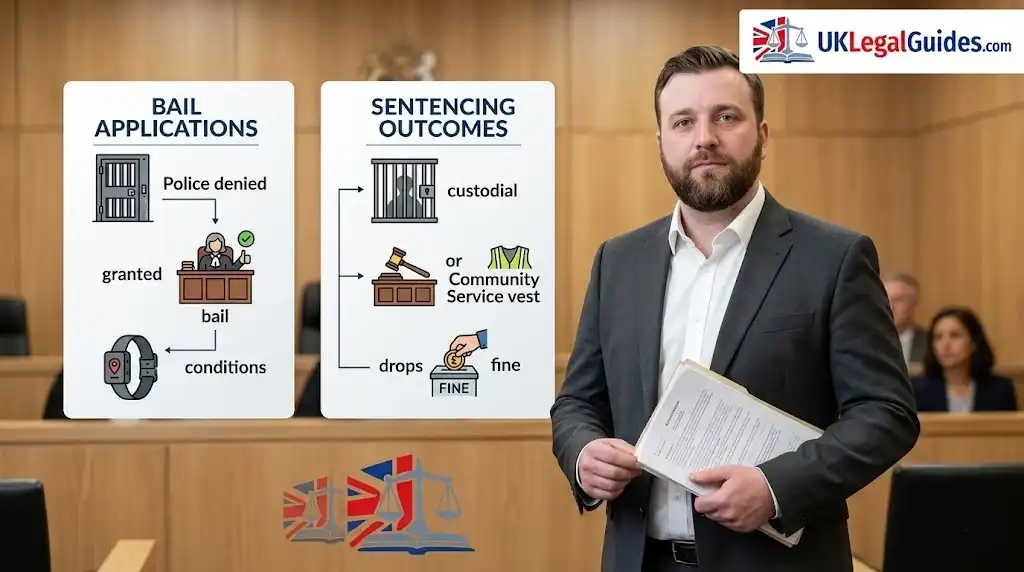
When a person in England and Wales is sentenced by a court - whether to custody, a community requirement, a suspended sentence or a licence period - they are legally required to follow all the conditions imposed. Failing to comply with those conditions is known as a breach and can trigger a structured legal response. The consequences vary depending on the type of sentence and the seriousness of the breach but can include additional penalties, re‑sentencing or a return to prison. This guide explains what happens when a defendant does not comply with their sentence, the process courts use to respond, and how non‑compliance can affect legal rights and outcomes.
Understanding Non‑Compliance
When a court sentences a person, it often attaches conditions designed to prevent re‑offending, promote rehabilitation and protect the public. These conditions may include probation supervision, unpaid work, curfews, treatment programmes, or compliance with licence conditions after release from prison. If someone fails to meet these conditions, the law gives authorities - such as the probation service, Offender Managers and courts - powers to take enforcement action and, if necessary, impose sanctions.
Non‑compliance is not simply “breaking rules”: it triggers specific legal processes and may lead to further court hearings or recall to custody.
Failing to Comply With a Community Order
A community order is a non‑custodial sentence with requirements such as unpaid work, supervision, rehabilitation activity or electronically monitored curfew. When an offender fails to comply:
Early Enforcement Options
A supervising officer must issue a warning on the first failure to comply without reasonable excuse, advising that a further breach within 12 months will lead to breach proceedings in court. In some cases of serious first failure, the officer may refer the matter immediately to court.
Breach Hearing and Court Assessment
If a defendant is returned to court for breach, the court will consider:
- Degree of compliance before the breach;
- Whether non‑compliance was wilful and persistent;
- Any mitigating factors such as health issues.
The Sentencing Council guidelines set out possible outcomes depending on the level of compliance. These include:
- High level of compliance: additional unpaid work, curfew days or a fine;
- Medium or low level of compliance: extended or added requirements, increased unpaid work, or a fine;
- Wilful and persistent non‑compliance: revocation of the community order and re‑sentencing, potentially leading to a custodial sentence. This can happen even if the original offence might not have warranted custody at first.
Court's Powers on Breach
When dealing with breach of a community order, the court can:
- Amend or add requirements (for example, extra unpaid work hours or a curfew);
- Impose a fine (up to certain statutory limits such as £2,500);
- Revoke the order and re‑sentence for the original offence, which may include immediate custody.
Failing to Comply With a Suspended Sentence Order
A suspended sentence order (SSO) is a custodial sentence that does not take immediate effect provided the offender meets all requirements during the suspension period. If the person:
- Commits another offence, or
- Fails to comply with requirements (such as unpaid work, supervision or other conditions),
the court normally activates the original custodial sentence. The degree of compliance affects whether the custodial sentence is activated in full or with adjustment to reflect requirements already completed.
Activation means the offender is sent to prison to serve the custodial period that was previously suspended.
Failing to Comply With Licence or Parole Conditions
After serving part of a custodial sentence and being released on licence - whether standard release or parole - a defendant must comply with licence conditions such as reporting to probation, residence requirements or treatment programmes. If they fail to comply:
Recall to Prison
Probation can request that the offender be recalled to prison. Recall means the person is returned to custody without a new criminal conviction, based on breach of licence or supervision conditions. This process is intended to manage public risk and ensure compliance with release conditions.
Once recalled:
- Sentences may end automatically after a fixed recall period (e.g. 28 days for certain offenders) or
- The offender may remain in custody until the Parole Board or Secretary of State decides on release, especially for serious or riskier cases.
Failure to return when recalled can itself be an offence punishable by further imprisonment.
Failing to Comply With Custodial Conditions
While in prison, someone has obligations such as adhering to prison rules and attending required programmes. Persistent or serious breaches can result in additional disciplinary sanctions within the institution, although these are internal to the prison regime rather than formal new criminal penalties. Failure to comply does not usually change the underlying sentence but can affect privileges and internal placement.
Practical Considerations and Risk Factors
Engagement and Compliance History
When courts assess a breach, they consider the degree of past compliance, the reasons for non‑compliance (for example, health issues or communication errors), and whether the defendant engaged meaningfully with the sentence requirements. Courts generally respond more leniently if the breach was minor and the overall compliance record was good.
Legal Representation
Because breach proceedings can lead to significant penalties - including loss of liberty - defendants are typically advised to seek legal advice or representation to explain circumstances and present evidence, such as medical documentation or proof of reasonable excuses.
Post‑Sentence Supervision
For some sentences, especially those involving post‑sentence supervision after short custodial terms, failure to comply with supervision may also result in recall or further court action, potentially including short periods of custody.
Key Takeaways
If a defendant fails to comply with a sentence in England and Wales, the consequences depend on the type of sentence and how serious the non‑compliance is:
- Community orders: May be amended, receive additional requirements or be revoked and replaced with a custodial sentence. Courts consider the level of prior compliance when deciding penalties.
- Suspended sentences: Typically result in activation of the original custodial sentence when conditions are breached.
- Licence or parole conditions: Non‑compliance can lead to recall to prison, potentially for a fixed period or until a review by the Parole Board.
Understanding these consequences and engaging proactively with supervising authorities and legal advisors can mitigate risk and promote compliance.
