
This guide is maintained as a current resource for September 2026 and covers only the laws of England and Wales. Information is for general guidance, not legal advice. Consult a qualified solicitor for advice specific to your situation.
Discover how non‑custodial sentences in England and Wales are monitored by the court and Probation Service, including supervision, electronic monitoring, unpaid work requirements, enforcement procedures and what happens if conditions are breached.
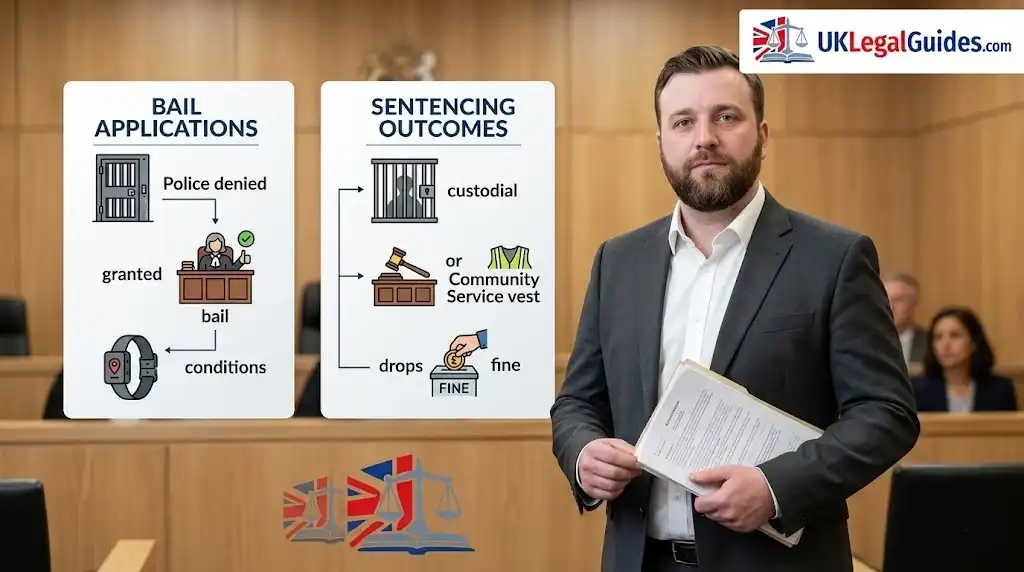
In England and Wales, when a court imposes a non‑custodial sentence - such as a community order, suspended sentence order (SSO), or fines - the sentence is served in the community rather than in prison. Although these sentences do not involve immediate imprisonment, they are still enforced and monitored to ensure compliance with the court's requirements. This article explains how non‑custodial sentences are overseen after conviction, the role of supervision and enforcement, what happens on breach, and what offenders need to know about how the justice system monitors their compliance.
What Are Non‑Custodial Sentences?
A non‑custodial sentence is a sentence that does not involve immediate imprisonment. These sentences are often used for less serious offences or where rehabilitation is a key objective. Examples include:
- Fines – monetary penalties requiring payment to the court.
- Community Orders – orders requiring offenders to comply with specific requirements, such as unpaid work or supervision.
- Suspended Sentence Orders (SSOs) – custodial sentences that are suspended provided the offender complies with conditions in the community.
Community and suspended sentence orders can include a wide range of requirements tailored to the offender and the offence, including supervision, unpaid work, curfew, exclusion, treatment programmes or electronic monitoring.
Who Is Responsible for Monitoring?
The Probation Service is the main statutory body responsible for supervising and monitoring non‑custodial sentences in the community. Once a sentence with supervision is imposed by the court, the Probation Service assesses the offender, creates a sentence plan, and allocates a responsible officer to manage compliance.
Caseload data shows that a large number of offenders are supervised in the community at any given time, reflecting the extensive use of non‑custodial sentences and the importance of consistent monitoring by probation professionals.
Monitoring Techniques and Requirements
Monitoring of non‑custodial sentences depends on the type of order and the requirements attached:
1. Supervision and Contact with Probation
For sentences involving supervision requirements, offenders must regularly meet with their assigned probation officer or responsible officer. These appointments are used to:
- Review compliance with court‑imposed conditions.
- Discuss progress against rehabilitation goals.
- Identify any new needs, such as employment, housing, treatment or training.
Probation officers record and assess attendance and engagement, and may make adjustments to supervision in response to changes in circumstances.
2. Unpaid Work / “Community Payback”
Many community orders require offenders to complete a set number of unpaid work hours (often called “community payback”), ranging from dozens to hundreds of hours depending on the offence. These hours are scheduled and monitored through probation and partner organisations. Failure to attend unpaid work sessions is recorded and can lead to enforcement proceedings.
3. Electronic Monitoring and Curfews
When a court imposes a curfew or exclusion requirement, the order may include electronic monitoring to check compliance with specified hours or restricted zones. Data from monitoring equipment allows authorities to verify if the offender is at the approved residence during the designated times or staying away from prohibited areas.
This technology can include ankle tags linked to monitoring systems or GPS systems for real‑time tracking in more serious cases, and is used to supplement supervision and reduce risk.
4. Treatment and Rehabilitation Programmes
Requirements such as drug or alcohol rehabilitation, mental health treatment, or educational programmes are monitored through attendance records and compliance reporting by the service providers. Probation officers track engagement and completion of these programmes as part of overall sentence monitoring.
Enforcement and Reporting Non‑Compliance
Non‑custodial sentences are monitored within a structured enforcement framework that includes clear procedures for addressing non‑compliance. The Enforcement of Community Orders, Suspended Sentence Orders and Post‑Sentence Supervision Policy Framework sets out how enforcement action should be taken when offenders fail to meet their requirements, ensuring responses are timely, proportionate and defensible.
When a probation officer or electronic monitoring provider records a suspected breach - such as missed appointments, failure to complete unpaid work hours, or breaking curfew - the case may be referred back to the court for enforcement action.
Court Proceedings for Breach
If a breach is formally identified, the supervising officer or relevant provider must lodge the matter with the court. Courts then decide whether the offender has failed to comply with the order and, if so, what enforcement action to take. This can include:
- Reprimands or warnings.
- Extension of existing requirements.
- Additional requirements or increased supervision.
- Re‑sentencing, including community order variation or custodial sentences in serious cases.
In breach proceedings specifically for SSOs, the court may activate the suspended custodial term in whole or in part if the offender is found to have breached the supervision or other attached conditions.
Practical Steps for Offenders
Those subject to non‑custodial sentences should:
- Attend all scheduled meetings with probation staff.
- Complete unpaid work or other requirements within set timeframes.
- Comply with electronic monitoring conditions and report issues promptly.
- Engage fully with rehabilitation programmes and maintain communication if difficulties arise.
Actively engaging with supervision and demonstrating progress can reduce the likelihood of a breach referral and may lead to early termination of certain requirements under future reforms.
Common Questions About Monitoring Non‑Custodial Sentences
What happens if an offender ignores unpaid work requirements?
Non‑attendance can lead to a breach report and enforcement action by the court, potentially resulting in additional penalties or custody if persistent.
Can electronic monitoring be applied to all non‑custodial sentences?
Electronic monitoring is available for curfew and exclusion requirements where practical, and courts may impose electronic compliance monitoring to support enforcement.
How does probation assess compliance overall?
Probation officers use sentence plans and regular contact to assess engagement with all requirements, recording evidence of compliance or non‑compliance that may influence future decisions.
Key Takeaways
Monitoring of non‑custodial sentences in England and Wales is a structured process involving probation supervision, technology‑assisted monitoring and formal enforcement procedures. Courts impose tailored requirements as part of community orders and suspended sentence orders, and the Probation Service oversees compliance, using electronic monitoring, attendance checks, unpaid work supervision and rehabilitation programme reporting. Non‑compliance can lead to formal breach proceedings, with courts deciding appropriate enforcement action, including re‑sentencing. Effective monitoring aims to balance public protection, rehabilitation, and justice system integrity.
