
This guide is maintained as a current resource for September 2026 and covers only the laws of England and Wales. Information is for general guidance, not legal advice. Consult a qualified solicitor for advice specific to your situation.
Learn how breaches of suspended sentences are enforced in England and Wales. This guide explains how breaches are identified, the court process, enforcement options including activation of custodial sentences, alternative penalties, and factors courts consider when deciding outcomes.
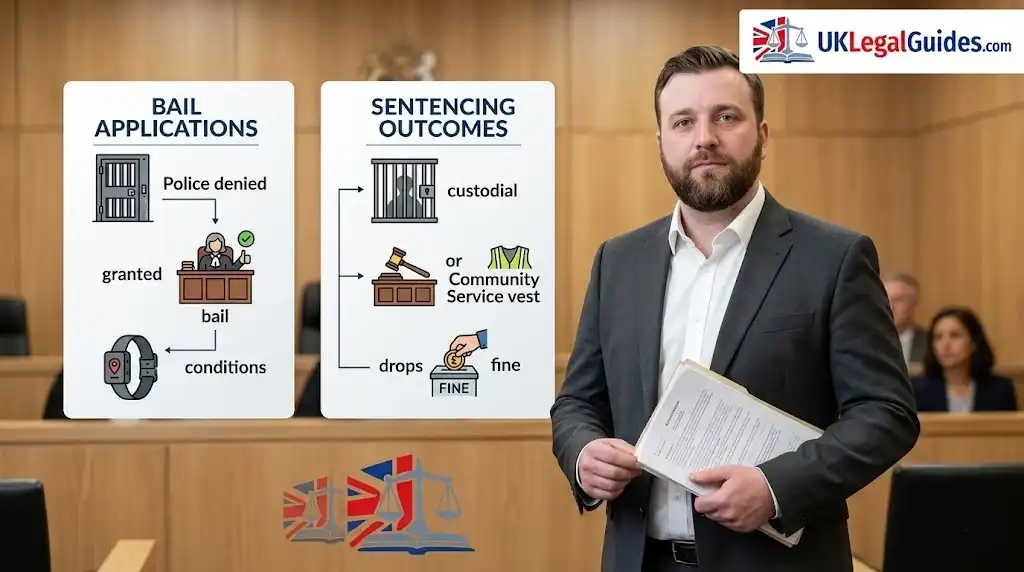
A suspended sentence order (SSO) is a custodial sentence that a court imposes but delays sending the offender to prison, provided that they keep to certain conditions and do not commit further offences during a specified period known as the operational period. If the offender fails to meet these conditions or commits a new offence during the operational period, the suspended custodial sentence may be activated or dealt with in other ways by the courts. This article explains how breaches of suspended sentences are identified and enforced under current law in England and Wales.
What Is a Suspended Sentence Order?
A suspended sentence order is a custodial sentence of up to two years that is not immediately enforced by imprisonment but instead suspended for a defined period. During that time, the offender must comply with any requirements set by the court. Common requirements include:
- Unpaid work (community service)
- Curfews or electronic monitoring
- Attendance at rehabilitation programmes (e.g. for drugs or alcohol)
- Supervision by a probation officer
If the offender complies with the requirements and commits no further offence during the operational period, they will not go to prison for that sentence.
What Constitutes a Breach?
There are two main ways a suspended sentence order can be breached:
1. New Offence During Operational Period (Reoffending Breach)
If the offender commits a new crime during the operational period of the SSO, they will usually be considered to have breached the order.
2. Failure to Comply with Requirements (Technical Breach)
If the offender fails to meet one or more of the requirements imposed by the court (for example, missing probation appointments or failing to complete unpaid work), this can also count as a breach.
How Breaches Are Identified and Brought Before the Court
Detection and Referral
Breaches may come to light through:
- Reports from the Probation Service
- Police notification of a new conviction
- Enforcement officers notifying the court of failure to comply with requirements
Legislation places a duty on enforcement officers to consider cases of non‑compliance and, where appropriate, refer them to a magistrates' court or Crown Court.
Court Proceedings
Once a breach is identified, the offender is summoned to court to face a breach hearing. The court will consider evidence of the breach, including:
- The nature and seriousness of any new offence
- Evidence of compliance or non‑compliance with the original sentence requirements
The hearing is generally conducted in the court that imposed the original suspended sentence.
Enforcement Options: What the Court Can Do
When dealing with a breach of an SSO, courts operate under the principle that the original custodial sentence should normally be activated unless to do so would be unjust in all the circumstances. This reflects both statutory guidance and sentencing council guidelines.
1. Activation of the Custodial Sentence
The primary response to a breach is to activate the suspended custodial sentence so that the offender must serve time in prison. This can be:
- Full activation: serving the remainder of the original sentence in custody
- Partial activation: serving part of the sentence with an appropriate reduction, often due to previous compliance with the order
Activation can apply whether the breach was a new offence or a failure to comply with specific requirements.
2. Courts May Reduce the Sentence on Activation
If the breach is less serious, or if the offender has otherwise made a good faith effort to comply, the court may activate the sentence with a reduction to reflect compliance or mitigating factors.
3. Alternative Enforcement Measures
In some situations, the court may decide that activation of the custodial sentence would be unjust. In these cases, the court has discretion to impose one or more of the following:
- A fine
- Extension of the operational period of the suspended sentence
- Extension of supervision requirements
- Addition of more onerous community requirements (e.g. additional unpaid work)
- Imposing a curfew or other condition, depending on the original order
These alternatives are used where the breach is less serious or where continued supervision and rehabilitation are preferable to immediate imprisonment.
Factors Courts Consider in Breach Decisions
When deciding how to deal with a breach, the court will typically consider:
- The nature and seriousness of a new offence, if there is one
- The level of compliance with the suspended sentence up to the point of breach
- Personal circumstances, including health or learning needs that may have affected compliance
- Public protection and risk of reoffending
The court must explain its reasoning, especially if it decides not to activate the custodial sentence.
Practical Example
Suppose an individual received a suspended sentence with requirements to complete unpaid work and attend probation appointments. If they miss meetings without reasonable excuse and fail to complete their unpaid work, the probation service may report the breach. At a court hearing, the judge could decide to activate the custodial sentence. However, if the court finds the failures were linked to serious health issues and the individual has otherwise complied well, the judge might instead impose a fine and extend the operational period.
Breach of Suspended Sentence vs New Offence
A breach because of a new offence carries a strong presumption in favour of activation. Even if the new offence does not itself attract a custodial sentence, the court may still activate the original suspended custodial sentence depending on seriousness and compliance.
Key Takeaways
Breaches of suspended sentence orders in England and Wales are taken seriously. The legal framework permits a range of enforcement responses, from immediate activation of the original custodial sentence to alternative measures such as fines, extended supervision, or additional requirements. The primary aim is to enforce compliance while also allowing courts to exercise discretion where strict activation would be unjust. Understanding how breach enforcement works helps both offenders and the wider public grasp the practical consequences of failing to comply with suspended sentence conditions.
