
This guide is maintained as a current resource for September 2026 and covers only the laws of England and Wales. Information is for general guidance, not legal advice. Consult a qualified solicitor for advice specific to your situation.
Learn what suspended custodial sentences are, how courts in England and Wales decide to impose them, the legal rules on eligibility, operational and supervision periods, possible requirements and what happens if someone breaches their suspended sentence order.
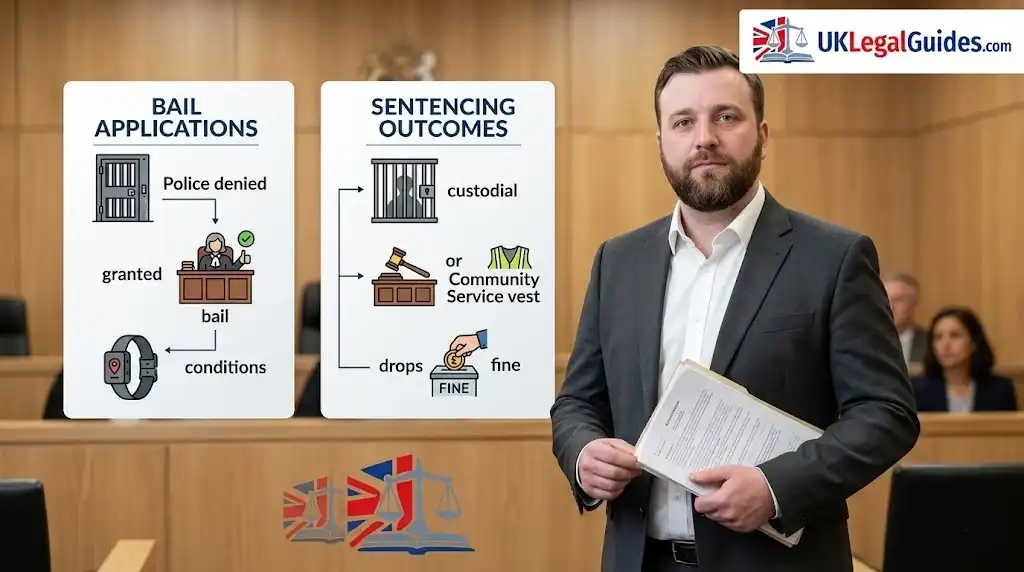
A suspended custodial sentence - formally a suspended sentence order (SSO) - is a form of punishment in England and Wales where a court imposes a custodial sentence but delays taking it into immediate effect, allowing the offender to remain in the community under supervision. It is an alternative to immediate custody that aims to balance punishment with rehabilitation and reintegration, provided the offender complies with set conditions and does not reoffend during a specified period.
This article explains how suspended custodian sentences work, what statutory rules govern them, how courts decide whether to impose them, what requirements and periods are involved, and what happens if someone fails to comply. It is intended to be clear and accessible to non‑lawyers while remaining accurate for solicitors and students.
What Is a Suspended Custodial Sentence?
A suspended custodial sentence, or suspended sentence order, is a custodial term of imprisonment that is not activated immediately. Instead, the sentence is suspended for an operational period during which the offender must comply with the law and any conditions imposed by the court. If the offender commits another offence during that time or fails to comply with the conditions, the court can activate the custodial sentence, meaning the offender will serve some or all of the original prison term.
Suspended sentences are only available when a custodial sentence is appropriate but the court is satisfied that the offender can be dealt with effectively in the community.
When Can a Sentence Be Suspended?
1. Threshold: Custody Must Be Appropriate
Before suspending a sentence, the court must decide that:
- The custody threshold has been passed - meaning the offence is so serious that neither a fine nor a community order alone would be sufficient so as to justify the seriousness of the offence; and
- There are circumstances suggesting that the offender can be safely managed in the community.
This means judges should not suspend a sentence simply to avoid immediate custody unless, if the suspension power were unavailable, they would have passed an immediate custodial term.
Magistrates' courts and the Crown Court regularly consider pre‑sentence reports to assess factors such as personal circumstances, risk of reoffending and the effect of custody on dependants.
Eligibility: Length and Type of Sentence
Under current law, a custodial sentence must be between 14 days and two years for adults to be eligible for suspension. In magistrates' courts, the lower threshold aligns with their sentencing powers.
However, forthcoming legal reforms propose extending the maximum custodial sentence that can be suspended to three years. These reforms include a statutory presumption that sentences of 12 months or less should be suspended unless there are compelling reasons to impose immediate custody.
Sentences such as extended determinate sentences or sentences for offenders of particular concern are excluded from suspension even under expanded powers.
Operational and Supervision Periods
Once the court chooses a suspended custodial sentence, it must set two key timeframes:
1. Operational Period
This is the period during which the custodial sentence is suspended. If the offender commits a new offence within this period, the custodial sentence can be activated by the court. The operational period must be:
- At least six months, and
- No more than two years (under current law).
The length chosen should reflect the seriousness of the offence, the length of the custodial term, and the perceived risk of reoffending.
Legal reforms propose extending the maximum operational period to three years for sentences of between two and three years - offering more flexibility in appropriate cases.
2. Supervision Period
This is the period during which the offender must comply with any requirements attached to the suspended sentence order. It must also be:
- At least six months, and
- No more than two years or the length of the operational period (whichever is shorter).
If the order includes a community requirement - for example, unpaid work - the supervision period must continue until that requirement is completed, up to the maximum permitted.
Requirements That Can Be Attached
A suspended sentence order may be imposed with or without specific requirements. Requirements are designed to support rehabilitation and public protection and are drawn from the same options available for community orders. They include:
- Unpaid work / Community Payback;
- Curfew or electronic monitoring;
- Treatment requirements for alcohol or drug misuse;
- Rehabilitation activity programmes;
- Exclusion or prohibited activity requirements;
- Supervision by the Probation Service.
Requirements should be proportionate and tailored to the individual's needs and risks. They support behavioural change and reduce the likelihood of reoffending.
How the Court Decides to Suspend
Factors Supporting Suspension
Courts will generally consider suspension where:
- There is a realistic prospect of rehabilitation in the community;
- The offender presents low risk of serious harm;
- Strong personal mitigation exists;
- Custody would have undue adverse consequences on dependants or vulnerable individuals.
Factors Against Suspension
Suspension may be inappropriate if:
- The offender presents a significant risk to a specific person or the public;
- Immediate custody is needed to reflect the seriousness of the offence;
- The offender has a history of poor compliance with court orders and is unlikely to comply with the suspended sentence's requirements.
What Happens if the Suspension Conditions Are Breached?
If the offender commits another offence during the operational period or fails to comply with any requirements of the order, the custodial sentence may be activated. Activation means the offender will typically serve all or part of the original custodial term, subject to any time already spent on remand.
The court's approach to breach hearings is to examine the nature of the breach and whether activating the custodial sentence remains just and proportionate in the circumstances.
Examples of Application
For example, a court may determine that an offender convicted of a non‑violent theft offence, with no significant risk history and positive pre‑sentence mitigation, should receive an 18‑week custodial sentence suspended for 12 months. If the offender complies with any attached supervision or rehabilitation requirements and does not reoffend during those 12 months, the custodial term will not be enforced. If they reoffend or breach conditions, the original custodial sentence is liable to activation.
Key Takeaways
A suspended custodial sentence is a discretionary sentencing option available in England and Wales where a custodial term (14 days to two years) can be delayed and served in the community if the offender complies with conditions during a defined operational period. Courts must assess whether custody is justified, whether suspension is appropriate, and what requirements support rehabilitation and public protection. Operational and supervision periods must be specified, and failure to comply during those periods can lead to activation of the custodial term. Ongoing reforms propose extending the maximum suspended sentence length to three years and introducing a presumption that sentences of 12 months or less should be suspended absent exceptional circumstances.
