
This guide is maintained as a current resource for September 2026 and covers only the laws of England and Wales. Information is for general guidance, not legal advice. Consult a qualified solicitor for advice specific to your situation.
Comprehensive guide to how sentences are adjusted for young offenders in England and Wales, covering legal principles, youth sentencing options, age‑specific rules, rehabilitation focus, and key differences from adult sentencing.
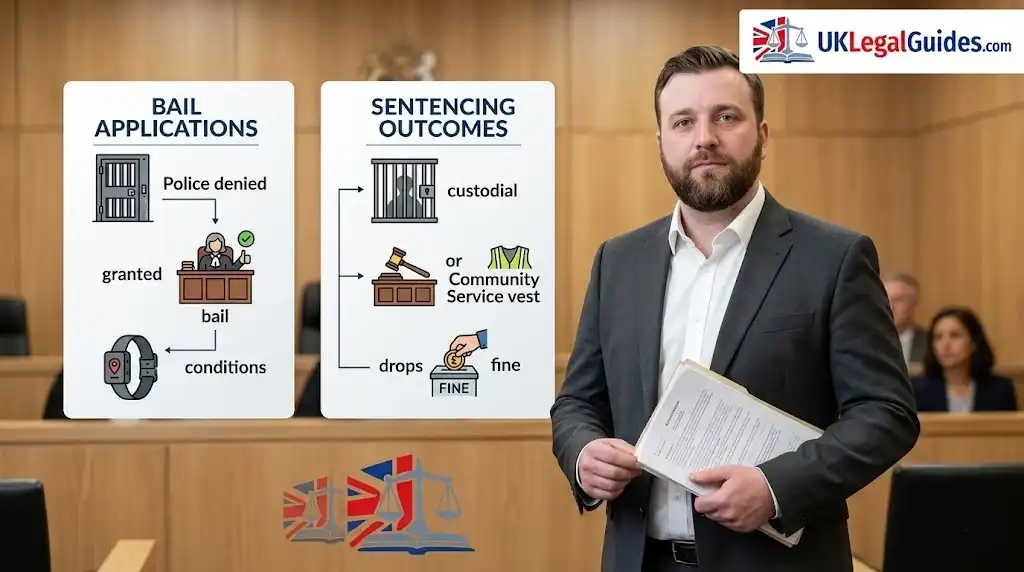
When a young person is convicted of a crime in England and Wales, the court must follow a distinct legal framework that treats them differently from adults. This reflects the principle that children and young people are less culpable than adults and more capable of rehabilitation. The justice system balances punishment with welfare, education and support to reduce reoffending and protect the young person's future prospects. Sentences for young offenders are crafted with this balance in mind, with different options and thresholds depending on age, maturity, seriousness of the offence and wider social factors.
This article explains how sentencing works for young offenders, including legal principles, types of sentences, age‑specific rules, the focus on rehabilitation, and practical implications.
Who Counts as a Young Offender?
In the youth justice system, a young offender usually means someone aged 10 to 17 at the date of conviction. The law treats individuals under 18 differently, with the youth courts and specific sentencing options designed for their age group. Those aged 18 to 20 are technically “young adults” and often have transitional provisions, but they are generally subject to adult sentencing rules if convicted after turning 18.
The age at conviction (not the age at the time of the offence) is crucial in determining which sentencing regime applies.
Principles Underpinning Youth Sentencing
Focus on Rehabilitation and Welfare
The youth justice system's principal aims are to:
- Prevent further offending, recognising that most young people will mature out of criminal behaviour;
- Prioritise welfare, considering education, emotional development and community support alongside punishment.
This contrasts with adult sentencing, where punishment and deterrence are usually dominant considerations.
Individualised Sentencing
Courts tailor sentences to the individual. Factors include:
- The young person's age and maturity;
- Culpability relative to an adult offender;
- Social and family background;
- Impact on education and prospects.
International human rights standards and domestic law hold that custody should be a last resort for children and young people and only imposed when no other community‑based option is appropriate.
Types of Sentences for Young Offenders
The sentencing options available to youth courts and Crown Courts vary with age and the seriousness of the offence.
Non‑Custodial Sentences
These are typically used for low‑level offences or first‑time offenders and include:
- Absolute discharge: No punishment is given because the offence is considered so minor that nothing further is appropriate.
- Conditional discharge: The young person is released with conditions (such as good behaviour) for up to three years; if they reoffend within this period, they may be resentenced.
- Fines: Only used where appropriate; the court assesses the young person's or parents' ability to pay. For under‑16s, fines are usually paid by a parent or guardian.
- Referral orders: Common for first‑time offenders, these require the young person to work with a youth offending team to address causes of offending.
- Youth Rehabilitation Orders (YROs): This broad community order can include supervision, education, curfews or other requirements tailored to reduce reoffending.
Custodial Sentences
Custody is reserved for serious offences or where community sanctions have failed. For young offenders, custody has specific forms:
- Detention and Training Orders (DTOs): The main custodial sentence used for youth offenders aged 12–17 (10–11s only if persistent). Half is served in a secure setting, then the remainder in the community under supervision.
- Detention “at Her Majesty's pleasure”: For the most serious offences (including murder), this is the youth equivalent of a life sentence, with a minimum tariff before parole eligibility.
- Maximum detention powers in the youth court are limited (e.g. two years for most offences). For offences requiring longer sentences, the case moves to the Crown Court.
Age‑Specific Considerations
Sentencing guidelines instruct that:
- For younger children (14 or under), custodial sentences should be especially rare and are generally shorter than for older youths for equivalent offences.
- Age and maturity may justify starting points for custodial sentences that are lower than adult equivalents, potentially as low as half to three‑quarters of an adult starting point, depending on maturity and the offence.
The emphasis is on developmental age as well as chronological age when assessing culpability and appropriate punishment.
Practical Application in Court
Youth Court vs Crown Court
Most young offender cases begin and conclude in youth courts, which are less formal and focused on rehabilitation. If the offence is too serious or the youth court's sentencing powers are inadequate, the case may be transferred to the Crown Court for sentence.
Welfare and Pre‑Sentence Reports
Before sentencing, courts often consider reports from youth offending teams that assess the young person's:
- Background and circumstances;
- Needs and risk factors;
- Prospects for rehabilitation.
These reports help the court decide on the most constructive sentence.
Common Questions
Can a 12‑year‑old be sent to prison?
Children aged 12 and over may receive a DTO if persistent offending justifies it, but it is rare and only after considering welfare and community alternatives.
Does turning 18 affect sentencing?
If a defendant turns 18 after conviction but before sentencing, they can still receive youth sentences. The age at conviction, not sentence date, controls eligibility for youth disposals.
Are rehabilitation and education part of sentences?
Yes. Youth sentencing strongly emphasises rehabilitation, including education requirements, structured programmes and support to prevent reoffending.
Key Takeaways
Sentencing young offenders in England and Wales is a structured process designed to balance accountability with the welfare and development needs of children and young people. Courts apply distinct principles that prioritise rehabilitation, use custody sparingly, and tailor punishments to age, maturity, and circumstances. Custodial sentences, where imposed, take forms such as Detention and Training Orders and are generally shorter and more supportive than adult equivalents. The sentencing framework aims to reduce reoffending, support reintegration and protect the community while recognising that young offenders have different needs and lesser culpability than adults.
