
This guide is maintained as a current resource for September 2026 and covers only the laws of England and Wales. Information is for general guidance, not legal advice. Consult a qualified solicitor for advice specific to your situation.
Detailed guide explaining how conditional release works after custody in England and Wales, covering automatic release points, parole, licence conditions, the recall process, supervision obligations and what happens if licence terms are breached.
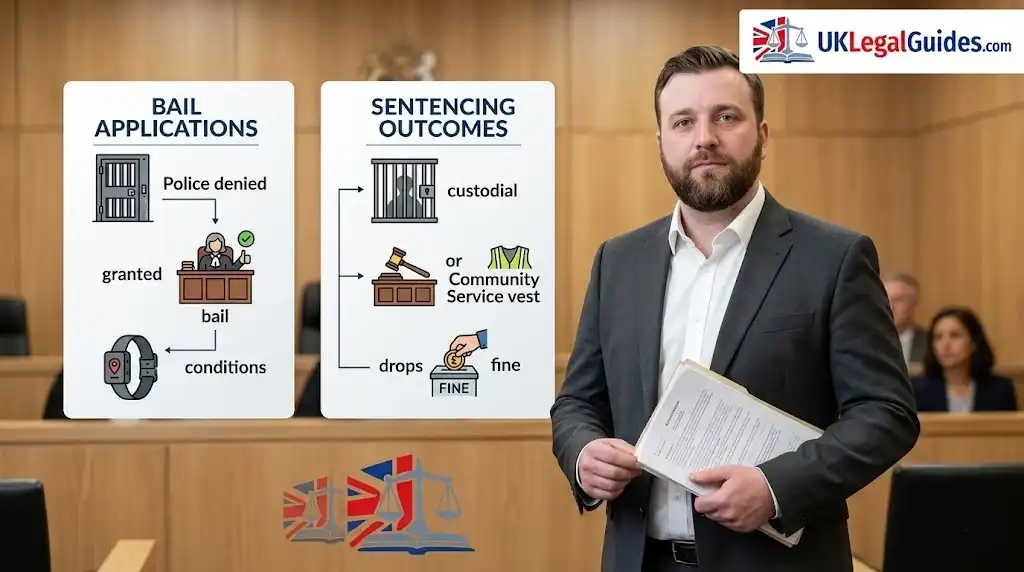
In England and Wales, most people sentenced to custody do not serve the entirety of their sentence in prison. Instead, they may be released back into the community before the end of their custodial term under specific procedures that involve supervision and conditions. This release is commonly referred to as conditional release, and it usually means the individual will live in the community subject to licence conditions, with the possibility of being returned to prison if those conditions are breached.
This article explains how conditional release works after custody, the legal framework governing it, what steps are involved, what conditions might be set, possible risks, and common questions people have about the process.
What Conditional Release Means
Conditional release refers to the stage at which a person leaves prison before the full sentence has been served, on the basis that they comply with rules set by the authorities. Conditional release can happen in a number of ways depending on the sentence type and length:
- Automatic release at a set point in the custodial sentence;
- Release after parole or licence approval; or
- Early release schemes, such as Home Detention Curfew or supervised licence release before the automatic date.
While released, the person remains subject to licence conditions and is normally supervised by the probation service until the end of the sentence or licence period. If licence conditions are broken, the person may be recalled to custody.
Legal Framework for Conditional Release
The main statutory framework for conditional release in England and Wales arises from:
- The Criminal Justice Act 2003, which sets out provisions for when and how determinate (fixed‑term) prisoners are released;
- Parole legislation and policies that govern how offenders serving longer or indeterminate sentences can be considered for conditional release; and
- Administrative frameworks from HM Prison and Probation Service that set licence conditions and recall procedures.
These frameworks aim to balance public safety, rehabilitation, and the concept that offenders should not serve unnecessary time in prison beyond what is proportionate to their offence.
When Conditional Release Occurs
Automatic Conditional Release of Determinate Sentence Prisoners
Most people serving a standard determinate sentence (a fixed finite period of custody) are released under licence partway through their sentence. The point at which this occurs can vary:
- Many prisoners are released on licence after serving 40% of their custodial sentence; this is increasingly the standard approach under recent policy changes.
- In some cases, Home Detention Curfew (HDC) may allow release before the 40% point, typically for prisoners serving between 3 months and 4 years and meeting eligibility criteria. This includes a period under electronic monitoring (e.g., tagging).
- Some early release schemes allow prisoners to be freed a set period (such as up to 70 days) before their standard licence release date, to manage prison capacity, subject to specific eligibility.
Once released under licence, the remainder of the sentence is served in the community under supervision and subject to a set of conditions.
Parole and Indeterminate Sentences
For people serving sentences that do not have a fixed automatic release point - such as life sentences or imprisonment for public protection (IPP) sentences - the Parole Board plays a central role in deciding when conditional release is appropriate. These offenders serve a minimum custodial term before they can be considered for release by the Parole Board. If the board directs their release, they will be on licence; if not, they remain in custody until it is satisfied that releasing them is safe.
Licence and Supervision
When a person is conditionally released, they will usually be on licence. Licence conditions are requirements the person must follow while living in the community. These conditions will be written on the licence document provided on release and typically include:
- Regular contact with a Community Offender Manager (COM) or supervising officer;
- Requirements to live at a specified address;
- Prohibitions on certain actions (such as associating with specific people or entering specific areas);
- Any other condition the authorities consider necessary to manage risk and support rehabilitation.
Licence periods vary depending on sentence length and type. For example:
- Determinate sentence licences usually last until the sentence expiry date;
- Extended or indeterminate licences (such as life licences or IPP) may apply for a much longer period, sometimes indefinitely.
What Happens if Licence Conditions Are Breached?
Breaching licence conditions is treated seriously. If a person fails to comply with their licence, the supervising officer can refer the breach to the Public Protection Casework Section (PPCS), which can decide to recall the person to prison.
There are different forms of recall:
- Fixed‑term recall: The offender returns to custody for a set period (for example, 14 or 28 days) before automatic re‑release if no further action is taken;
- Standard recall: The offender stays in custody until the end of their sentence unless the Parole Board or Secretary of State directs release.
Once recalled, the person is normally entitled to be told the reasons for recall and may make representations to the Parole Board for earlier re‑release.
Practical Steps in the Conditional Release Process
- Sentence Calculation and Early Release Eligibility:
Before release, the prison will calculate when the individual becomes eligible for conditional release or parole. This calculation incorporates statutory rules (e.g., release at 40% for many determinate sentences). - Preparation for Licence:
The prisoner will usually meet with a Prison Offender Manager (POM) to discuss licence conditions and support arrangements. They are provided with details of their licence and supervision. - Release Transition:
On the day of release, arrangements are made for supervision in the community. Contact details for the supervising officer and any required programmes will be provided. - Ongoing Supervision:
The individual must report to their supervising officer and comply with licence conditions. Failing to comply may result in recall to custody.
Risks and Considerations
- Recall Risk: Any breach of licence conditions can lead to being returned to custody, potentially for the remainder of the sentence, depending on the breach and risk assessment.
- Public Safety and Assessment: The Parole Board or authorities assess risk to public safety when considering release or re‑release after recall.
- Supervision Requirements: Licence supervision can include regular meetings, mandated programmes and restrictions on activities. Compliance is essential to avoid recall.
Common Questions
Can someone be released before the automatic licence date?
Yes. Early release options like Home Detention Curfew or other supervised arrangements can allow conditional release before the main licence date if eligibility criteria are met.
Does conditional release mean the sentence is finished?
No. Conditional release means part of the sentence is served in the community under licence. The sentence is only fully complete when the licence period ends.
What happens at the end of the licence period?
Once the licence period expires, the person is no longer under supervision, providing there have been no recalls or further conditions.
Key Takeaways
Conditional release after custody in England and Wales is a structured process that allows many prisoners to spend part of their sentence living in the community under supervision and licence conditions. Whether through automatic release at a set point, early release schemes, or Parole Board decisions, conditional release aims to balance public protection with rehabilitation and reintegration. Licence conditions are tailored to manage risk, and breach of those conditions can lead to recall to custody. Understanding this process, rights and responsibilities is important for anyone affected by custodial sentences.
