
This guide is maintained as a current resource for September 2026 and covers only the laws of England and Wales. Information is for general guidance, not legal advice. Consult a qualified solicitor for advice specific to your situation.
Detailed guide on how restorative justice processes are incorporated into sentencing in England and Wales, including deferred sentencing, community and suspended sentence requirements, victim engagement, and how restorative outcomes can influence court sanctions.
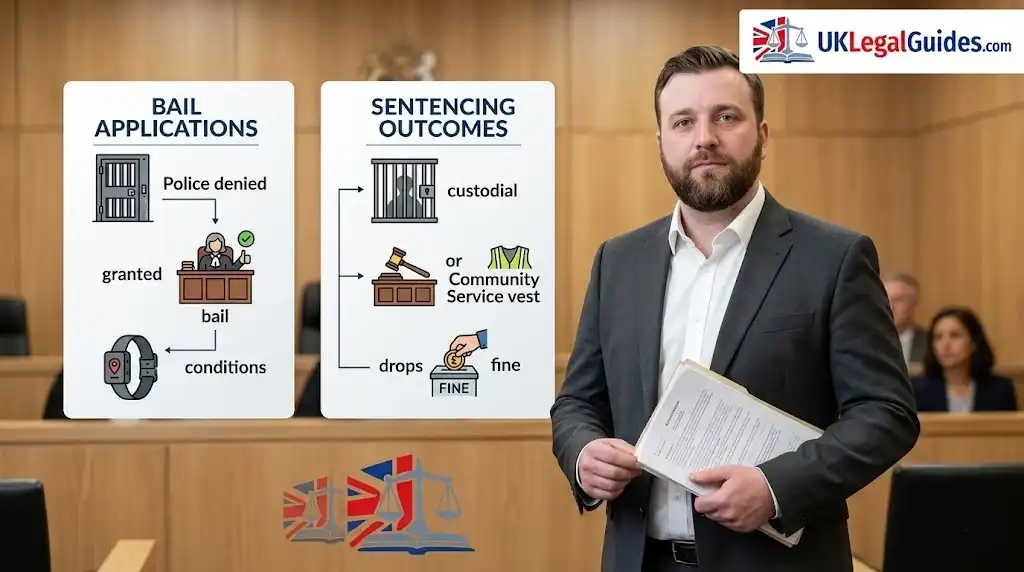
In England and Wales, restorative justice has increasingly become part of the broader criminal justice landscape. Rather than replacing formal sentencing, restorative justice processes can be incorporated into sentencing or linked with criminal sanctions to support rehabilitation, repair harm and involve victims more directly in the justice process. These processes facilitate dialogue between the victim and the offender - with the victim's consent - to discuss the impact of the offence, foster accountability and agree on meaningful actions to repair harm.
This article explains where and how restorative justice may be used in sentencing, how courts and practitioners incorporate it into orders, what the legal frameworks and procedures are, and practical considerations for victims and offenders.
What Is Restorative Justice?
Restorative justice is a voluntary process that brings victims and offenders together, usually with a trained facilitator, to discuss the effects of a crime and agree on ways the offender can make amends. The process may be face‑to‑face or indirect (for example, through letters, video or other mediated communication) depending on safety and consent. The aim is to give victims a voice, promote offender accountability, and support rehabilitation and reintegration.
Importantly, participation in restorative justice processes is entirely voluntary for both victims and offenders. A restorative justice process cannot be imposed on either party without their willing involvement.
The Stages at Which Restorative Justice Can Be Used
Restorative justice may be engaged at several points in the criminal justice process, including:
- Pre‑charge or pre‑trial out‑of‑court resolution – where police or prosecutors offer restorative justice in lieu of formal charges or as part of conditional cautions.
- Pre‑sentence deferred processes – where sentencing is deferred to allow a restorative process to take place before the court imposes a sentence.
- Part of a community or suspended sentence order – where restorative justice outcomes influence or form part of structured requirements.
- During or after custody – in some cases restorative meetings may be encouraged alongside custodial sentences or after release.
Legal and Policy Framework for Incorporation
There is no single statutory “restorative justice order” in the sentencing statutes, but the law and policy provide avenues for the principle of restorative justice to inform sanctions:
- Deferred sentencing – Courts have a longstanding power to defer sentence (under the Powers of Criminal Courts (Sentencing) Act 2000) to allow events such as restorative processes to occur before final sentencing.
- Sentencing components – The Offender Rehabilitation Act 2014 and earlier provisions in the Criminal Justice Act 2003 allowed restorative activities to be included within rehabilitation activity requirements (RARs) attached to community or suspended sentences.
- Pre‑sentence guidance – Ministry of Justice guidance supports the use of restorative justice at the pre‑sentence stage and encourages courts to consider it where appropriate.
Government policy and professional frameworks from the Restorative Justice Council and the Ministry of Justice emphasise integrating restorative practices into day‑to‑day justice work, including in the context of probation supervision or community orders.
Incorporation Within Sentencing: How It Works
1. Pre‑Sentence Restorative Processes
Where both victim and offender consent, a restorative justice process can take place after conviction but before sentence is passed. The court may defer sentencing to allow this engagement, after which the outcome can help inform the sentence. For example:
- If the victim and offender agree a set of actions that demonstrate genuine insight and willingness to repair harm, the sentencer may treat this as a mitigating factor or may include aspects of the agreement in the sentence.
- The deferred process may involve restorative meetings, mediated dialogue or other structured activities that show the offender is engaging positively with the consequences of their offending.
Because the court retains discretion, restorative outcomes do not automatically amend the sentence; they may influence whether a community order, suspended sentence or other sanction is appropriate.
2. Incorporation Into Community and Suspended Sentences
Restorative elements may be incorporated into community sentences and suspended sentences through rehabilitation activity requirements (RARs) or equivalent conditions. RARs allow the probation service to deliver interventions designed to reduce reoffending. Courts or probation practitioners can recommend restorative justice participation as part of these requirements where:
- The victim is willing and the process is safe;
- The intervention aligns with rehabilitation goals; and
- It is appropriate given the offence and offender.
In such cases, the restorative justice activity becomes one of the structured conditions the offender is expected to complete. Failing to engage with those requirements may constitute a breach, which the court can address.
3. Restorative Justice During or After Custody
Although more limited in scope, restorative processes can be facilitated while the offender is serving a custodial sentence or shortly after release. Participation following conviction, where both parties agree, can support rehabilitation and reintegration, and may inform supervised release conditions.
This approach is not a separate sentencing “order” but a practice that complements the formal sentence, particularly in cases where victims wish to articulate impact and offenders wish to take responsibility.
Practical Considerations and Safety
- Voluntary Participation: Participation in restorative processes is voluntary for both victim and offender. A restorative activity cannot be imposed without consent.
- Assessment of Suitability: Professionals, including probation officers and restorative justice facilitators, assess suitability and safety before any restorative meeting.
- Timing: Courts may defer sentencing to allow a restorative process when practicable and appropriate; this requires coordination with local services and facilitators.
Impact on Sentencing Outcomes
Restorative justice can influence sentencing by providing:
- Victim insight that informs the court's understanding of harm;
- Evidence of offender engagement and responsibility, which can be considered when deciding on the type and severity of the sentence; and
- Agreed actions that may be included within community or suspended sentences when appropriate.
However, restorative justice is not a direct substitute for sentencing, and the judge retains full authority to determine the appropriate sentence.
Common Questions
Does restorative justice alter a sentence automatically?
No; involvement in restorative justice does not automatically change the sentence. It may, however, influence judicial decision‑making where consent and suitable evidence of engagement exist.
Can restorative justice be compulsory?
No. Participation is always voluntary for both victim and offender. Restorative justice cannot be forced as a condition without consent.
Is restorative justice only for youth offenders?
While widely used with young people, restorative justice is available for adults at various stages, including pre‑sentence and within community rehabilitation contexts.
Key Takeaways
Restorative justice offers an opportunity to repair harm, give victims a voice and support offender rehabilitation. In England and Wales, it is integrated into the criminal justice process at multiple points - from pre‑sentence restorative activities that inform sentencing, to incorporation within community and suspended sentences via rehabilitation requirements. While not a standalone sentencing order, restorative justice can meaningfully shape sanctions and supervision, provided both the victim and offender consent and participation is safe and appropriate.
