
This guide is maintained as a current resource for September 2026 and covers only the laws of England and Wales. Information is for general guidance, not legal advice. Consult a qualified solicitor for advice specific to your situation.
Comprehensive guide to how combined custody and community sentences are applied in England and Wales, including suspended sentence orders with community requirements, custodial sentences with supervised release, enforcement and breach processes, and practical considerations under the Sentencing Code and guidelines.
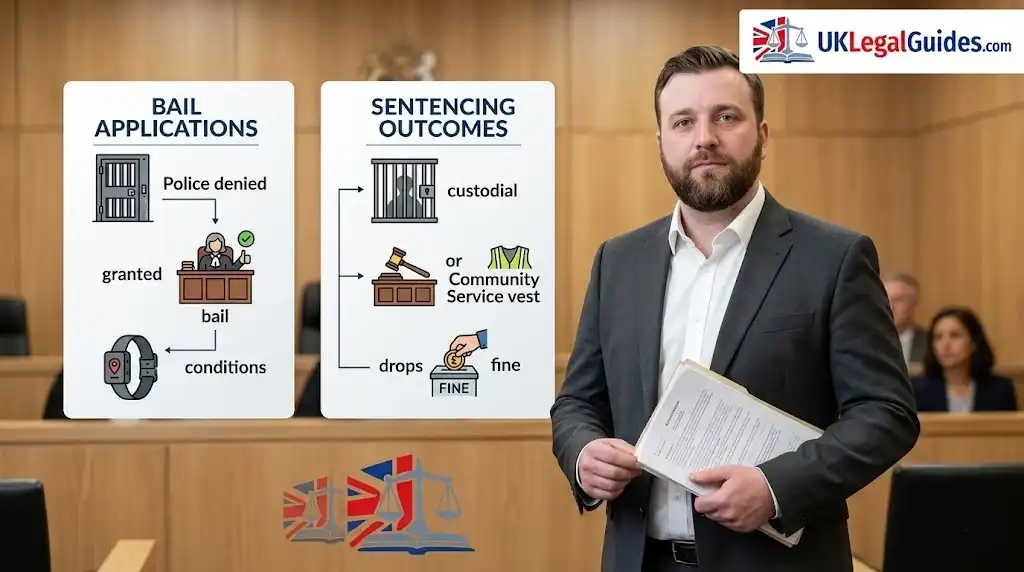
In England and Wales, courts have a range of sentencing options that balance punishment, public protection, and rehabilitation. While some sentences involve immediate custody and others require community‑based sanctions, there are structured ways in which custodial elements and community requirements can be combined to form a single, coherent sentence. These combinations can occur when a custodial sentence is suspended with community requirements, or when a sentence incorporates structured supervision in the community linked to a period of imprisonment. This article explains how these combined orders operate, the legal framework underpinning them, the sentencing process, enforcement mechanisms and common questions that arise.
The Legal Framework: Custody and Community Elements
Under modern sentencing law, the court must decide on an appropriate sentence by reference to the Sentencing Code 2020 and the Sentencing Council's guidelines on custodial and community sentences. Two key statutory principles are:
- Custodial sentences must be imposed only where the offence (or the totality of offences) is so serious that neither a fine nor a community order could achieve the purposes of sentencing.
- Community orders can be imposed where the offence is serious enough to warrant a penalty but does not pass the custody threshold. A community sentence can include a range of requirements such as unpaid work, supervision, curfew or treatment activities.
The legislation allows for suspended custodial sentences, which effectively combine custody and community elements and, historically, older statutory regimes included combination orders requiring supervision and unpaid work together.
Custody Threshold and the Role of Combined Sentences
Before any sentence is passed, the court must assess whether the seriousness of the offence crosses a legal “custody threshold”. This means the offending is sufficiently serious that nothing less than a custodial sentence would be appropriate in principle. Even if this threshold is met, a custodial sentence is not inevitable if a community sentence with appropriate requirements can still achieve the purposes of sentencing, including rehabilitation and public protection.
A combined sentence may arise in practice in two principal ways:
- Suspended Sentence Orders (SSOs): A custodial sentence that is not immediately enforced but is suspended on the condition that the offender complies with requirements in the community.
- Custody Followed by Community Supervision: A custodial sentence that includes or leads to a period of community supervision on release (e.g., licence conditions, post‑release supervision). This reflects the broader sentencing aim of supporting reintegration.
Suspended Sentence Orders: Custody With Community Requirements
A Suspended Sentence Order (SSO) is a custodial sentence that the court orders not to take effect immediately, provided the offender meets certain conditions for a specified period. An SSO is technically a custodial sentence and unlike a pure community order it represents an actual sentence of imprisonment (which would take effect on breach). As with community orders, courts can attach requirements that the offender must comply with while the custody sentence is suspended. These may include:
- Unpaid work or community payback;
- Supervision by probation services;
- Treatment programmes for drug or alcohol misuse;
- Curfews or other activity requirements.
The detention term is suspended for an operational period (which is usually the same length as the custodial term), and any requirements imposed have to match the period of supervision set by the court. If the offender breaches any of the conditions, the court can activate the custodial sentence.
How Courts Decide on a Suspended Sentence Order
When considering an SSO, courts typically follow a structured approach:
- Determine custody threshold: Assess whether the offence is sufficiently serious to warrant custody at all.
- Consider community options: Even where custody would be justified, consider whether an SSO with requirements can achieve the purposes of sentencing.
- Set conditions: Specify the supervision period and any additional requirements the offender must follow while the sentence is suspended.
- Explain consequences of breach: Inform the offender of the conditions and that non‑compliance can lead to activation of custody.
This approach ensures that the order reflects proportionality and the individual circumstances of the offender.
Custody With Post‑Release Community Measures
Although not termed “combination orders” in current statutory language, another form of combined sentence occurs where a fixed custodial sentence is followed by mandatory community supervision or licence conditions when the offender is released. For example:
- Prisoners serving determinate sentences are usually released on licence part‑way through their term and will be supervised in the community under conditions intended to support rehabilitation and protect the public.
- Some custodial sentences can be followed by structured community supervision as a mandatory part of the penalty, especially where rehabilitation needs or public protection concerns are significant.
The current law allows a flexible mix of custodial and community components to meet the statutory purposes of sentencing, ensuring punishment, reform and public protection can be balanced.
Enforcement and Breach Mechanisms
When a combined order includes community requirements (either as part of an SSO or post‑release supervision), enforcement is principally handled by the Probation Service. The supervising officer monitors compliance with requirements such as attendance at programmes or unpaid work placement. Failure to comply can trigger formal breach proceedings.
- For suspended sentences, breach can lead to the custodial sentence being activated and the offender sent to prison.
- For licensed release or post‑custody supervision, serious breach may lead to recall to custody, depending on the nature of the breach and risk assessment.
Clear communication of conditions and the consequences of non‑compliance is essential for offenders, and courts aim to set requirements that are achievable and proportionate to the offender's circumstances at the time of sentencing.
Practical Context and Examples
When Is a Suspended Sentence With Requirements Used?
A suspended sentence with community requirements may be applied when:
- The offence is serious enough to warrant custody, but circumstances such as lack of prior record, rehabilitation prospects, or mitigating factors suggest that immediate imprisonment is not necessary.
- There is a clear benefit in addressing underlying issues (such as addiction or unemployment) through structured community support.
- Public protection can be managed through supervision conditions without requiring immediate custodial confinement.
For example, a court dealing with a non‑violent offence that technically meets the custody threshold might order a suspended sentence of six months with supervision and rehabilitation activity requirements, enabling the offender to remain in the community while addressing contributory factors to offending.
Custody Followed by Supervision
In other cases, an offender may serve part of a custodial sentence in prison and then, upon release, be subject to professional supervision and restrictions on activity or residence - a combination designed to bridge the transition from custody to liberty and support reintegration.
Rights and Sentence Review
Those subject to combined orders retain legal rights:
- They can appeal their sentence if there are grounds to argue it was disproportionate or procedurally incorrect.
- They have the right to review of their licence conditions or requirements if circumstances change, although courts balance fairness with public protection.
- Breach proceedings must comply with procedural safeguards, including notice of breach and the opportunity to explain non‑compliance.
Legal advice may assist in navigating these processes, especially where breach could lead to activation of custodial terms.
Common Questions
Is a suspended sentence the same as immediate custody with community requirements?
No. A suspended sentence is technically a custodial sentence kept in abeyance - the offender does not go to prison immediately but can be sent if conditions are breached. Immediate custody with post‑release supervision is different: the offender serves part of their time in prison before supervised release.
Can all custodial sentences be suspended?
Only certain custodial terms fall within the scope of suspension (often shorter terms). Legislation and guidelines set limits, and courts exercise discretion based on suitability.
Are community requirements only about unpaid work?
No. Requirements can range from supervision and treatment to curfews and exclusion orders, tailored to rehabilitation and risk.
Key Takeaways
In England and Wales, sentences that combine custodial elements and community sanctions are applied through mechanisms like Suspended Sentence Orders and custodial sentences followed by community supervision on release. These approaches allow courts to address serious offending with a custodial sentence while using structured community measures to achieve rehabilitation and protect the public. The Sentencing Code and Sentencing Council guidance require courts to consider the seriousness of the offence, individual circumstances, and proportionality when making such orders. Enforcement is managed by the Probation Service, and breach can lead to activation of custodial terms or recall. Combined orders exemplify the balance in modern sentencing between punishment and rehabilitation, offering courts flexibility to tailor sentences that are fair, structured and grounded in legal principles.
