
This guide is maintained as a current resource for September 2026 and covers only the laws of England and Wales. Information is for general guidance, not legal advice. Consult a qualified solicitor for advice specific to your situation.
Understand how dangerous offenders are sentenced differently in England and Wales, including extended sentences, risk assessments, public protection measures and how courts balance punishment with safety.
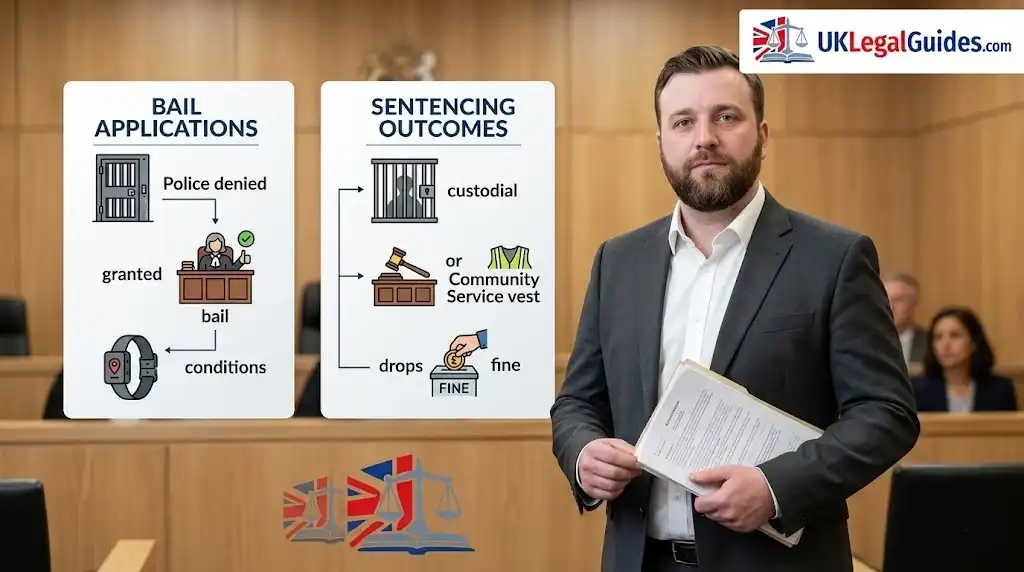
In criminal law in England and Wales, certain offenders are regarded as “dangerous” because they present a significant risk of causing serious harm to members of the public. The legal system treats such cases differently from routine offences to balance punishment with public protection and reduced risk of re‑offending. This article explains the legal framework for dangerous offenders, how sentencing differs from standard cases, the statutory processes courts follow, and the implications for offenders and public safety.
This explanation draws on authoritative sources including the Sentencing Act 2020, the Criminal Justice Act 2003, and guidance on extended sentences for violent, sexual and terrorism offences.
What Does “Dangerous Offender” Mean in Law?
A dangerous offender is not a separate crime category. Instead, this legal label arises during sentencing when the court assesses that:
- the offender has been convicted of a specified violent, sexual or terrorism offence, and
- there is a significant risk that they will commit further serious offences in future.
The assessment considers the seriousness of the index offence, past convictions, behavioural patterns and risk of harm to the public. The court may rely on evidence and reports, including probation assessments, to decide whether the test of dangerousness is met.
When Does the Court Apply Special Dangerous Offender Sentencing?
The dangerous offender provisions apply after conviction, before sentence, and only if the offence meets prescribed legal criteria. These criteria include:
- conviction of a specified offence (violent, sexual or terrorist offences listed in statute);
- court finds a significant risk of serious harm from future offending; and
- either a life sentence is not mandatory or justified, or the offence type and offender's history justify extended or indeterminate detention.
“Specified offences” cover a wide range of serious crimes including assaults, rape, sex with a minor and terrorism‑related offences.
Types of Sentences for Dangerous Offenders
When an offender is deemed dangerous, the court must consider a wider range of sentencing options than for an ordinary case. These include:
Extended Determinate Sentences
If a court finds a danger but a life sentence is not appropriate, it may pass an extended determinate sentence. This includes:
- a custodial term that reflects the seriousness of the offence; and
- an extended licence period supervised after release, to protect the public.
Extended licence periods can be up to five years for violent offences and eight years for sexual offences. During this time the offender remains under probation supervision and must comply with licence conditions.
Release before completion of custody may involve Parole Board approval where the sentence structure requires it, helping ensure the person no longer poses significant risk before reintegration into the community.
Life Imprisonment or Indeterminate Sentences
For the most serious specified offences or where risk remains high, courts may impose:
- a detention for life sentence, where available; or
- previously, an imprisonment for public protection (IPP) or other indeterminate sentence.
IPP sentences were abolished in 2012 because of concerns about their effectiveness, but historic cases remain. Under older law, individuals could be held past their minimum term until the Parole Board was satisfied they were no longer dangerous.
Under current law, life sentences remain the ultimate sanction for the most serious offences, with the court specifying a minimum term before parole eligibility.
How Sentencing for Dangerous Offenders Differs from Standard Sentences
The key features that distinguish dangerous offender sentencing from typical cases include:
1. Statutory Assessment of Dangerousness
Standard sentencing does not require a formal dangerousness finding. By contrast, dangerous offender sentencing depends on the court consciously assessing whether the defendant poses a significant risk of future harm.
2. Extended Supervision on Licence
Offenders given extended sentences serve a structured licence period after release, during which they are monitored and can be recalled to custody if conditions are breached. This extends public protection beyond the custodial term.
3. Parole Board Involvement
In some extended sentences, release within the custodial term requires approval by the Parole Board rather than automatic release at a fixed point. This adds an extra layer of review focused on risk.
4. Higher Custodial Responsibility
Dangerous offender provisions often lead to longer periods in custody relative to comparable standard sentences, reflecting the need both to punish and to protect.
Practical Implications for Defendants and Public Protection
For Defendants
Being labelled a dangerous offender affects sentence length, licence conditions and the likelihood of early release. Defendants and their legal representatives can provide mitigating evidence to the court about risk factors and rehabilitation prospects. Participation in risk assessments and rehabilitation programmes can influence outcomes.
For Public Safety
Dangerous offender sentencing is designed to reduce the risk of re‑offending and protect the public by extending supervision and custody where risk is significant. This approach aims to balance fairness with safety.
Common Questions About Dangerous Offender Sentencing
Is every violent or sexual offender automatically dangerous?
No. The court must assess whether there is a significant risk of further serious offending. The seriousness of the offence alone is not determinative.
Do extended licence conditions mean lifelong supervision?
Extended licence periods are finite and set by the judge based on risk and statutory limits (such as up to eight years for sexual offences).
Can sentences be challenged?
Defendants can appeal sentences they consider excessive or based on an incorrect risk assessment through the Court of Appeal, subject to statutory grounds and time limits.
Key Takeaways
Dangerous offender sentencing in England and Wales reflects a legal framework designed to address offenders who pose a significant risk to public safety. Courts apply specific tests and may impose extended or indeterminate sentences with enhanced supervision and custody, going beyond standard determinate sentences. The approach balances punishment with public protection and risk management, using structured assessments and licence conditions to support safer reintegration following release.
