
This guide is maintained as a current resource for September 2026 and covers only the laws of England and Wales. Information is for general guidance, not legal advice. Consult a qualified solicitor for advice specific to your situation.
Learn the steps courts in England and Wales follow to impose a suspended sentence, including eligibility, assessing suitability, setting the operational period, imposing requirements, and consequences of breach.
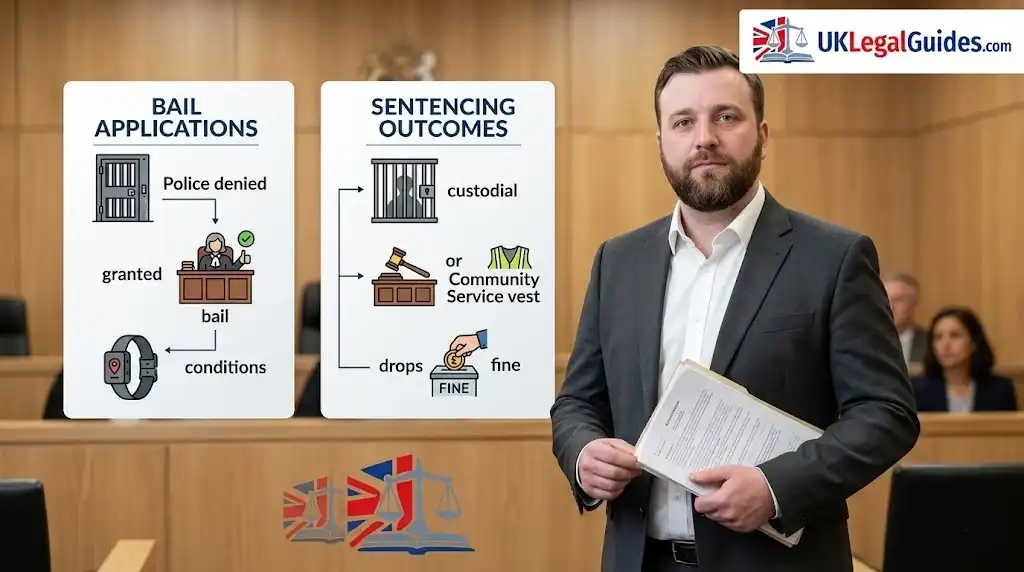
In criminal law in England and Wales, a suspended sentence order (SSO) is a form of custodial sentence that allows a court to delay an offender's immediate imprisonment, provided certain conditions are met. It is a structured way of balancing punishment with the opportunity for rehabilitation in the community. This article explains the legal steps and considerations courts follow when deciding whether to impose a suspended sentence, what it means, and how the process works in practice.
What Is a Suspended Sentence?
A suspended sentence is a custodial sentence that is imposed but not immediately activated. Instead, the offender remains in the community for a set period - known as the operational period - during which they must comply with any conditions attached to the order and refrain from further offending. If they breach the terms, the original custodial sentence can be activated and they may be required to serve it in prison.
A suspended sentence is only available where the term of imprisonment falls within specific limits and when the court considers it appropriate in all the circumstances.
1. Establishing That Custody Is Appropriate
The first legal step in imposing a suspended sentence is for the court to decide that:
- the offence is serious enough to justify a custodial sentence, and
- the custody threshold has been crossed - meaning that no non‑custodial sentence (such as a community order or fine) is sufficient to achieve the purposes of sentencing.
This assessment involves considering the seriousness of the offence, any mitigation, the offender's background, and other relevant factors. The custodial term must be the shortest suitable sentence commensurate with the seriousness and culpability in the case.
2. Checking Eligibility for a Suspended Sentence
Once custody is considered appropriate, the court must check whether the sentence falls within the statutory eligibility limits:
- A custodial sentence between 14 days and 2 years (for adults) may be suspended.
- In the case of multiple consecutive sentences, the aggregate term may be considered if it falls within the same range.
If the sentence is outside this range, it cannot be suspended and must normally be served immediately.
3. Considering Whether Suspension Is Appropriate
The court then assesses whether it would be appropriate to suspend the custodial sentence. This is a separate question from whether custody should be imposed in the first place. A suspended sentence should not be imposed simply as a more severe form of a community order; the court must be clear that it would have imposed an immediate custodial sentence absent the power to suspend.
Judges and magistrates should weigh a range of factors, including:
Factors That May Support Suspension
- A realistic prospect of rehabilitation in the community.
- The offender does not present a high risk of reoffending or serious harm.
- Strong mitigation such as personal circumstances or good character.
- Immediate custody would cause significant harm to dependants or other responsibilities.
Factors That May Weigh Against Suspension
- The offender presents a significant risk to others.
- The seriousness of the offence suggests that punishment can only be effective via immediate custody.
- A history of poor compliance with court orders and a lack of likelihood to comply with future requirements.
The court may benefit from a Probation Service report to assist this evaluation, especially when considering the offender's suitability to be managed safely in the community.
4. Determining the Operational Period
If the court decides to impose a suspended sentence, it must set the operational period, which is the length of time during which the sentence is suspended and compliance is monitored. This period:
- is at least 6 months and not more than 2 years, and
- is linked to the length of the custodial term being suspended - it should reflect the total term that would apply if the sentence were not suspended.
During this period, if the offender commits a new offence or fails to comply with requirements, the custodial sentence may be activated.
5. Imposing Requirements
A suspended sentence order may include one or more requirements that the offender must satisfy while the sentence is suspended. These requirements are broadly similar to those available under community orders and are aimed at rehabilitation and public protection.
Common requirements include:
- Unpaid work or community service.
- Rehabilitation activity requirements (such as education or training).
- Treatment programmes for drug or alcohol dependence.
- Curfew or exclusion requirements restricting movement.
Requirements must be suitable, realistic and proportionate to the offender's circumstances and the purposes of sentencing.
6. Explaining the Order in Court
When imposing a suspended sentence, the judge or magistrates must explain to the offender:
- the nature of the suspended sentence;
- the length of the operational period;
- any requirements attached to the order; and
- the consequences of breach or reoffending during the operational period.
This ensures that the offender understands their obligations and the potential consequences of non‑compliance.
7. Consequences of Breach or Reoffending
A suspended sentence is contingent on compliance. If the offender:
- commits a further offence during the operational period, or
- fails to comply with any requirements,
the court may activate the custodial sentence, requiring the offender to serve some or all of the original term in prison.
Activation is not automatic in every case, but courts usually take breaches seriously, and significant breaches typically result in immediate custody.
Practical Considerations for Defendants
- A suspended sentence is still a custodial sentence; the offender's conviction includes a prison term that is merely delayed.
- Legal representatives can present mitigating evidence about rehabilitation prospects and personal circumstances to influence whether suspension is appropriate.
- Participation in rehabilitation programmes and compliance with supervision can reduce the risk of breach and activation.
Key Takeaways
Imposing a suspended sentence in England and Wales involves a clear legal process in which the court first decides that custody is appropriate, checks eligibility, assesses whether suspension is suitable, sets an operational period, and may impose community‑focused requirements. The approach enables courts to combine punishment, rehabilitation and public protection while providing the offender with an opportunity to avoid immediate imprisonment. Offenders must comply with conditions during the operational period to avoid activation of the custodial sentence.
