
This guide is maintained as a current resource for September 2026 and covers only the laws of England and Wales. Information is for general guidance, not legal advice. Consult a qualified solicitor for advice specific to your situation.
Learn how courts in England and Wales decide to impose a Community Payback requirement as part of a community or suspended sentence order, including legal framework, suitability assessments, how hours are determined, and factors that influence sentencing decisions.
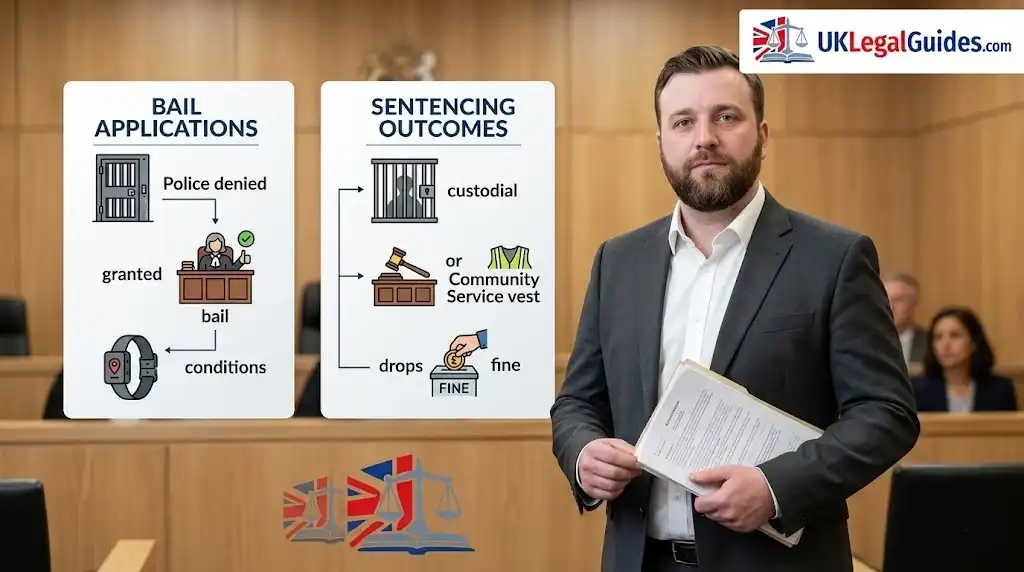
When an individual is convicted of a crime in England and Wales, courts have a range of sentencing options available. One widely used community‑based punishment is an unpaid work requirement, commonly known as Community Payback. Instead of immediate custody, this measure requires an offender to complete a specified number of hours of unpaid work that benefits the local community. The court's decision to impose a Community Payback requirement forms part of a broader community order or suspended sentence order, and is governed by statutory law, sentencing guidelines and judicial discretion.
This article explains how the court evaluates whether to impose a Community Payback requirement, how the number of hours is determined, what factors influence that decision, and how the process works in practice. It is designed to be clear and informative for solicitors, students and members of the public.
What Is a Community Payback Requirement?
Community Payback refers to the delivery of an unpaid work requirement imposed by the court as part of a community sentence. It obliges the offender to undertake projects that benefit local communities, such as clearing graffiti, removing litter, maintaining public spaces or other forms of work that deliver visible restoration. The requirement is managed and delivered by the Probation Service.
An unpaid work requirement is only available as part of a community order or suspended sentence order - it cannot be imposed in isolation outside these frameworks. The court will specify the number of hours, which must be completed within a set period.
Legal Framework: Statute and Sentencing Guidelines
The statutory basis for Community Payback requirements is found in Schedule 9 to the Sentencing Act 2020, which lists the conditions that can be attached to community and suspended sentence orders, including the unpaid work requirement.
In addition, the Sentencing Council's “Imposition of Community and Custodial Sentences” guideline sets out how courts should consider and structure unpaid work requirements alongside other possible conditions on community orders. This includes ranges for hours and relevant factors the court must weigh when making its decision.
When Can a Community Payback Requirement Be Considered?
1. The Offence Must Warrant a Community Sentence
Before a Community Payback requirement can be imposed, the court must decide that a community order or suspended sentence order (as opposed to a fine or immediate custody) is appropriate given the seriousness of the offence and the circumstances of the case. Only then can the court attach one or more requirements, including unpaid work.
2. Suitability of the Offender
The court must be satisfied that the offender is suitable to perform unpaid work. This includes:
- the offender's physical and mental capacity to complete the work;
- whether the offender is in employment at times that could make participation impractical;
- whether they have dependants or other circumstances that may make an unpaid work requirement inappropriate without adjustment;
- any other personal circumstances that would make attendance or participation difficult.
This suitability assessment is often informed by a pre‑sentence report prepared by the Probation Service, which provides the sentencer with background information and risk assessments regarding possible community requirements.
Deciding the Number of Hours
Once the court decides that an unpaid work requirement is appropriate, it must determine how many hours of community work to impose. The Sentencing Council guideline anticipates a range based on the seriousness of the offence and sentencing purpose. Typical ranges include:
- Low seriousness community order: 40 – 80 hours
- Medium seriousness community order: 80 – 150 hours
- High seriousness community order: 150 – 300 hours
These ranges serve as non‑exhaustive examples to help the court identify a proportionate requirement within the statutory limit of 40 to 300 hours.
In practice, the court balances punishment and reparation - the idea that the offender pays back to the community - with practical considerations about the offender's life circumstances to ensure the requirement is reasonable and achievable.
Factors Influencing the Court's Decision
Several considerations influence how the unpaid work requirement is structured:
Punishment and Reparation
Unpaid work is primarily a punitive and reparative measure. It signals that the offender must contribute to community improvements as a consequence of their offending.
Rehabilitation and Skill Development
Although not exclusively rehabilitative, unpaid work can also offer opportunities for skills development, such as learning work discipline or vocational skills, which may reduce the risk of reoffending. Courts may take this potential into account, particularly where it positively supports desistance.
Suitability and Practicality
The court must consider practical aspects of compliance - for example, whether an offender is employed or caring for dependants - and whether a requirement of certain hours within the statutory timeframe is realistic. In cases where work is unsuitable, the court may opt for alternative community requirements.
Probation Input
The Probation Service's assessment can inform the court about local project availability, the offender's ability to complete a requirement within the timeframe, and any bespoke considerations that may affect structured work.
Completion Period
Traditionally, unpaid work requirements were to be completed within 12 months of the date of sentence. Although recent legislative proposals seek to align this timeframe with the overall duration of the community order, the court must still ensure the schedule is feasible when imposing the requirement.
What Happens After the Order Is Made?
Once imposed, the Probation Service notifies the offender of their induction session and schedules work placements. Offenders are usually required to attend sessions on days and times that avoid conflict with existing commitments such as employment. Failure to comply with the requirement can lead to breach proceedings, where the court may impose additional hours, vary the order, or ultimately consider a different sentence.
Participation in unpaid work is monitored by probation supervisors, and offenders typically wear high‑visibility clothing to demonstrate the visibility of the sentence, although wider publicity of identities has been the subject of policy discussion and recent legislative debate.
Practical Example
A court might impose an unpaid work requirement of 120 hours on an individual convicted of criminal damage, finding that a fine alone would not achieve the purposes of punishment and reparation. Before specifying the hours, the judge would consider the offender's employment, health, family responsibilities and input from a pre‑sentence report. The unpaid work would then be scheduled as Community Payback projects supervised by probation staff, designed to benefit local community spaces.
Key Takeaways
A Community Payback requirement is decided through a structured judicial process that integrates statutory authority, sentencing guidelines and individual circumstances. The court first determines that a community sentence is appropriate and that unpaid work is suitable for the offender. It then decides the number of hours - within a statutory range - based on the seriousness of the offence, the offender's circumstances, and probational assessments. Community Payback serves both punitive and reparative purposes and requires coordination with probation to ensure effective delivery and compliance.
