
This guide is maintained as a current resource for September 2026 and covers only the laws of England and Wales. Information is for general guidance, not legal advice. Consult a qualified solicitor for advice specific to your situation.
Explore the role of the Probation Service in sentencing in England and Wales. This comprehensive guide explains pre‑sentence reports, probation assessments, court advice, and how probation input shapes effective and proportionate sentencing decisions.
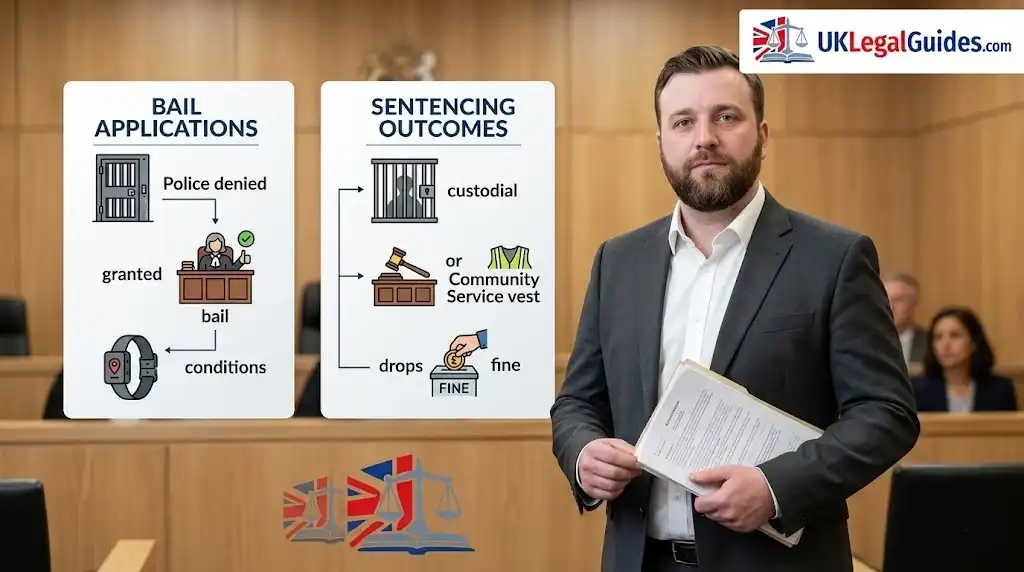
The Probation Service plays a central role in the criminal justice system of England and Wales, particularly in the sentencing stage of a case. Probation practitioners provide courts with important information, assessments and recommendations that influence how a defendant is dealt with following conviction. Their work helps courts to make informed, proportionate and effective sentencing decisions while balancing public protection, punishment and rehabilitation. This article explains the statutory responsibilities, practical processes, and how probation input shapes sentencing outcomes.
Probation and the Sentencing Process
When a person is convicted of a crime, the sentencing court must decide on an appropriate sentence. The court's decision is governed by legal principles such as proportionality - the punishment must fit the crime - and must consider factors such as harm, culpability, personal mitigation and risk. In many cases, particularly where custody is a possibility or where a community sentence might be appropriate, the court relies on pre‑sentence information prepared by the Probation Service to understand the individual before it.
The Probation Service is a statutory criminal justice agency responsible for offender assessment and supervision in the community. In the context of sentencing, its role is primarily advisory and informational - assisting the judge or magistrates with expert analysis of the offender and options for sentence.
Pre‑Sentence Reports: Core Input to Sentencing
What Is a Pre‑Sentence Report?
A pre‑sentence report (PSR) is a detailed assessment prepared by the Probation Service to assist the court in choosing an appropriate disposition following conviction. It is not a form of plea or binding recommendation, but an evidence‑based evaluation of the offender's background, behaviour, risk and needs.
Under Section 30 of the Sentencing Act 2020, courts are expected to request a PSR for most adult offenders unless it is unnecessary in a specific case. PSRs may include:
- Information about the nature and causes of offending;
- Assessment of risk of re‑offending and risk of harm to others;
- Personal, social and economic circumstances (e.g. employment, family support);
- History of past convictions and sentence outcomes;
- Potential sentencing options, such as community orders, rehabilitation requirements or custody.
Probation officers often interview the offender and gather information from other sources such as police, the defendant's family, employers and relevant agencies to prepare a nuanced and balanced report.
Types and Timing of Reports
There are different formats of pre‑sentence reports:
- Standard reports provide a full assessment with detailed analysis;
- Fast delivery reports are prepared quickly when time is limited;
- Oral reports may be given directly in court where circumstances permit.
The report must be available to the court in time to influence the sentencing decision. Judges and magistrates may postpone sentencing if the report is not ready, recognising its importance in fulfilling the court's duty to impose a fair and tailored sentence.
Probation Advice and Recommendations
Content and Purpose
A PSR does more than list facts; it offers probation advice on interventions that may reduce re‑offending, protect the public and address underlying issues. These can include suggestions for:
- Community orders with specific requirements (e.g. unpaid work, treatment programmes);
- Suspended sentences with supervision and rehabilitation activities;
- Custodial sentences, where risks and circumstances make community measures unsuitable.
Probation recommendations are based on professional assessment of risk, needs and the potential effectiveness of different sentence options. The aim is to help courts balance punishment, public protection and rehabilitation.
Influence on Sentencing Decisions
Although probation reports are advisory, they are often influential. Judges and magistrates rely on the professional assessment to:
- Understand the individual circumstances that may aggravate or mitigate a sentence;
- Determine whether an offender is a suitable candidate for community supervision;
- Decide on appropriate requirements or licence conditions attached to a community or custodial sentence.
Statistical evidence indicates that sentences accompanied by PSRs, particularly fast delivery or oral reports, are associated with higher completion rates of court orders, suggesting that better‑informed sentencing contributes to more effective outcomes.
The Probation Officer's Role at Court
Probation officers often appear in court to present findings and recommendations orally, especially where immediate sentencing follows. Their role includes:
- Explaining complex assessments in clear, structured terms;
- Clarifying risk levels and public safety considerations;
- Discussing the offender's potential for rehabilitation and the support needed.
This courtroom role complements written reports and ensures that the judge has access to authoritative and timely interpretation of the individual's risks and needs.
Supervision and Enforcement After Sentencing
While the core focus at sentencing is on assessment and advice, the Probation Service also manages orders after they are imposed. For community sentences or licences attached to custodial sentences, probation practitioners:
- Supervise compliance with court orders such as unpaid work, rehabilitation activities, abstinence from substances, or curfews;
- Monitor risk of re‑offending and safety concerns in the community;
- Work with the offender to address underlying criminogenic needs (e.g. substance misuse, unemployment, housing instability);
- Report non‑compliance to courts, which can trigger enforcement proceedings or transitions to more stringent sanctions.
Though this supervisory role post‑sentencing is distinct from input at sentencing, it reflects the continuity of probation involvement across the life of a criminal justice order.
Practical Considerations and Challenges
Balancing Risks and Rehabilitation
Probation assessment must weigh public protection against the advantages of non‑custodial sentences. This is a complex task requiring professional judgement, informed by structured tools and training.
Resource and Capacity Issues
Probation services sometimes face heavy caseloads and resource limitations, which can affect timescales for producing reports and supervising orders. This has been highlighted by independent inspectors and commentators concerned about public protection and quality of assessments.
Despite these challenges, probation practitioners remain integral to delivering informed and balanced sentencing decisions.
Key Takeaways
- The Probation Service plays a key role in sentencing by providing objective, expert information and recommendations to courts, primarily through pre‑sentence reports.
- Pre‑sentence reports assess the offender's circumstances, risk and rehabilitation needs, helping judges and magistrates choose appropriate sentences that reflect legal principles and public safety.
- Probation officers may present oral reports in court and advise on potential requirements such as community supervision or rehabilitative interventions.
- Beyond sentencing, probation supervises community orders and licence conditions, supporting compliance and reducing re‑offending.
- Effective probation involvement helps courts balance punishment with rehabilitation and promotes safer, fairer outcomes.
