
This guide is maintained as a current resource for September 2026 and covers only the laws of England and Wales. Information is for general guidance, not legal advice. Consult a qualified solicitor for advice specific to your situation.
A comprehensive guide to the criminal process in England and Wales from arrest through bail or remand, court hearings, trial, sentencing and release. Learn how bail decisions are taken, how trials proceed, what influences sentencing and how sentences are served and credited. Essential overview for defendants, solicitors and the public.
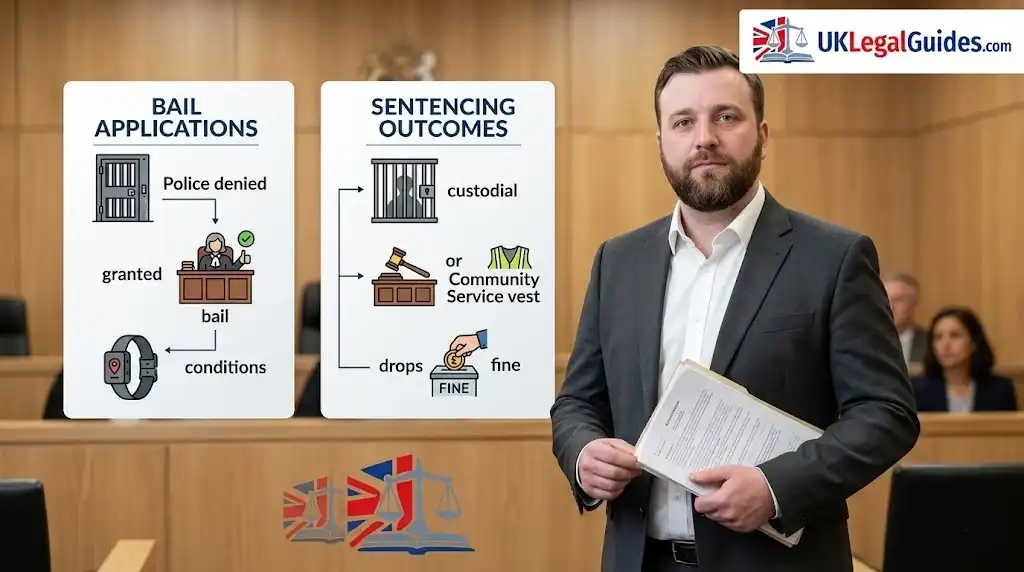
When someone is suspected of committing a crime in England and Wales, the criminal justice process involves a sequence of legal steps from arrest through bail or remand, then through court hearings and sentencing, and ultimately to release. Understanding these stages helps defendants, families, solicitors and the public know how the system operates, what rights and obligations apply, and what practical events will unfold. This article explains the key stages clearly and accurately, drawing on current law and practice.
1. Arrest and Initial Custody
Arrest
The process typically begins with an arrest by the police on suspicion of a criminal offence. Police officers must have reasonable grounds to suspect a person has committed an offence before arresting them. Upon arrest, suspects are taken to a police custody suite for detention and questioning.
Rights in Custody
At the custody stage, individuals are informed of their rights, including the right to legal advice and the right to make a phone call. Custody officers must ensure detainees understand why they are being held and what will happen next.
2. Charging Decisions and Pre‑Charge Bail
Charging or Release
After arrest and initial interview, the police decide whether to charge a suspect with an offence. If there is insufficient evidence to charge immediately, the police may:
- Release the suspect without charge, with no further conditions, or
- Release the suspect on pre‑charge bail, requiring them to return to the police station at a later date while further enquiries continue.
Pre‑charge bail may include conditions intended to prevent interference with the investigation, such as reporting to a station or non‑contact with alleged victims, although conditions are subject to legal tests of necessity and proportionality.
If a suspect is not charged by the end of a lawful detention period, they must generally be released, either with or without bail.
3. First Court Appearance and Bail or Remand
Charge and First Hearing
If a suspect is charged with an offence, the case moves to the magistrates' court for the first hearing. At this hearing:
- The charge is formally read.
- The defendant enters a plea (guilty or not guilty).
- The court decides whether to grant bail or remand them in custody until the next hearing.
Bail Considerations
Under the Bail Act 1976, the law establishes a general right to bail at first appearance unless exceptions apply (for example in serious offences such as murder). Courts and police must articulate reasons if they refuse bail or impose conditions to manage risk.
If bail is granted, the defendant is free pending trial or further hearings but must comply with any conditions.
Remand
If bail is refused - because of risk of failing to appear, risk to the public, or interfering with witnesses or evidence - the court may remand the defendant in custody. Remand can also occur if the defendant is already serving a sentence and must be brought before the court for related proceedings.
4. Pre‑Trial and Case Management
Further Hearings and Preparations
Once bail or remand is decided, the case proceeds through a series of preliminary hearings, where matters such as disclosure of evidence, legal challenges, and preparation work are undertaken by the prosecution and defence. The Criminal Procedure Rules set out procedural steps courts follow.
Some cases, such as minor summary offences, may be dealt with through procedures such as the single justice procedure without a full court hearing.
Pre‑Trial Bail Reviews
At subsequent hearings, both defence and prosecution can renew bail applications, and courts must review bail if circumstances change or if previous bail conditions become questionable.
5. Trial or Plea Hearing
Guilty Plea
A defendant may plead guilty at an early hearing. If a guilty plea is entered, the court may proceed to sentencing at the same hearing or adjourn to obtain reports (such as a pre‑sentence report) to assist in sentencing.
Trial
If a defendant pleads not guilty, the case may proceed to trial:
- In the magistrates' court for less serious cases.
- In the Crown Court, especially for more serious or indictable offences.
Trial involves the prosecution presenting evidence, witnesses giving testimony, and the defence challenging the prosecution case, before a conviction or acquittal is reached.
6. Sentencing
Factors Considered
If convicted - whether by plea or after trial - the court must impose a sentence appropriate to the offence and the individual, having regard to sentencing principles in statute and relevant sentencing guidelines.
Courts must consider factors such as the seriousness of the offence, any mitigating factors (for example, a guilty plea), and the defendant's background and previous record.
If the defendant was on bail before conviction, the court may also consider credit for time spent on bail with conditions, such as electronic monitoring, in calculating the final sentence.
Types of Sentences
Sentences can include:
- Custodial sentences (prison),
- Community orders,
- Fines,
- Ancillary orders, including compensation or disqualification.
Many modern reforms aim to use community measures where appropriate and to tailor release conditions to balance rehabilitation with public protection.
7. Release and Post‑Sentence Processes
Serving a Sentence
After sentencing, the defendant will begin serving the sentence imposed. For custodial sentences, this may involve:
- Serving a specified portion in prison, and
- Being released on licence or parole subject to conditions, depending on the length and type of sentence and statutory rules. Recent reforms under the Sentencing Act 2026 and other law may affect release mechanisms.
Credit for Time on Remand
Time spent on remand - whether in custody or on bail subject to electronically monitored conditions - may count toward the sentence. Courts must direct how such time is credited when passing sentence.
Post‑Sentence Supervision
After release, some offenders are subject to supervision, licences, or monitoring. Breach of post‑release conditions can lead to recall to prison or further sanctions.
Common Questions
What if bail conditions are breached?
A breach of bail conditions can lead to re‑arrest and a bail review or remand. Some breaches may also be offences in their own right. Courts may consider stricter conditions or custody on review.
How long before sentencing?
Time between arrest, charge and sentence varies considerably depending on complexity, plea, and court scheduling. Minor cases can be resolved quickly, while serious indictable cases may take months of preparation and trial.
Can time spent on remand reduce sentence?
Yes. Time spent on remand may be credited towards the final sentence, subject to statutory rules and the type of remand (e.g. custody, bail with electronic monitoring).
Key Takeaways
From arrest to release, the key stages in bail and sentencing in England and Wales form a structured criminal justice process. It begins with arrest and custody, moves through charging decisions, bail or remand, then through court hearings, trial or plea and, if convicted, sentencing. After sentencing, individuals serve their sentence and may be released under supervision or licence with conditions. Throughout this process, legal rights, statutory tests for bail, and sentencing criteria apply, ensuring fair adjudication and the proper administration of justice.
