
This guide is maintained as a current resource for September 2026 and covers only the laws of England and Wales. Information is for general guidance, not legal advice. Consult a qualified solicitor for advice specific to your situation.
A clear, step‑by‑step guide to bail in England and Wales. Learn what bail is, how courts assess bail applications, the legal tests and conditions, what happens if bail is refused or breached, and how bail decisions affect defendants, victims and the justice process.
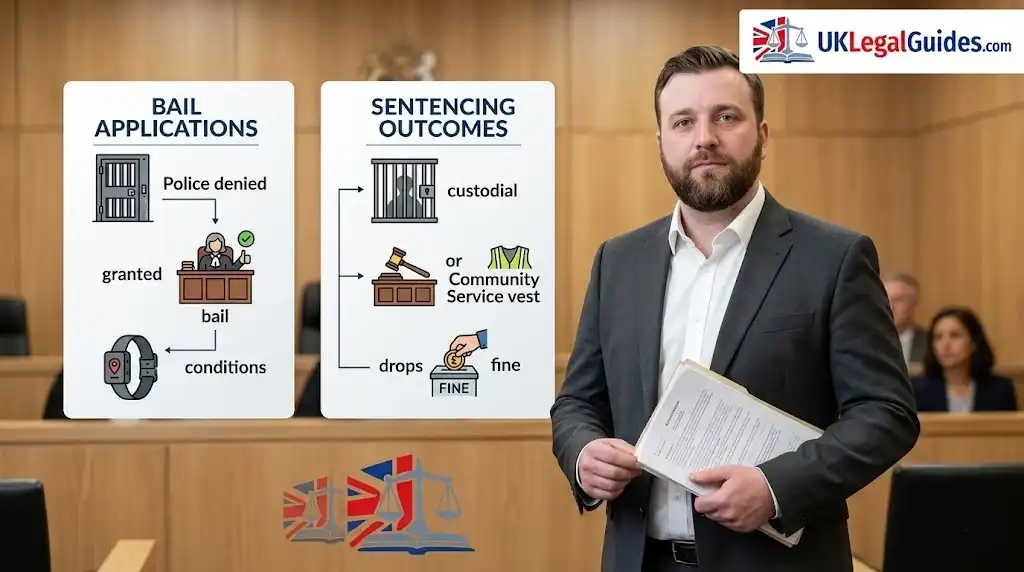
Bail is a legal mechanism in criminal law that determines whether a person charged with an offence may remain at liberty while their case proceeds through the justice system. It balances the legal presumption of innocence with public safety and the administration of justice. In England and Wales, bail decisions arise both at the police stage and in court, and the law that governs these decisions sets out clear criteria, rights and procedures. This article explains what bail is, how it works, how courts decide on bail, the conditions that may be imposed, and what happens if bail is breached.
What Bail Is
Bail means allowing a person who has been charged with a criminal offence to stay out of custody while they await their next court hearing or trial. Bail can be granted by the police or by a court. The purpose of bail is to ensure that those accused of crimes can prepare their case, maintain personal responsibilities, and return to court when required, unless there is good reason to refuse it.
The legal right to bail for people brought before a court is founded in the Bail Act 1976. Generally, there is a presumption in favour of bail unless there are specific legal reasons to refuse it.
Bail by the Police
Before a defendant appears in court, the police may grant pre‑charge bail or post‑charge bail:
- Pre‑charge bail is used when the police have arrested a suspect but have not yet made a charging decision. Bail can be granted to allow further investigation outside custody.
- Post‑charge bail follows a decision to charge and allows the person to remain out of custody until their first court appearance.
Police bail may be limited by statutory time frames and must be justified as necessary and proportionate in all the circumstances, including considerations such as whether it helps ensure the suspect returns to custody or protects victims and witnesses.
Conditions can be attached to police bail, such as requiring an individual to live at a certain address, report to a police station at specified times, or surrender their passport to prevent travel abroad.
Bail in Court
Once a person has been charged and appears before a magistrates' court, youth court or Crown Court, the court decides whether to grant bail. Bail at this stage is often referred to as court bail.
The Presumption and Legal Right to Bail
Under section 4 of the Bail Act 1976, a person appearing before a court generally has a right to bail unless exceptions apply. This reflects the fundamental principle that liberty should not be withheld without justification.
However, this right is not absolute. The court may refuse bail if there are grounds to believe that:
- the person might fail to surrender to custody (fail to attend court when required),
- there is a real risk of re‑offending while on bail,
- they might interfere with witnesses or evidence, or
- there are other substantial concerns that justify detention. These are set out in Schedule 1 of the Bail Act 1976.
For certain serious offences, such as murder, the court's ability to grant bail is further restricted by statute.
How a Court Decides Whether to Grant Bail
When considering a bail application, the court follows a structured approach:
- Lawful Right to Bail – First, the court establishes whether the defendant has a statutory right to bail or whether exceptions apply.
- Risk Assessment – The judge or magistrates consider material factors, including the defendant's past conduct, criminal history, previous bail compliance, and likelihood of attending court.
- Public Safety and Justice Considerations – The court must balance individual liberty with the need to protect the public, uphold confidence in the justice system and prevent further offences.
- Conditions to Address Risks – If risks are identified, the court may impose conditions rather than refuse bail outright. Conditions must be necessary and proportionate to mitigate the risks.
The court may grant:
- Unconditional bail – release without further requirements other than attending court;
- Conditional bail – release subject to conditions such as reporting to police, abiding by a curfew, or staying away from certain individuals or locations.
Common Bail Conditions
Conditions are tailored to address specific risks while enabling the defendant to live in the community. Typical conditions include:
- Reporting to a police station at regular intervals.
- Curfews with or without electronic monitoring.
- Residence requirements, ensuring the defendant remains at an address approved by the court.
- Non‑contact orders, such as not contacting victims, witnesses or associates.
Conditions must be reasonable, proportionate and capable of enforcement. They should address the specific reasons that bail might otherwise be refused.
Breach of Bail
Failing to comply with bail conditions can lead to serious consequences:
- Breach of bail can result in arrest and subsequent revocation of bail.
- Breach itself is a separate offence under section 6 of the Bail Act 1976, punishable by fine or imprisonment.
When a breach occurs, the court may remand the defendant in custody or re‑grant bail, potentially with stricter conditions.
Bail if Refused by the Court
If bail is refused, the defendant remains in custody until the next hearing. The defendant or their legal representative can make further applications for bail at subsequent hearings. The court must reconsider bail at each appearance unless the case has been concluded or a bail decision has been reserved for specific reasons.
In some circumstances, refusal decisions can be appealed to the Crown Court or higher appellate courts, particularly where there is a contention that the refusal was unlawful or disproportionate.
Special Considerations for Young People
The Bail Act 1976 applies to youths as well as adults, but courts also consider welfare factors when deciding bail for minors. In addition to usual criteria, courts may impose conditions in the best interests of a young person and consider alternative secure accommodation when appropriate.
Key Takeaways
Bail in England and Wales is a legal process that allows an accused person to remain out of custody while their case progresses through the criminal justice system. There is a statutory presumption in favour of bail, but this can be overridden where the court finds substantial risk to justice, public safety, or the defendant's attendance at court. Bail may be granted with or without conditions tailored to address specific risks. Failure to comply with bail conditions can lead to arrest, revocation of bail, or separate criminal charges. Understanding bail rights and processes helps defendants and their representatives navigate the criminal justice system and make informed decisions.
