
This guide is maintained as a current resource for September 2026 and covers only the laws of England and Wales. Information is for general guidance, not legal advice. Consult a qualified solicitor for advice specific to your situation.
Learn how minimum and maximum sentences are determined in the UK legal system. This article explains how statutory laws, sentencing guidelines, and judicial discretion play a role in setting appropriate penalties for various criminal offences.
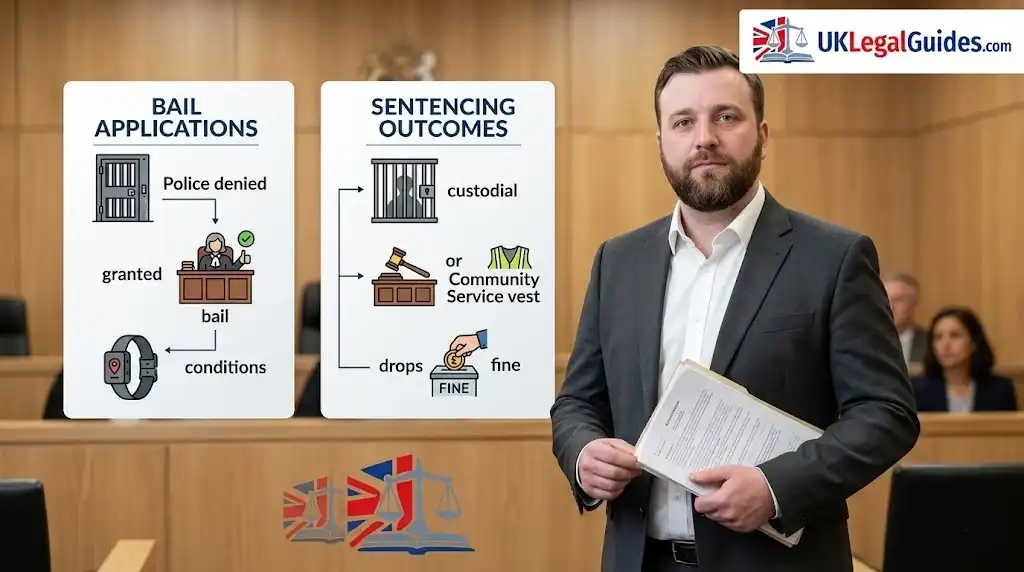
In the UK legal system, sentencing for criminal offences is governed by a set of rules and guidelines that help ensure fairness and consistency in punishing offenders. When a defendant is found guilty, one of the most crucial elements of the sentence is its length, which is determined by both minimum and maximum sentence limits. These sentence limits are crucial because they guide the judge in setting a penalty that is both proportional to the crime and within the legal framework established by Parliament.
This article explains how minimum and maximum sentences are determined in the UK, covering statutory provisions, judicial discretion, and how various factors influence sentencing decisions.
What Are Minimum and Maximum Sentences?
- Minimum sentences are the shortest period an offender can be sentenced to for a particular crime. Some offences carry a mandatory minimum sentence, meaning the court must impose a minimum penalty, regardless of the offender's background or circumstances.
- Maximum sentences are the longest sentence an offender can face for a specific offence. These can vary greatly depending on the crime and the circumstances surrounding it.
These sentences are set to ensure that the punishment is consistent with the seriousness of the offence, while also allowing room for discretion, ensuring the judge's decision is fair and appropriate to the circumstances of each case.
How Are Minimum Sentences Determined?
Minimum sentences are primarily determined by Parliamentary legislation. Certain serious offences carry mandatory minimum sentences, meaning that the judge cannot impose a sentence below a certain level. These minimum sentences are usually set to ensure that offenders face a significant penalty for serious crimes.
1. Statutory Minimum Sentences for Specific Crimes
Certain crimes, particularly violent offences and crimes involving firearms, carry mandatory minimum sentences. For example:
- Murder: A mandatory life sentence is required, but the minimum term (the period the offender must serve before being eligible for parole) can vary depending on the case, such as a 25-year minimum for some types of murder.
- Serious Offences Involving Firearms: The Firearms Act 1968 sets out mandatory minimum sentences for possession of a firearm with intent to commit certain crimes, such as robbery, where offenders can face a mandatory 5-year sentence.
- Three-Strikes Rule: Under the Criminal Justice Act 2003, certain repeat offenders who are convicted of specified offences, such as burglary, may face minimum sentences after multiple convictions. For example, a third conviction for a burglary can result in a mandatory minimum sentence of 3 years in prison.
These laws ensure that offenders who commit specific crimes receive a prescribed minimum penalty, regardless of individual circumstances. However, there are limited circumstances in which a judge can reduce the minimum sentence, such as where there are exceptional mitigating factors.
2. Judicial Discretion and Exceptional Circumstances
Even when a mandatory minimum sentence applies, judges have the discretion to reduce the sentence in exceptional cases. For example, if the defendant has shown significant remorse, or if the crime was committed under extreme provocation or duress, the judge can exercise their discretion.
How Are Maximum Sentences Determined?
Maximum sentences are set by Parliament and are based on the nature of the offence, the harm caused, and the intent behind the crime. They reflect the most severe punishment available for specific crimes and provide a limit beyond which the court cannot go. However, a judge can impose a lower sentence within that range depending on the circumstances.
1. Statutory Maximum Sentences
Each offence has a maximum sentence outlined in law, often in the Criminal Justice Act 1988 or other relevant statutes. For example:
- Murder: Life imprisonment is the maximum sentence, but judges determine the minimum term, which is the period before parole eligibility. In most cases, it is 25 years, but this can vary depending on the type of murder.
- Theft: For theft, the maximum sentence is 7 years imprisonment, though a judge may impose a sentence far lower based on factors like the value of the stolen property, the offender's background, and the impact on the victim.
2. Sentencing Guidelines
Judges are also guided by sentencing guidelines provided by the Sentencing Council for England and Wales. These guidelines break down offences into different categories of seriousness and provide a range of sentences within which the judge can make their decision. These ranges take into account various aggravating and mitigating factors, such as:
- The defendant’s previous criminal record.
- Whether the offence was committed in a planned manner or was a spontaneous act.
- The impact of the crime on the victim, especially in violent crimes or crimes causing significant harm.
3. Judicial Discretion
While the maximum sentence is set by law, judges have significant discretion when deciding where within the maximum range a sentence should fall. Factors that influence this discretion include:
- Mitigating Factors: The offender's background, such as mental health issues, or whether they were under duress at the time of the crime.
- Aggravating Factors: If the crime was committed in a particularly violent manner or was premeditated.
- Rehabilitation Potential: The court will also consider whether the offender is likely to benefit from rehabilitation or whether a custodial sentence is necessary to protect the public.
Why Are Minimum and Maximum Sentences Important?
1. Consistency in Sentencing
Minimum and maximum sentences ensure uniformity in how offenders are punished for the same type of crime. Without these limits, judges might be more likely to impose inconsistent or unfair sentences based on personal biases or perceptions.
2. Public Confidence
Setting minimum and maximum sentences provides clarity about the consequences of criminal behaviour. It also ensures that the public has confidence that the justice system is fair, transparent, and consistent.
3. Discretion and Flexibility
While minimum sentences help ensure that offenders face significant penalties, the discretion judges are given with maximum sentences allows them to tailor the penalty to the circumstances of the crime. This balance between consistency and flexibility is key to ensuring fairness in the system.
Final Thoughts
In the UK, minimum and maximum sentences are vital elements in the criminal justice system. Minimum sentences are determined by statutes and apply to specific serious crimes, often leaving judges with limited room for discretion. Maximum sentences, on the other hand, are set for each offence and allow judges to impose penalties within a specified range based on the severity of the crime and the circumstances of the offender.
By understanding how these sentences are determined, the public, solicitors, and offenders can better navigate the complexities of criminal law and the sentencing process.
