
This guide is maintained as a current resource for September 2026 and covers only the laws of England and Wales. Information is for general guidance, not legal advice. Consult a qualified solicitor for advice specific to your situation.
Comprehensive guide to how courts apply sentencing guidelines in England and Wales, including the role of the Sentencing Council, step‑by‑step decision process, judicial discretion, pre‑sentence reports and how sentencing ranges are adjusted in practice.
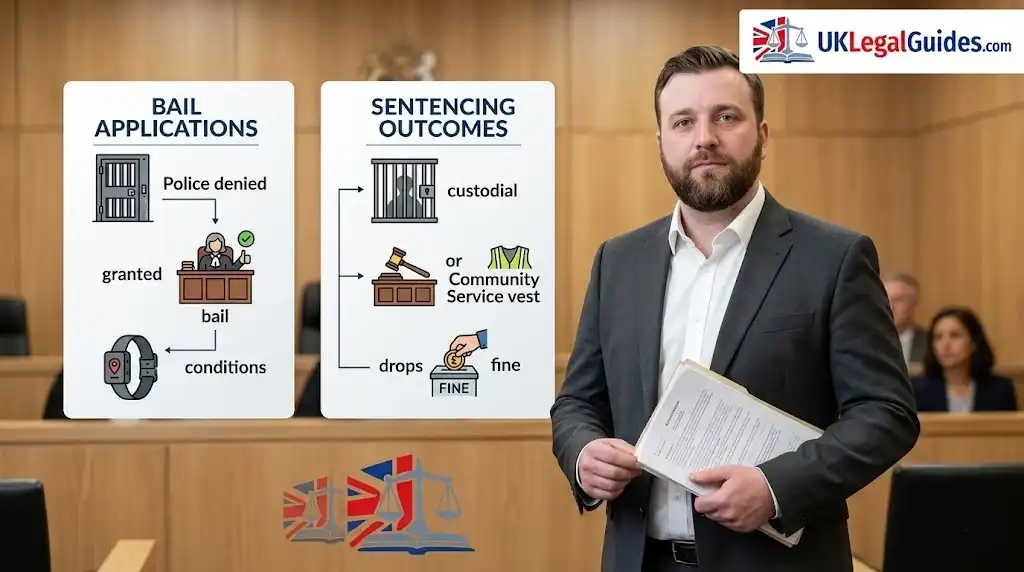
Sentencing is a central part of the criminal justice system in England and Wales. When a person is convicted of a criminal offence, courts must decide what punishment or corrective action is appropriate. To promote consistency, transparency and proportionality, judges and magistrates use sentencing guidelines produced by the Sentencing Council. These guidelines help courts translate statutory objectives and legal limits into practical sentencing decisions.
This article explains what sentencing guidelines are, the legal basis for their use, how courts apply them step by step, how discretion works, and common questions about their role in modern sentencing. It is designed to be accessible to non‑experts while remaining accurate for solicitors.
What Are Sentencing Guidelines?
Sentencing guidelines are structured frameworks that guide courts in choosing appropriate sentences for criminal offences. They are published by the Sentencing Council for England and Wales, an independent body established under the Coroners and Justice Act 2009 to improve transparency, consistency and public understanding of sentencing practices.
There are:
- Offence‑specific guidelines – which set out steps for particular types of crime (e.g. violence, fraud or sexual offences);
- Overarching and general guidelines – which apply across all offences, including principles such as culpability, harm and mitigation; and
- Specialised guidelines – for groups such as children and young people.
Where no specific guideline applies, courts use the General Guideline: overarching principles, often alongside relevant Court of Appeal judgments, to structure sentencing.
Legal Basis and Mandatory Application
The Sentencing Code requires that every court must follow any relevant sentencing guideline when sentencing an offender, unless it would be “contrary to the interests of justice” to do so. If a court decides to depart from a guideline range, it must give clear reasons for doing so in open court.
This statutory obligation ensures that sentencing is not arbitrary and that similar cases are treated similarly, improving fairness and public confidence.
Step‑by‑Step: How Courts Apply Sentencing Guidelines
1. Identify the Relevant Offence and Guideline
The first step in court is to determine the offence for which the defendant has been convicted and the corresponding guideline. Courts consult the Sentencing Council's database to locate the definitive guideline relevant to:
- The specific offence; and
- Any broader principles that may apply.
If a definitive guideline does not exist for an offence, the General guideline and relevant Court of Appeal decisions help structure the decision.
2. Assess the Seriousness of the Offence
Most sentencing guidelines ask the court to assess the seriousness of the offence by considering harm caused and the offender's culpability. These key factors determine a starting point and an appropriate range within the guideline.
For example, health and safety sentencing guidelines categorise harm levels from low to high and define culpability from low to very high, with corresponding sentence recommendations.
3. Identify Aggravating and Mitigating Factors
Once the guideline range is established, the court considers aggravating factors, such as:
- Violence used in the offence;
- Targeting a vulnerable victim;
- Previous convictions.
And mitigating factors, such as:
- Early guilty plea;
- Youth or mental health issues;
- Remorse and cooperation.
These factors adjust the sentence towards the higher or lower end of the guideline range.
4. Consider Guilty Plea Reductions and Other Discounts
Sentencing guidelines and the Sentencing Code require courts to consider reductions for guilty pleas. The earlier the plea, the greater the reduction in sentence in recognition of saving court time and sparing victims from trial.
Other statutory provisions, including time already spent in custody on remand, may also influence the final sentence.
5. Apply Ancillary Orders
After determining the sentence, the court considers whether ancillary orders are needed, such as:
- Compensation orders for victims;
- Forfeiture or deprivation orders;
- Licences or supervision conditions in community sentences.
These help implement the broader purposes of punishment and reparation.
6. Record Reasons in Open Court
Courts must give reasons for their sentencing decisions, particularly where they depart from guideline recommendations. This transparency supports appealability and public understanding.
Judicial Discretion and the “Interest of Justice”
While sentencing guidelines are mandatory, courts retain discretion. If a guideline does not fit the circumstances of a case, the court can depart from it if applying the guideline would be contrary to the interests of justice. In such cases, the judge must explain why a departure was necessary.
This ensures flexibility where rigid application might lead to disproportionate outcomes, for example in rare or highly unusual cases.
The Role of Pre‑Sentence Reports
Pre‑sentence reports (PSRs) prepared by probation officers inform courts about the offender's background, circumstances and rehabilitation prospects. Courts are under a statutory requirement to request and consider PSRs except where they consider them unnecessary.
Guidelines may advise when PSRs are particularly helpful - for example where custody is possible or where personal circumstances may affect rehabilitation.
Practical Context and Examples
Example 1: Assault Offence
A guideline for assault may set ranges based on harm and culpability. A mid‑range sentence could then be adjusted upwards if the victim was vulnerable, or downwards if the offender showed genuine remorse and pleaded guilty early.
Example 2: Fraud Offence
In fraud cases, courts examine financial loss, sophistication of offending and breach of trust to set an appropriate guideline category before adjusting for personal factors.
In every case, reasons are recorded and, if the guideline range is not strictly followed, the court explains departures clearly.
Common Questions
Are courts legally bound by guidelines?
Yes. Courts must follow relevant sentencing guidelines unless it would be contrary to the interests of justice. Reasons must be given for departures.
Do guidelines determine the sentence exactly?
No. Guidelines provide structured ranges and factors to consider. Judicial discretion, personal mitigation and statutory factors influence the final sentence.
What happens if no guideline exists?
The court uses the General guideline and Court of Appeal precedent to structure its approach.
Key Takeaways
In England and Wales, sentencing guidelines play a central role in helping courts apply criminal sanctions consistently and transparently. Produced by the independent Sentencing Council, these guidelines guide judges through structured steps. Courts assess seriousness, adjust for aggravating and mitigating factors, consider guilty plea discounts, and impose appropriate sentences while respecting statutory limits. Guidelines are mandatory unless it is unjust to apply them, ensuring both consistency and flexibility in sentencing. Understanding how courts apply these frameworks helps readers appreciate how sentencing balances legal standards, individual circumstances and wider societal goals.
