
This guide is maintained as a current resource for September 2026 and covers only the laws of England and Wales. Information is for general guidance, not legal advice. Consult a qualified solicitor for advice specific to your situation.
A detailed guide to challenging unfair standard terms in consumer contracts under English and Welsh law, explaining your rights under the Consumer Rights Act 2015, practical steps for complaints and dispute resolution, the role of enforcement bodies, and what happens in court.
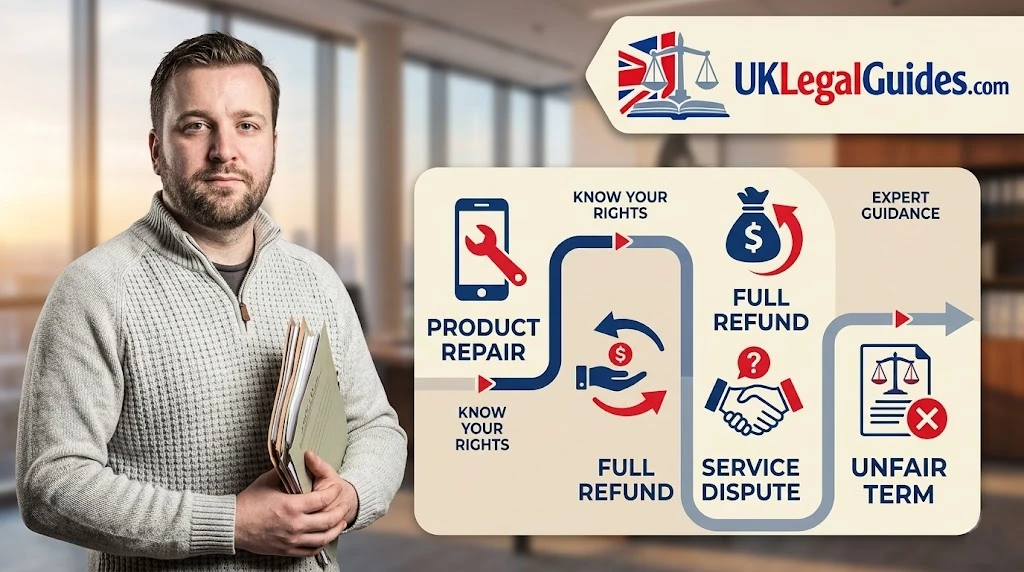
Standard terms are clauses in consumer contracts prepared in advance by businesses and presented to consumers on a “take it or leave it” basis. While most terms are lawful, some may be unfair, giving the business an unbalanced advantage and disadvantaging the consumer. In England and Wales, the Consumer Rights Act 2015 (CRA) governs how such terms are assessed and enforced. This article explains how consumers can identify potentially unfair terms and the practical routes available to challenge them, including complaints, alternative dispute resolution, and court action. It also covers time limits, risks, and how different bodies such as the Competition and Markets Authority (CMA) and courts play a role in disputes over unfair terms.
What Makes a Term Unfair?
Under the CRA, a term may be unfair if it creates a significant imbalance between the rights and obligations of the trader and the consumer to the consumer's detriment. Such terms must also fail the test of good faith, meaning they are not written and agreed fairly and openly. Terms that are both transparent and prominent (for example, clear pricing) are generally exempt from the fairness test.
Examples of potentially unfair terms include clauses that:
- Permit a business to unilaterally increase prices after the contract is agreed;
- Require automatic renewal without giving a reasonable right to cancel;
- Impose excessive cancellation fees or penalties;
- Limit or exclude liability for poor service or defective goods to an unreasonable extent; or
- Bind consumers to hidden or unclear provisions.
Understanding whether a term is unfair requires considering the full context of the contract and the specific clause in question.
Step‑by‑Step: Challenging Unfair Terms
1. Read Your Contract Carefully
Begin by reviewing the contract's terms and conditions. Identify the clauses you believe are unfair, particularly those affecting your financial obligations, cancellation rights, or legal remedies. Terms must be in plain and intelligible language; unclear wording may itself be evidence of unfairness.
2. Raise the Issue Directly with the Business
Your first practical step is to contact the trader in writing:
- Explain which term you consider unfair and why (for example, it imposes a disproportionate penalty);
- State how you believe it affects your rights or obligations; and
- Request that the business amend or remove the term in relation to your contract.
The business may be unaware of the issue or may agree to adjust its terms rather than face further dispute.
3. Use Established Complaints and Dispute Resolution Routes
If the business refuses to amend or remove the term:
- Consider making a formal complaint under the trader's internal complaints procedure;
- Use alternative dispute resolution (ADR) schemes if one is available in your sector, such as an Ombudsman service; or
- In financial services contracts, you may report the term to the Financial Conduct Authority (FCA), which has powers to challenge unfair or unclear terms.
ADR can be quicker and less costly than court action and may result in an independent determination or recommendation that the term should not be applied.
4. Report to Enforcement Bodies
Consumers can report unfair terms to enforcement bodies that monitor compliance with consumer protection law:
- The Competition and Markets Authority (CMA) supports action against unfair contract terms and can investigate systemic issues in a business's terms;
- Local Trading Standards offices also have powers to enforce consumer rights and may take action to stop the use of unfair terms.
These bodies may engage with the trader on your behalf or take broader action that benefits other consumers.
5. Court Action
If the business continues to enforce the term and it affects your rights or leads to a financial loss, you can consider court action:
- Citizens Advice and Which? consumer guidance note that if the dispute involves money you believe you are owed, you may need to pursue the matter in court.
- In England and Wales, claims under a certain threshold may be brought in the small claims court. If the sum involved is larger, the normal civil court process applies.
- When a court decides if a term is unfair, it has the power to declare the term not binding on the consumer, meaning it cannot be enforced. The rest of the contract may still stand if it remains workable without the unfair term.
Before initiating court proceedings, ensure you are clear on time limits, court costs, and the strength of your evidence, as well as whether legal advice or representation is needed.
Time Limits and Practical Considerations
There is no specific deadline solely for challenging an unfair term, but procedural time limits apply when taking action in court or making claims for compensation or refunds. You should act promptly once you become aware of the issue.
Record all communications with the business, invoices, and copies of the contract. This documentation will support any claim you make, whether through complaint channels, enforcement bodies, or the courts.
Be aware that if you accept a term or continue to pay under it without objection, a business may argue that you have accepted the contractual terms. Clearly articulating your objection early in writing strengthens your position.
Risks and Limitations
Challenging unfair terms can be straightforward in principle, but there are potential challenges:
- Only courts can ultimately determine whether a term is unfair; enforcement bodies can influence but not make binding legal judgments.
- If you pursue court action, you may face legal costs, though in small claims this is usually limited; disputes above the small claims limit may involve more complex procedures and potentially solicitor involvement.
- Some “core” terms (such as pricing or the main subject matter of the contract) are exempt from the fairness test if they are prominent and transparent.
Common Questions
Can I simply ignore an unfair term?
No. Ignoring a term without formally challenging it may weaken your position. Follow a structured challenge process and consider formal complaint or court action if necessary.
Will the term be removed from the contract entirely?
If a court rules a term unfair, that term is not binding on you. The rest of the contract may continue if it remains practical without the unfair clause.
Can enforcement bodies act on my behalf?
Enforcement bodies like the CMA or Trading Standards can investigate and take action against systemic unfair terms, but they may prioritise cases with wider consumer impact.
Final Thoughts
Challenging unfair standard terms in consumer contracts involves understanding your rights under the Consumer Rights Act 2015, identifying problematic clauses, and following a structured approach to dispute resolution. Start by communicating with the business, utilise complaints and ADR schemes, report issues to enforcement bodies, and consider court action where appropriate. Acting promptly and keeping clear records improves your chances of a successful outcome. Challenging unfair terms not only protects your own rights but can contribute to broader improvements in business practices.
