
This guide is maintained as a current resource for September 2026 and covers only the laws of England and Wales. Information is for general guidance, not legal advice. Consult a qualified solicitor for advice specific to your situation.
Learn how to return faulty goods in England and Wales. This guide explains your legal rights, refund rules, repair processes, time limits, and how to take action under the Consumer Rights Act 2015.
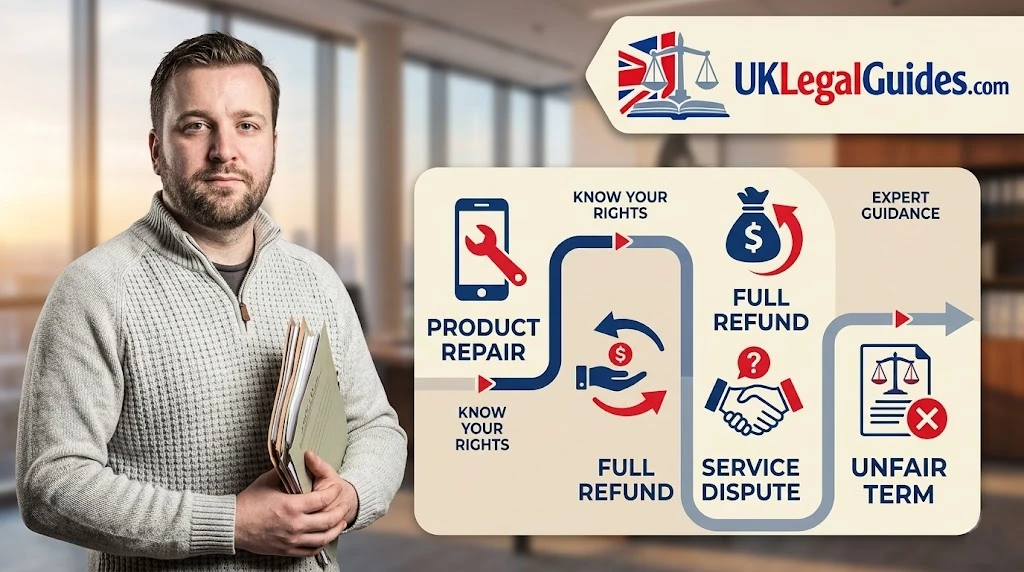
Returning faulty goods is a common issue faced by consumers, yet the legal process can appear unclear. In England and Wales, the return of defective products is governed primarily by the Consumer Rights Act 2015, supported by related regulations such as the Consumer Contracts Regulations 2013.
This guide explains, step by step, how to return faulty goods, what legal rights apply, what procedures should be followed, and what to do if a retailer refuses to cooperate. It is intended to provide a clear and practical understanding of the law while maintaining accuracy for more advanced readers.
What Qualifies as Faulty Goods?
Before returning an item, it is important to confirm that it meets the legal definition of “faulty”.
Goods are considered faulty if they are:
- Not of satisfactory quality
- Not fit for purpose
- Not as described
Examples include:
- A kettle that stops working after a short period
- Clothing that arrives damaged
- Electronics that do not match advertised specifications
Consumers do not have rights if:
- The fault was disclosed before purchase
- The issue is caused by misuse, wear and tear, or accidental damage
Step 1: Act Quickly and Identify Your Legal Position
The process for returning faulty goods depends heavily on timing.
Within 30 Days of Purchase
You usually have the right to reject the goods and claim a full refund.
- This applies whether the item was bought in-store or online
- You are not required to accept a repair or replacement during this period
A retailer must provide a refund if the goods are faulty, not as described, or unfit for purpose
After 30 Days
You lose the automatic right to reject but still have rights:
- You can request a repair or replacement
- The retailer must resolve the issue within a reasonable time
Within the First 6 Months
If a fault appears within six months:
- It is presumed the fault existed at the time of delivery
- The retailer must prove otherwise to refuse a remedy
Step 2: Gather Evidence Before Returning the Goods
Preparation is important to support your claim.
You should collect:
- Proof of purchase (receipt, bank statement, or order confirmation)
- Photographs or videos showing the fault
- Copies of any communication with the retailer
Retailers are entitled to request proof of purchase, but it does not have to be a physical receipt
Step 3: Contact the Retailer
Your legal relationship is with the retailer, not the manufacturer.
How to Make Contact
- Write clearly explaining the fault
- State what remedy you want (refund, repair, or replacement)
- Keep records of all correspondence
Written communication (email or letter) is often preferable, as it provides evidence if the matter escalates.
What to Include
- Date of purchase
- Description of the fault
- Reference to your rights under the Consumer Rights Act 2015
- Your requested outcome
Step 4: Return the Goods
Who Pays for the Return?
If the goods are faulty:
- The retailer is generally responsible for return costs
How to Return the Item
- Follow the retailer's returns process where reasonable
- Use tracked delivery if returning by post
- Retain proof of postage
Retailers may inspect the goods before agreeing to a refund or repair.
Step 5: Allow Repair or Replacement (If Applicable)
If you are outside the 30-day rejection period:
- The retailer is entitled to attempt a repair or replacement
This must be:
- Completed within a reasonable time
- Without significant inconvenience to the consumer
If the attempt fails, you may move to the next stage.
Step 6: Final Remedies if the Issue Is Not Resolved
If repair or replacement is unsuccessful, you may:
Exercise the Final Right to Reject
- Return the goods and request a refund
- A deduction for use may apply in some cases
Request a Price Reduction
- Keep the goods and receive a partial refund
Special Rules for Online Purchases
If goods were bought online, by phone, or by mail order:
- You have a 14-day cooling-off period to cancel for any reason
- You then have another 14 days to return the item
However:
- This is separate from rights relating to faulty goods
- Faulty goods can still be returned regardless of these time limits
What If the Retailer Refuses to Accept the Return?
If a retailer disputes your claim:
1. Escalate the Complaint
- Use the retailer's formal complaints procedure
- Refer clearly to your statutory rights
2. Use Alternative Dispute Resolution (ADR)
Some sectors offer independent dispute resolution schemes.
3. Consider a Court Claim
You may bring a claim in the County Court, typically via the small claims track for lower-value disputes.
This may involve:
- Court fees
- Preparation of evidence
- Legal arguments based on contract law
Time Limits for Bringing a Claim
Consumers generally have:
- Up to six years to bring a claim in England and Wales
However:
- Claims become harder to prove over time
- Evidence becomes increasingly important after six months
Common Mistakes When Returning Faulty Goods
- Delaying too long before reporting the fault
- Contacting the manufacturer instead of the retailer
- Failing to keep proof of purchase
- Accepting repairs when a refund is still available
- Assuming store policies override legal rights
Retailers cannot legally exclude or restrict statutory consumer rights
Common Questions from our Readers
Do I need the original packaging?
No, this is not a legal requirement, although it may help.
Can I return second-hand goods?
Yes. The same legal principles apply, but expectations of quality may differ.
What if I damaged the item myself?
You may not have a legal right to a refund, though partial remedies could still apply depending on circumstances.
Final Thoughts
Returning faulty consumer goods in England and Wales follows a structured legal process. The key steps are:
- Identify whether the goods are legally faulty
- Act quickly, particularly within the first 30 days
- Contact the retailer with clear evidence
- Return the goods following appropriate procedures
- Escalate the matter if necessary
Understanding these steps ensures consumers can enforce their rights effectively while reducing the likelihood of disputes. In most cases, clear communication and early action lead to a satisfactory resolution without the need for formal legal proceedings.
