
This guide is maintained as a current resource for September 2026 and covers only the laws of England and Wales. Information is for general guidance, not legal advice. Consult a qualified solicitor for advice specific to your situation.
Bought something that isn't up to standard? Learn your legal rights to a repair, replacement, or full refund under the Consumer Rights Act. Get simple, actionable steps to resolve your issue.
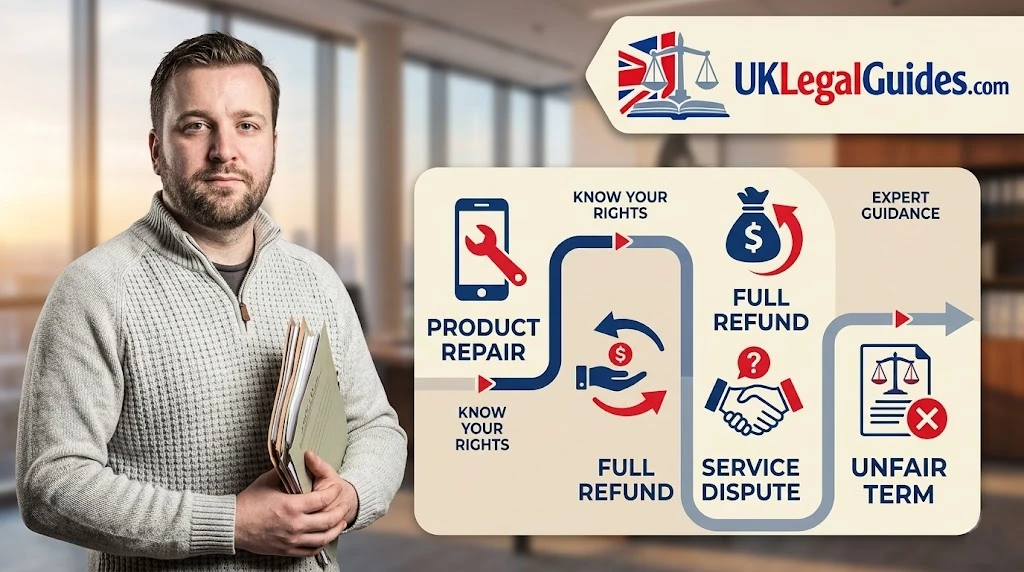
When a product develops a fault, consumers in England and Wales are protected by a clear legal framework. The primary legislation is the Consumer Rights Act 2015, which sets out what buyers can expect when purchasing goods and what remedies are available when things go wrong.
This guide explains, in practical and accessible terms, what counts as faulty goods, what your legal rights are, how long those rights last, and what steps can be taken to resolve disputes. It is designed for a broad audience, including members of the public, students, and solicitors seeking a structured overview.
What Counts as “Faulty Goods” Under UK Law?
Under the Consumer Rights Act 2015, goods must meet three key legal standards:
- Satisfactory quality
- Fit for purpose
- As described
Satisfactory Quality
Goods must meet the standard a reasonable person would consider acceptable, taking into account factors such as price, description, durability, safety, and appearance.
Fit for Purpose
If a consumer makes a specific purpose known to the seller, the goods must be capable of fulfilling that purpose.
As Described
Products must match their description, including any representations made in advertising, packaging, or by the seller.
Examples of Faulty Goods
Goods may be considered faulty if they:
- Do not function as expected
- Are damaged or incomplete
- Fail prematurely
- Are unsafe
- Do not match their description
These standards apply to goods purchased online, in-store, or by phone.
Your Legal Rights Within the First 30 Days
One of the most important protections is the short-term right to reject.
If goods are faulty, you usually have 30 days from delivery to:
- Reject the goods
- Receive a full refund
This is a strict legal right, and the retailer cannot insist on a repair or replacement during this period if you choose to reject the goods.
Key Point
The refund must generally be provided within 14 days of agreeing that the consumer is entitled to one.
Rights After 30 Days: Repair or Replacement
If more than 30 days have passed, the legal position changes.
You are entitled to:
- A repair, or
- A replacement
The retailer is usually allowed one attempt to fix the issue.
Conditions
- The repair or replacement must be carried out within a reasonable time
- It must not cause significant inconvenience to the consumer
If the repair or replacement fails, you move to the next stage of remedies.
Final Right to Reject or Price Reduction
If the trader cannot resolve the issue through repair or replacement, you gain a final right to reject the goods or request a price reduction.
Final Right to Reject
- You can return the goods and claim a refund
- In some cases (e.g. vehicles), a deduction may be made for use
Price Reduction
- You may keep the goods and receive a partial refund
The First Six Months: Presumption of Fault
If a fault appears within the first six months, the law assumes:
- The fault was present at the time of delivery
This is known as the reverse burden of proof.
In practice:
- The retailer must prove the item was not faulty when sold
- The consumer does not need to provide evidence initially
This significantly strengthens consumer claims during this period.
After Six Months: Burden of Proof Shifts
After six months:
- The consumer must prove the fault existed at the time of delivery
This may require:
- Expert reports
- Evidence of common defects
- Documentation of the issue
How Long Do You Have to Make a Claim?
Consumers generally have up to six years (in England and Wales) to bring a claim for faulty goods under contract law.
However:
- This does not mean goods must last six years
- It means you have six years to pursue a claim if the goods did not meet legal standards at the time of purchase
Who Is Responsible: Retailer or Manufacturer?
Your contract is with the retailer, not the manufacturer.
This means:
- You must pursue the seller for remedies
- Retailers cannot require you to contact the manufacturer instead
This is a common point of confusion in practice.
Practical Steps When Goods Are Faulty
1. Gather Evidence
- Receipt or proof of purchase
- Photos or videos of the fault
- Records of communication
2. Contact the Retailer
- Clearly explain the issue
- State the remedy you are seeking (refund, repair, or replacement)
3. Escalate the Complaint
If unresolved:
- Use the retailer's complaints procedure
- Consider Alternative Dispute Resolution (ADR)
4. Consider Court Action
If necessary, you may:
- Bring a claim in the County Court (often via the small claims track)
This is typically used for lower-value disputes.
Common Issues and Misunderstandings
“Sold as Seen”
This does not remove statutory rights. Goods must still meet legal standards.
Warranties vs Legal Rights
- A warranty is additional protection
- It does not replace your statutory rights
Change of Mind
There is generally no right to a refund for change of mind in-store (unless the retailer offers one), though separate rules apply to distance selling.
Risks and Practical Considerations
- Delays in reporting faults may weaken a claim
- Misuse or accidental damage may invalidate rights
- Disputes may require evidence or expert opinion
- Court action involves time, cost, and risk
Common Questions from our Readers
Can I demand a refund instead of a repair?
- Yes, within 30 days
- After that, usually only if repair/replacement fails
Do these rights apply to second-hand goods?
Yes, but expectations of quality may be lower.
Do these rights apply to online purchases?
Yes, the same standards apply regardless of how the goods are purchased.
Final Thoughts
Consumer rights for faulty goods in England and Wales are well-established and structured. The law provides a tiered system of remedies:
- A 30-day right to reject for a full refund
- A right to repair or replacement
- A final right to reject or seek a price reduction
Understanding these rights enables consumers to act confidently when goods do not meet expected standards. In most cases, early communication with the retailer and clear evidence will help resolve disputes without the need for formal legal action.
