
This guide is maintained as a current resource for September 2026 and covers only the laws of England and Wales. Information is for general guidance, not legal advice. Consult a qualified solicitor for advice specific to your situation.
Stuck with a faulty product? The Consumer Rights Act 2015 is on your side. Learn exactly when you are entitled to a repair, a replacement, or your money back-and how to enforce these rights today.
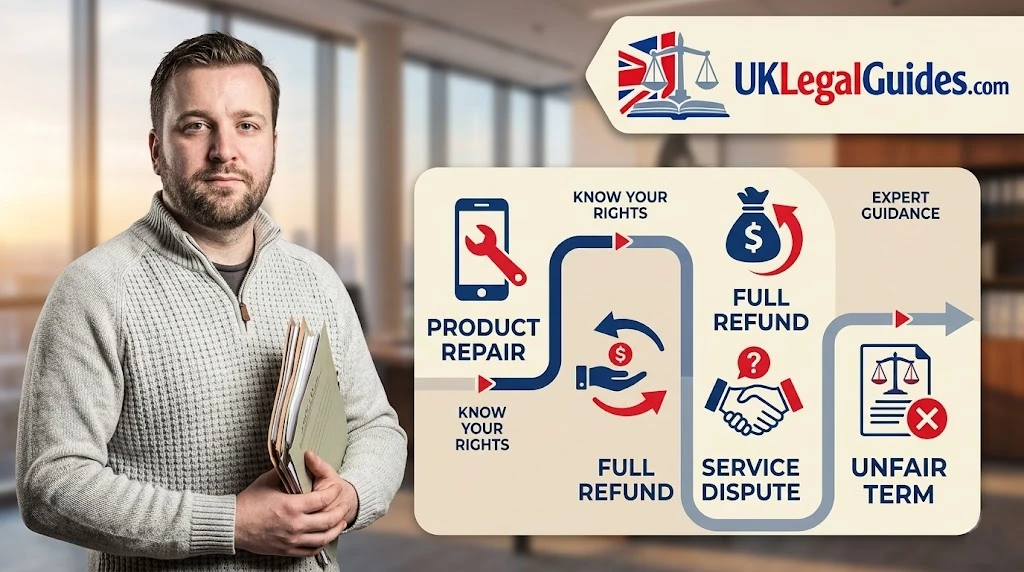
When goods develop a fault after purchase, consumers in England and Wales are protected by a structured system of legal remedies. One of the most important stages in this system is the right to a repair or replacement, governed by the Consumer Rights Act 2015.
This article explains when these rights apply, how they operate in practice, what obligations retailers must meet, and what steps consumers can take if a repair or replacement fails. It provides a clear and detailed overview suitable for both general readers and those seeking a more technical understanding of consumer law.
Legal Framework: The Consumer Rights Act 2015
The Consumer Rights Act 2015 is the primary legislation governing consumer contracts for goods, services, and digital content in England and Wales. It consolidates earlier laws and establishes a clear hierarchy of remedies where goods do not meet required standards.
Under the Act, goods must be:
- Of satisfactory quality
- Fit for purpose
- As described
If goods fail to meet these requirements, consumers are entitled to remedies including repair, replacement, refund, or price reduction.
When Does the Right to Repair or Replacement Apply?
The right to repair or replacement typically arises after the initial 30-day rejection period has passed.
Within the First 30 Days
- Consumers usually have a short-term right to reject goods for a full refund
- They are not required to accept a repair or replacement
After 30 Days
- The consumer loses the automatic right to reject
- The retailer must offer a repair or replacement as the primary remedy
This marks the transition from an immediate refund-based remedy to a corrective remedy.
Choosing Between Repair and Replacement
Consumer Preference vs Retailer Decision
Consumers may express a preference for:
- A repair, or
- A replacement
However, the retailer can choose the option that is:
- Less costly, or
- More practical to provide
Limitations on Choice
A retailer may refuse a chosen remedy if it is:
- Impossible, or
- Disproportionate compared to the alternative
For example:
- Repairing a low-cost item may be disproportionate compared to replacing it
- Replacing a rare or discontinued item may be impossible
Requirements for a Valid Repair or Replacement
The law imposes strict conditions on how repairs and replacements must be carried out.
Reasonable Time
The repair or replacement must be completed within a reasonable time.
What is “reasonable” depends on:
- The nature of the goods
- The complexity of the fault
- Availability of parts or replacements
No Significant Inconvenience
The process must not cause significant inconvenience to the consumer.
Examples of inconvenience include:
- Excessive delays
- Repeated failed repairs
- Lack of communication
No Cost to the Consumer
The retailer must bear all necessary costs, including:
- Labour
- Materials
- Postage or collection
The One Attempt Rule
In most cases, the retailer is given one opportunity to repair or replace the goods.
If this attempt fails, the consumer gains access to further remedies.
Examples of failure include:
- The same fault reappears
- A new fault develops
- The repair does not resolve the issue
What Happens If Repair or Replacement Fails?
If the retailer cannot successfully repair or replace the goods, the consumer can move to the next stage.
Final Right to Reject
You may:
- Reject the goods
- Claim a refund
In some cases, particularly after extended use, a deduction for use may apply.
Price Reduction
Alternatively, you may:
- Keep the goods
- Receive a partial refund
These remedies ensure that consumers are not left with defective products indefinitely.
The First Six Months: Presumption of Fault
If a fault arises within the first six months:
- It is presumed the fault existed at the time of delivery
This means:
- The retailer must prove the goods were not faulty
- The consumer benefits from a stronger legal position
This presumption applies equally to repair or replacement claims.
After Six Months: Burden of Proof
After six months:
- The burden shifts to the consumer
You may need to provide:
- Evidence of the fault
- Expert reports
- Documentation of the issue
This makes early action particularly important.
Step-by-Step: How to Request a Repair or Replacement
1. Identify the Fault
Confirm that the issue relates to:
- Quality
- Fitness for purpose
- Description
2. Gather Evidence
Collect:
- Proof of purchase
- Photographs or videos of the fault
- Records of communications
3. Contact the Retailer
Write clearly:
- Explain the issue
- State that you are requesting a repair or replacement
- Refer to your statutory rights
4. Allow the Retailer to Act
Give the retailer a reasonable opportunity to:
- Inspect the goods
- Carry out the repair or replacement
5. Monitor the Outcome
If the repair or replacement:
- Succeeds → the matter is resolved
- Fails → you may move to rejection or price reduction
Who Is Responsible?
The legal obligation rests with the retailer, not the manufacturer.
This means:
- You must pursue the seller
- The retailer cannot require you to deal with the manufacturer
This reflects the contractual relationship between buyer and seller.
Time Limits for Claims
Consumers generally have up to six years to bring a claim for breach of contract in England and Wales.
However:
- This is a limitation period, not a guarantee of remedy
- Claims become harder to prove over time
Common Issues and Disputes
Delays in Repair
Retailers may delay repairs beyond a reasonable timeframe, which can trigger further rights.
Repeated Failures
Multiple failed attempts strengthen the consumer's position for rejection.
Disputes Over “Reasonable Time”
What counts as reasonable can vary and may become a point of legal dispute.
Replacement Also Faulty
If a replacement item is also defective, the consumer may proceed directly to rejection.
Practical Risks and Considerations
- Accepting repeated repairs may weaken your position
- Lack of evidence can undermine a claim
- Retailers may argue the fault is due to misuse
- Court action may involve cost and time
Consumers should keep detailed records and act promptly.
Common Questions from our Readers
Can I insist on a replacement instead of a repair?
You can request it, but the retailer may choose the cheaper or more practical option.
How long should a repair take?
There is no fixed period; it must be reasonable in the circumstances.
What if the repair fails?
You may reject the goods or request a price reduction.
Final Thoughts
The right to repair or replacement is a central feature of consumer protection in England and Wales. The key points are:
- This right usually applies after the initial 30-day rejection period
- Retailers must repair or replace goods within a reasonable time and without inconvenience
- Only one attempt is generally required
- If the attempt fails, consumers can seek a refund or price reduction
Understanding these rights enables consumers to resolve disputes effectively and ensures retailers meet their legal obligations under the Consumer Rights Act 2015.
