
This guide is maintained as a current resource for September 2026 and covers only the laws of England and Wales. Information is for general guidance, not legal advice. Consult a qualified solicitor for advice specific to your situation.
If a product doesn't work as expected, you are protected by law. Learn your rights to a refund, repair, or replacement and how to enforce them under the Consumer Rights Act.
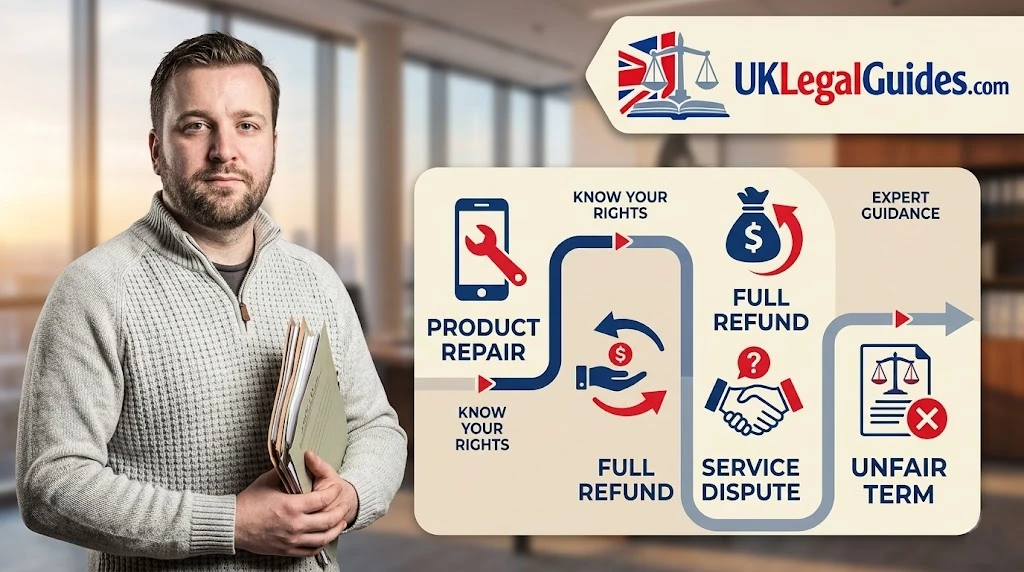
When you buy goods in England and Wales, the law expects the items to meet certain standards. One of the key standards under UK consumer law is that goods must be fit for purpose. If what you've bought cannot perform the job you reasonably expected it to do, you have specific rights and remedies under the Consumer Rights Act 2015. This article explains what “not fit for purpose” means, what legal rights consumers have when goods fail to meet this standard, how to pursue remedies, relevant time limits, and tips for handling disputes with traders.
Introduction – What Does “Not Fit for Purpose” Mean?
Under the Consumer Rights Act 2015 (CRA), when goods are sold to consumers they must be:
- Of satisfactory quality;
- Fit for the purpose for which they were supplied;
- As described.
A product is “not fit for purpose” when it fails to fulfil the purpose that a reasonable person would expect, including any specific purpose you told the seller about before purchase. This can include everyday use (for example, a kettle that doesn't boil water consistently) and particular uses you made known at the time of sale (for example, a camera you told the seller you needed for underwater photography but that has no waterproofing).
The law treats fitness for purpose as a statutory implied term of every consumer contract. That means it applies automatically, whether or not it is written in the contract itself.
What Legal Standards Apply to Goods?
1. Statutory Minimum Standards
The CRA sets out three minimum implied terms in goods contracts:
- Satisfactory quality: Goods should meet the standard a reasonable person would expect, taking into account description, price and other relevant circumstances.
- Fit for purpose: Goods must be capable of performing the function they are normally supplied to do, and any specific purpose you made known to the trader.
- Match description: Goods must correspond with the description given by the seller, including samples and models shown.
Failing any of these standards means the goods have not conformed to the contract. Your rights as a consumer arise from this non‑conformity.
Your Rights When Goods Are Not Fit for Purpose
If goods are not fit for purpose, the CRA gives you a tiered set of legal remedies. These depend on how long ago you bought the item and what actions you take.
1. Short‑Term Right to Reject (First 30 Days)
If goods are not fit for purpose, you have a short‑term right to reject them within 30 days of receiving them and obtain a full refund. This is automatic and does not require you to accept a repair or replacement first.
This right applies from the date you take physical possession of the goods. You can insist on a refund even if you initially asked for a repair or replacement.
2. Repair or Replacement
If more than 30 days have passed, you must normally offer the trader a chance to repair or replace the goods first. The retailer can choose whether to repair or replace, unless repair or replacement is impossible or would cause significant inconvenience or disproportionate cost.
Both remedies must be carried out within a reasonable time and without significant inconvenience to you. If the attempted repair or replacement fails, you can move on to other remedies.
3. Price Reduction or Final Right to Reject
If a repair or replacement is not possible, unsuccessful, or would cause significant inconvenience:
- You can ask for a price reduction, potentially up to a full refund if the goods are clearly not fit for purpose; or
- You can exercise your final right to reject the goods and obtain a refund.
For final rejection, a “deduction for use” may be made to reflect the time you have had the goods. However, where rejection occurs within six months of purchase, the burden of proof is often on the trader to show that the goods were fit for purpose at the time of sale, unless the nature of the goods or the type of defect makes this unreasonable.
Time Limits and Burden of Proof
Understanding time limits is crucial to asserting your rights:
- 30‑day window: Full refund right for goods not fit for purpose.
- After 30 days up to 6 months: You may need to accept a repair or replacement before claiming a refund or price reduction.
- After 6 months: A refund or reduction remains possible, but you may need to demonstrate that the fault existed at the time of purchase, except for certain types of durable goods.
These limits help structure when and how you pursue remedies. Acting promptly and communicating with the trader enhances your ability to secure your rights.
How to Enforce Your Rights
1. Communicate Clearly With the Seller
Notify the trader as soon as possible if goods are not fit for purpose. Provide details in writing, including the nature of the issue and the remedy you are seeking. Retaining evidence such as receipts, photos and correspondence strengthens your position.
2. Allow Repair or Replacement Where Required
In most cases after 30 days, you will first need to allow the trader a fair chance to repair or replace the goods. Failure to allow this may weaken your claim for a refund.
3. Escalate If Necessary
If the trader refuses to comply with your rights:
- Use the retailer's formal complaints procedure;
- Consider Alternative Dispute Resolution (ADR) or a certified consumer ombudsman;
- Bring a claim in the County Court or via the small claims track if the amount is relatively modest.
4. Keep Evidence
Record all interactions, opinions from independent experts if applicable, and any attempts to resolve the matter. Detailed documentation supports claims in tribunals and courts.
Common Misconceptions
“It's Not Broken, So It's Fit for Purpose”
A product can be technically working yet still not fit for purpose if it does not meet the expected performance or the specific use you made known at the time of sale (for example, garden equipment that fails under reasonable conditions).
“Warranty Means the Only Protection”
Consumer statutory rights under the CRA are independent of any manufacturer's warranty. Warranties are contractual promises separate from your legal rights. Even if a warranty has expired, you may still have rights under the CRA.
Practical Example
Imagine you buy a waterproof jacket described by the seller as suitable for hiking in wet conditions. If the jacket leaks in rain under normal use within a short time of ownership, you could:
- Reject the jacket within 30 days for a full refund;
- After 30 days, ask for repair or replacement;
- If repair or replacement fails, seek a price reduction or final rejection for refund.
Conclusion
When goods are not fit for purpose in England and Wales, the Consumer Rights Act 2015 gives you clear legal rights and remedies. Goods must perform the function for which they were supplied and any specific purpose you told the seller about. If they do not, you may be entitled to a refund, repair, replacement, price reduction or a final rejection of the goods.
Knowing your rights, acting promptly, and keeping good records will improve your chances of resolving disputes effectively, whether through negotiation, consumer dispute resolution services, or formal claims. Your rights against faulty goods are a cornerstone of UK consumer protection law.
