
This guide is maintained as a current resource for September 2026 and covers only the laws of England and Wales. Information is for general guidance, not legal advice. Consult a qualified solicitor for advice specific to your situation.
Can a verbal consumer contract be legally binding in the UK? This article explains how English contract law treats oral agreements, when such contracts are enforceable, exceptions requiring written form, practical risks, dispute options, and steps consumers can take to protect their rights in England and Wales. (Verbal agreements can be binding if they satisfy key contract elements, but certain contracts must be in writing.)
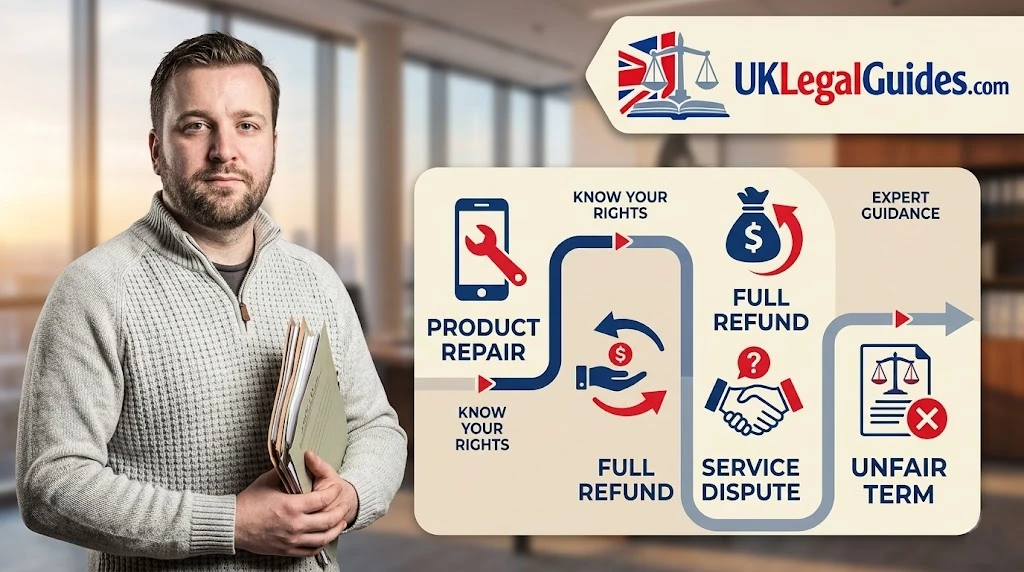
Understanding whether a spoken, “handshake” agreement counts as a legally binding contract is a common concern for consumers in England and Wales. Many everyday transactions start with a conversation rather than a signed document. This guide explains what the law actually says about verbal contracts in the UK, when they are enforceable, when they are not, how disputes are handled, and what practical steps consumers can take if a verbal deal goes wrong.
Introduction – What Is a Verbal Contract?
A verbal contract (also called an oral agreement) is an agreement made through spoken words between two or more parties without a formal written document. In everyday life, these can arise in situations such as agreeing a price with a service provider on the phone, arranging repairs with a trader after a visit, or deciding terms for the supply of goods during a face‑to‑face discussion.
Under English law, the simple fact that an agreement is not recorded in writing does not, in principle, make it invalid. A verbal agreement can be legally binding if it meets the basic requirements of contract law.
1. What Makes Any Contract Legally Binding?
For a contract to be legally enforceable in England and Wales, it must satisfy these fundamental elements:
- Offer and acceptance – one party proposes terms and the other clearly agrees to those terms.
- Consideration – something of value must be exchanged, typically money for goods or services.
- Intention to create legal relations – the parties must intend that the agreement could form the basis of legal rights. In consumer and business contexts, this intention is usually presumed.
- Certainty of terms – the contract must have sufficiently clear terms so that a court could enforce them if necessary.
- Capacity and legality – the parties must be legally capable of contracting and the purpose must be lawful.
If these elements are present, then the law treats a verbal agreement in the same way as a written contract in terms of enforceability.
2. Are Verbal Consumer Contracts Legally Binding in the UK?
Yes. In general, verbal agreements can be legally binding in England and Wales, including in consumer situations, provided the contract elements above are present. The law does not automatically require contracts to be in writing for them to exist and be enforceable.
However, there are important exceptions where the law does require certain consumer agreements or contract types to be in writing or to comply with specific legal formalities. In those cases a purely verbal agreement will not be enforceable.
3. When a Verbal Agreement Is Not Legally Enough
Certain contracts, by statute or legal principle, must be written and signed to be enforceable. Key examples relevant to consumers include:
a. Consumer Credit Agreements
Consumer credit contracts (for example, loans, credit agreements, hire‑purchase and similar agreements regulated by the Consumer Credit Act 1974) require specific written disclosures, information requirements, and formality to be valid. A purely verbal agreement will not satisfy these statutory requirements and is unlikely to be enforceable.
b. Sale or Transfer of Land
Contracts involving the sale, transfer or long‑term lease of land or certain property rights must be in writing and signed under the Law of Property (Miscellaneous Provisions) Act 1989. A verbal agreement on land matters is not enforceable on its own.
c. Guarantees and Statutory Formalities
Certain promises such as guarantees (one person promising to answer for the debt of another) must be in writing and signed. Consumer protection provisions also exist in a range of regulated sectors.
d. Sector‑Specific Requirements
Some specific regulated agreements (for example, certain financial services or insurance contracts) require written confirmations and specific disclosures as a matter of law.
In these circumstances, a verbal agreement is either ineffective, or at best enforceable only to the extent allowed by statute.
4. Challenges With Verbal Agreements
Even when a verbal contract can be legally binding, it is generally harder to enforce than a written one:
a. Proof
The core difficulty in enforcing a verbal contract is proving that it existed and establishing the precise terms. In the absence of written documentation, disputes often turn into “your word versus theirs”. Evidence such as confirmation emails, text messages, payment records, or conduct consistent with the agreement can help, but uncertainty remains a significant issue.
b. Consumer Rights Law
Even if a verbal contract exists, consumer protection legislation such as the Consumer Rights Act 2015 still applies to the transaction (for example, rights relating to satisfactory quality, fitness for purpose, and clear terms). That means certain contractual terms may be unfair and not enforceable – regardless of whether the contract was verbal or written.
c. Dispute Resolution and Costs
Without clear written terms, resolving disputes can be more time‑consuming and potentially more expensive, often requiring evidence gathering and interpretation of oral discussions.
5. How Disputes Over Verbal Contracts Are Resolved
If a consumer believes the other party has breached a verbal contract (for example, failing to deliver goods or services as agreed), the following steps outline typical legal options:
a. Reconciliation and Confirmation
Start by putting your understanding of the agreement in writing (for example, a letter or email to the other party summarising the discussed terms and asking for confirmation). This serves as contemporaneous evidence.
b. Consumer Complaints and Alternative Dispute Resolution
Many tradespeople and businesses are members of approved consumer codes or dispute resolution schemes. Consumers can pursue complaints through organisations such as Trading Standards, certified ADR providers, or independent mediators.
c. Small Claims Court
For smaller disputes, courts such as the County Court or the small claims track can be used to pursue unpaid sums or breaches. Evidence remains critical. Legal advisors or Citizens Advice can assist consumers in preparing claims based on a verbal contract.
d. Time Limits
Under the Limitation Act 1980, most claims for breach of contract must be brought within six years from the date of the breach. For some consumer credit agreements or regulated contracts, different time limits or statutory procedures apply.
6. Practical Tips for Consumers
- Ask for confirmation in writing: After any verbal agreement, request the other party to confirm key terms by email or text. This reduces uncertainty.
- Keep evidence: Receipts, messages, notes, and invoices help to show what was agreed and performed.
- Be clear on what was agreed: Where possible, clarify essential terms such as price, quality expectations, delivery dates, and cancellation rights.
- Know your rights: Even with verbal contracts, consumer rights under statutory law remain in place.
- Put important deals in writing: For significant purchases or long‑term services, insist on a written contract to reduce risk.
Conclusion
Under English law, a verbal consumer contract can be legally binding if it meets the core requirements of contract formation: offer, acceptance, consideration, intention to create legal relations, and sufficient certainty of terms. However, oral agreements often present evidential challenges and are not suitable for all types of contracts. In some regulated areas – such as consumer credit, land transactions, and guarantees – the law expressly requires a written contract for enforceability.
While verbal agreements may be enforceable in principle, consumers should seek to confirm important deals in writing and understand their statutory rights. If a dispute arises, early documentation and clear evidence are essential to support any claim in a court or tribunal.
