
This guide is maintained as a current resource for September 2026 and covers only the laws of England and Wales. Information is for general guidance, not legal advice. Consult a qualified solicitor for advice specific to your situation.
Understand your legal rights in England and Wales when goods do not match the description under the Consumer Rights Act 2015. This guide explains what “not as described” means, statutory remedies such as refunds, repairs and replacements, relevant time limits, and practical steps to enforce your consumer rights.
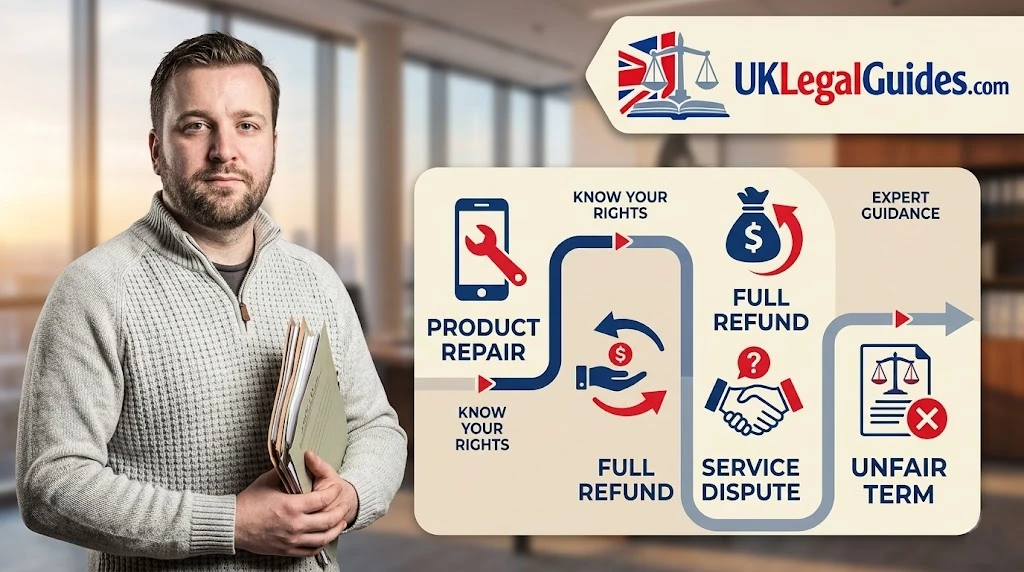
When you buy goods in England and Wales, the law expects the items you receive to match the description provided by the seller. If what you are supplied is materially different from what was described in advertising, on packaging, on a website, in a catalogue, or by a salesperson, you may have legal rights and remedies under the Consumer Rights Act 2015 (CRA). This guide explains what “does not match the description” means, how the law protects consumers, what practical steps you can take, time limits, dispute resolution options, and common questions.
Introduction – Why Description Matters
When you enter into a consumer contract for goods, terms are implied into the agreement by law. One of these terms is that the goods must be “as described”. This means that the product actually delivered must match any description given by the seller before or at the point of sale, whether in writing, verbally, in photographs, specifications, a model you examined, or any combination of these.
Failing to match the description constitutes a breach of contract, and you have legal rights to remedies. This standard applies automatically to most purchases from traders and cannot generally be excluded by contractual terms.
What Does “Goods Do Not Match the Description” Mean?
The legal concept of “as described” under the CRA requires that:
- Any description provided becomes an implied contractual term that the goods will conform to that description.
- Descriptions include all information given by the trader about the goods' features and characteristics, including in marketing materials, online listings, labels, oral statements, brochures, and technical specifications.
- Samples and models shown before purchase also form part of the description the goods must match.
For example, if a bag is advertised as genuine Italian leather but is made from synthetic materials and produced elsewhere, it does not match the description and is not conforming goods.
Statutory Rights Under the Consumer Rights Act 2015
The Consumer Rights Act 2015 consolidated and modernised consumer protections in England and Wales, replacing earlier laws such as the Sale of Goods Act 1979 for most purchases made after 1 October 2015. Under the CRA:
- Goods must be of satisfactory quality.
- Goods must be fit for any particular purpose you communicated to the seller.
- Goods must be as described, including any description, sample or model used.
The “as described” requirement applies to all consumer purchases from traders. It protects you regardless of whether the description was provided online, in a shop, in a catalogue or verbally.
Remedies When Goods Do Not Match the Description
If your goods do not match the description, the CRA gives you a hierarchy of legal remedies depending on how long ago you bought them:
1. Short‑Term Right to Reject (Within 30 Days)
If goods are not as described, you can reject them within 30 days of receipt and demand a full refund. This is known as the short‑term right to reject. The refund should be paid without undue delay.
You do not need to accept a repair or replacement before asking for a refund in this period.
2. Right to Repair or Replacement
If more than 30 days have passed, you must normally allow the trader an opportunity to repair or replace the goods that do not match the description before pursuing other remedies. The trader can choose whether to repair or replace, unless that remedy is impossible or disproportionate.
3. Price Reduction or Final Right to Reject
If repair or replacement is not possible, unsuccessful, or would cause significant inconvenience, you can ask for:
- A price reduction reflecting the difference between what was promised and what was received; or
- A final right to reject the goods for a refund.
When exercising the final right to reject, a deduction can be made for use if you have had the item for some time.
Time Limits and Burden of Proof
Time limits are important when enforcing your rights:
- 30 days gives you the strongest position for a full refund if goods are not as described.
- After 30 days, you must generally allow repair or replacement first.
- Six‑month period: For goods that still do not match the description after this period, you may be able to claim a refund or price reduction, though you may need to prove that the non‑conformity existed at the time of supply.
The burden of proof in the first six months after delivery is often on the trader to demonstrate that the goods were as described at the point of sale, unless this is unreasonable.
Practical Steps for Consumers
To maximise your chances of securing the remedies you are entitled to:
- Retain proof of purchase: Receipts, order confirmations, bank statements and delivery records.
- Document the discrepancy: Take photographs and note precisely how the goods differ from the description.
- Communicate in writing: Notify the trader promptly, clearly stating that the goods do not match the description and outlining the remedy you seek.
- Keep records of all correspondence: This supports your claim if you need to escalate to dispute resolution or court.
Handling Disputes
If a trader refuses to honour your rights:
- Use the trader's formal complaints procedure.
- Consider Alternative Dispute Resolution (ADR) schemes or a consumer ombudsman.
- If necessary, bring a claim in the County Court or small claims track.
Many community advice services (for example Trading Standards or Citizens Advice) can help you understand your rights and pursue a claim.
Common Questions and Clarifications
Does “as described” cover every detail in adverts?
Yes. Details such as product specifications, features, model numbers, materials, size, colour and performance expectations form part of the description the goods must match.
What if only part of the description is wrong?
If any part of the pre‑contract description is inaccurate - for example, a product page lists incorrect specifications - the goods can still be treated as not matching the description. In practice, whether a discrepancy is significant enough to warrant remedies depends on the circumstances.
Does this apply to second‑hand goods?
Yes, but the standard of description takes into account the nature and age of second‑hand items. They must still match the description given by the seller.
Conclusion
In England and Wales, the Consumer Rights Act 2015 provides clear legal rights when goods do not match the description promised by a seller. You have a statutory right to reject goods that are not as described, obtain a refund, or require repair or replacement, with remedies structured according to how much time has passed since purchase. Acting promptly, gathering evidence, and using appropriate dispute resolution mechanisms can help you enforce your rights effectively. Understanding these protections empowers you to hold traders to account and secure fair outcomes when goods fall short of what was promised.
