
This guide is maintained as a current resource for September 2026 and covers only the laws of England and Wales. Information is for general guidance, not legal advice. Consult a qualified solicitor for advice specific to your situation.
Learn how exclusion clauses in consumer contracts are treated under UK law in England and Wales. This guide explains when exclusion clauses are enforceable, how the Consumer Rights Act 2015's fairness test works, examples of unfair terms, practical steps for challenging them, and how to protect your consumer rights in disputes.
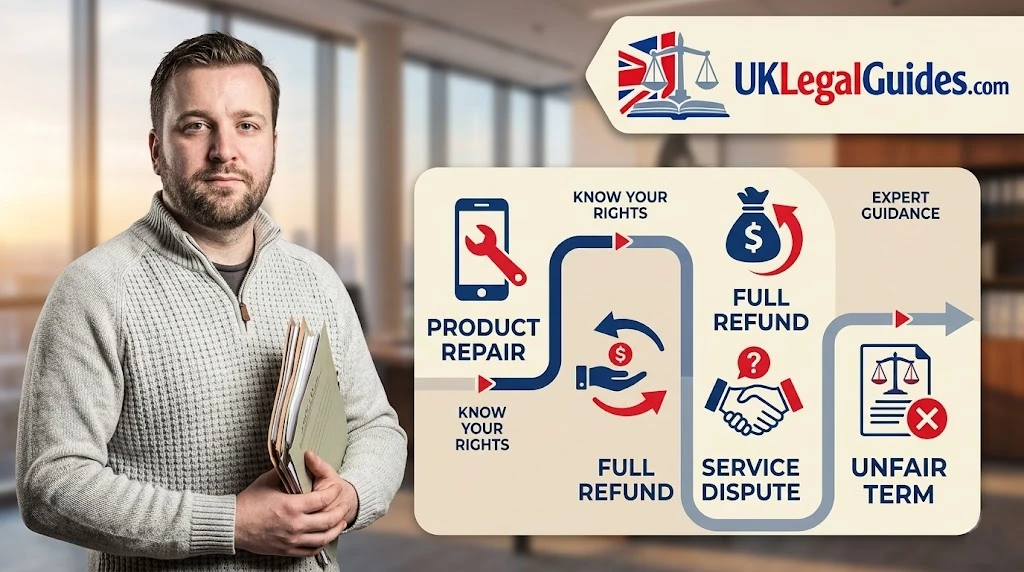
In consumer law, exclusion clauses are contractual terms that seek to limit or exclude a trader's liability for loss, damage, or other failures in performance. Traders commonly include such clauses in terms and conditions, notices, or contracts to protect themselves from significant legal and financial risk. However, under English law, particularly the Consumer Rights Act 2015 (CRA), many exclusion clauses in consumer contracts - especially those that unfairly disadvantage consumers - are unenforceable or subject to strict rules. This guide explains how exclusion clauses work in consumer contracts in England and Wales, what the law says about fairness, when these clauses are valid or void, how disputes are resolved, and practical steps consumers can take.
Introduction – What Is an Exclusion Clause?
An exclusion clause is a term in a contract that seeks to restrict or exclude a party's legal liability. In consumer contracts, these clauses might attempt to limit liability for faulty goods, defects in services, loss, delay or damage. They might appear in written terms and conditions, notices displayed at physical locations, online contracts, or verbally agreed terms incorporated into a contract. The legal treatment of exclusion clauses in consumer contracts is governed primarily by the Consumer Rights Act 2015, which provides protections against unfair terms.
Legal Framework: Consumer Rights Act 2015 and Unfair Terms
The Consumer Rights Act 2015 is the main statute regulating unfair terms - including exclusion clauses - in consumer contracts. Part 2 of the CRA applies to contracts between a trader and a consumer and to consumer notices which purport to exclude or limit liability.
Fairness Requirement
Under section 62 of the CRA, a term (including an exclusion clause) is unfair if, contrary to the requirement of good faith, it causes a significant imbalance in the parties' rights and obligations to the detriment of the consumer. An unfair term is not binding on the consumer.
In assessing fairness, courts consider the nature of the subject matter and all circumstances when the term was agreed, including how the term was presented and whether it was highlighted or buried in small print.
Which Exclusion Clauses Are Likely Unfair?
Certain types of exclusion clauses are very likely to be considered unfair under the CRA. The grey list in Schedule 2 of the CRA provides examples of terms that may be unfair, particularly those that:
- Exclude or limit the trader's liability for death or personal injury caused by negligence.
- Inappropriately exclude or limit legal rights relating to poor performance or non‑performance of key contractual obligations.
- Allow a trader to render performance different from what was reasonably expected.
- Allow the trader to vary the contract unilaterally after it has been concluded without a valid reason.
An exclusion clause that attempts to prevent liability for death or personal injury resulting from negligence is typically void and unenforceable under the CRA.
Exclusion Clauses and Transparency
A term that specifies the main subject matter of the contract or the price may be exempt from the fairness test, but only if it is transparent and prominent. Transparency means the wording is in plain and intelligible language and - if in writing - legible. Prominence requires that an average consumer would realise the existence and effect of the term before agreeing. If these conditions are not met, even fundamental terms can be subject to the fairness assessment under the CRA.
How Exclusion Clauses Interact With Other Consumer Rights
Exclusion clauses must not interfere with statutory consumer rights implied into contracts for goods, services and digital content, such as:
- Implied terms that goods are of satisfactory quality, fit for purpose and as described.
- Implied terms that services are performed with reasonable care and skill.
- The consumer's right to reject faulty goods within a statutory period.
A clause that seeks to remove or unduly restrict these statutory rights is likely to be considered unfair and unenforceable.
Examples of Unfair Exclusion Clauses
Practical examples of clauses that courts may find unfair include:
- A term stating the trader is not liable for any defect in products or services whatever the cause.
- A provision limiting liability for consequential losses (such as loss of income) arising from a breach of contract.
- A clause requiring consumers to waive future legal rights or remedies, or to pay disproportionate penalties for termination.
- Large disclaimer notices in small print on car park signs restricting all liability for damage or injury, which could cause a significant imbalance.
When Are Exclusion Clauses Enforceable?
Not all exclusion clauses are inherently unfair. Clauses may be enforceable if they are:
- Transparent and prominently communicated at the time of contracting;
- Designed to limit liability moderately and proportionately (for example, capping liability at a reasonable level rather than excluding it altogether);
- Consistent with statutory protections and do not remove core consumer rights.
Whether a clause is fair depends on all the circumstances of the contract and how the clause affects the consumer's rights and obligations.
Dispute Resolution and Legal Remedies
If you believe an exclusion clause in a consumer contract is unfair:
- Challenge the clause directly with the trader, citing relevant consumer law (CRA fairness test).
- Use formal complaints procedures or alternative dispute resolution (ADR), mediation or ombudsman services where available.
- Consider bringing a claim in court or via the small claims track if a dispute cannot be resolved.
- Evidence such as correspondence, term placement, adverts, and how the contract was presented will support your case in disputes.
Because unfair terms are not binding, a court or tribunal may disregard the exclusion clause and allow your claim to proceed on the underlying contractual or statutory rights.
Practical Tips for Consumers
- Examine contract terms carefully before agreeing, especially clauses limiting liability.
- Ask for clarification in plain language if a clause is unclear or buried in small print.
- Retain documentation including screenshots of terms at the time of purchase.
- Seek independent advice from consumer advice services or solicitors when in doubt.
- Act promptly if you believe a clause is unfair, as delays may affect evidence gathering.
CMA and Trading Standards also have powers to challenge unfair terms on a wider scale and may publish guidance on specific issues.
Conclusion
Exclusion clauses in consumer contracts seek to limit or exclude a trader's liability, but under the Consumer Rights Act 2015 many such clauses are subject to a fairness assessment. A term that causes a significant imbalance in rights and obligations or that attempts to exclude core legal protections - such as liability for death or personal injury - will generally be unenforceable. Clear, transparent, proportionate limitation clauses may sometimes be valid, but consumers retain statutory protections that cannot be simply contracted away. Understanding how exclusion clauses operate helps consumers assess their rights, challenge unfair terms, and pursue remedies effectively when disputes arise.
