
This guide is maintained as a current resource for September 2026 and covers only the laws of England and Wales. Information is for general guidance, not legal advice. Consult a qualified solicitor for advice specific to your situation.
Learn what happens during a bail variation hearing in England and Wales, including how applications are made, how courts consider changes to bail conditions, the procedural steps involved, and the practical factors that influence judicial decisions during bail condition reviews.
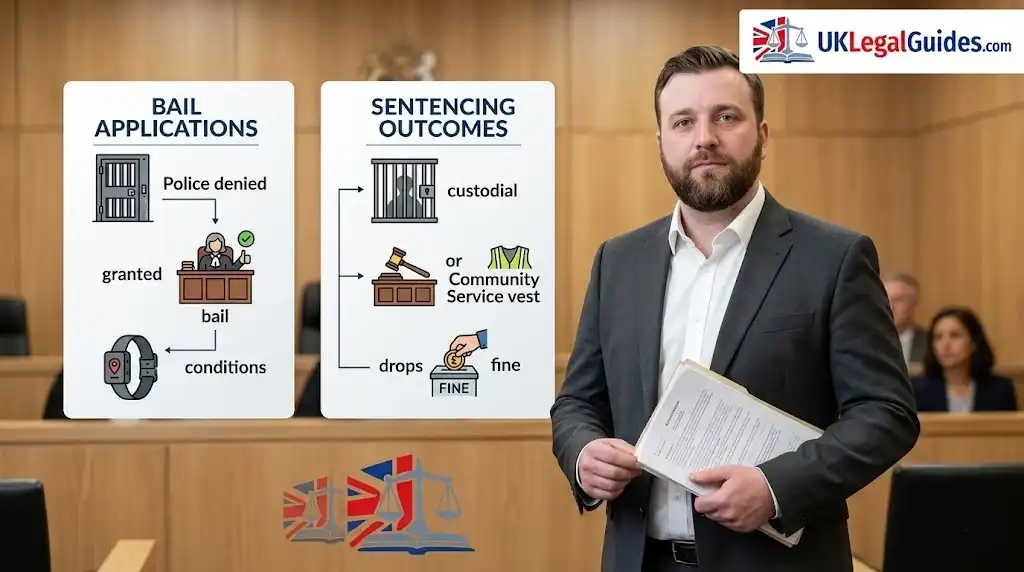
When a defendant is released on bail in a criminal case in England and Wales, the conditions attached to that bail may change over time. Changes might be required because circumstances have changed, a defendant cannot comply with existing terms, or because the prosecution seeks stricter conditions to manage risk. Such changes are dealt with through a bail variation hearing - a formal process in which a court reviews proposed amendments to bail conditions. This article explains what happens during these hearings, the legal framework, procedural steps, rights involved, and practical considerations for defendants, legal representatives, and others involved.
What Is a Bail Variation Hearing?
A bail variation hearing is a court session in which an application is made to change existing bail conditions that have already been granted. This may involve altering conditions such as reporting requirements, residence restrictions, curfews, non‑contact orders, or other terms designed to address risks associated with release on bail. The hearing arises under the Bail Act 1976 and Criminal Procedure Rules, which govern how and when applications to vary bail conditions are made and heard.
Legal Basis for Varying Bail Conditions
Under section 3(8) of the Bail Act 1976, either the defence or the prosecution may apply to a magistrates' court or Crown Court - as appropriate - to vary existing bail conditions or to impose conditions where previously bail was unconditional. Any application to vary bail must satisfy the statutory requirements that the variation is necessary, reasonable, and proportionate to address risks such as failing to attend court, re‑offending or interference with witnesses. Conditions must also be capable of being enforced and tailored to specific identified risks.
When Can a Bail Variation Hearing Be Requested?
1. At Any Time During Bail
Either party - the defendant (or their solicitor) or the prosecution (often via the Crown Prosecution Service) - may request a variation of bail conditions at any stage while bail is still active. The need for variation commonly arises where a defendant's personal circumstances change (for example, employment or health needs), or where new information justifies stricter conditions.
2. Following a Breach or Risk Change
If the prosecution believes that the defendant's behaviour while on bail indicates increased risk - such as failing to comply with the existing terms - it can apply to vary conditions or revoke bail entirely. Under section 5B Bail Act 1976, prosecutors may apply to have already‑granted bail reconsidered if new material information becomes available that was not before the original court.
Filing and Listing the Application
Written Application and Notice
An application to vary bail conditions is normally submitted in writing to the court handling the case. The applicant (defence or prosecution) must set out:
- The current bail terms.
- The proposed variation (what changes are sought).
- The reasons supporting the variation, including any evidence of changed circumstances or risks.
In most cases, the applicant must serve the written notice on the prosecutor and the court with sufficient time before the hearing, often at least five working days' notice, to give the prosecutor time to consider and respond to the proposal.
Court Listing and Notification
Once the application is received and served, the court will list the variation application for hearing. In a magistrates' court, the matter will usually be heard by a district judge or a panel of magistrates. In the Crown Court, a judge will deal with the application. If the prosecutor does not oppose the variation and both sides agree, the court may deal with the application administratively without a contested hearing. If there is opposition, a formal hearing will be listed.
What Happens at the Bail Variation Hearing
1. Formal Hearing in Court
During the hearing, both parties - or their legal representatives - present submissions. The defence outlines why the variation should be granted, addressing issues such as necessity and proportionality. The prosecution may oppose the variation or propose alternative conditions if they consider the defendant poses a risk.
The court considers:
- Whether the existing conditions remain appropriate.
- Whether the proposed changes address risk or are otherwise justified.
- The statutory presumption in favour of bail, balanced against risk factors under the Bail Act 1976.
2. Court Powers at the Hearing
The court has the authority to:
- Grant the variation as requested.
- Refuse the variation if not justified.
- Impose alternative conditions it considers appropriate.
- Revoke bail entirely, remanding the defendant into custody if risks cannot be managed by conditions.
Conditions imposed must be specific, justifiable, and enforceable - for example, modifying reporting requirements, residence restrictions, curfews or non‑contact orders.
Factors the Court Considers
The court assesses variation applications within the same legal framework used for initial bail decisions. Key factors include:
- Risk of non‑attendance at future hearings.
- Risk of further offending while on bail.
- Risk of interference with witnesses or victims.
- Whether the proposed variations address these risks effectively and proportionately.
- Any change of circumstances since the original bail decision.
- Previous history of compliance with bail conditions.
Conditions should be tailored to specific issues identified in the case rather than overly broad or arbitrary.
Hearing Outcomes and Orders
Variation Without a Hearing
Where both sides agree on a proposed variation, the court may approve it administratively and issue a revised bail order without a contested hearing. This can streamline the process and reduce delay.
Variation After a Hearing
If a hearing takes place, the judge or magistrates will announce the decision in open court. If variation is granted, the court will issue a new bail order or amendment sheet setting out the updated conditions. The defendant and prosecution are then bound by these updated terms.
Refusal of Variation
Where a variation application is refused, the previous bail conditions remain in force. To bring another variation application in future, the applicant typically must show a substantial change of circumstances.
Practical Considerations
Timing and Communication
It is important to notify the prosecutor early and serve any written application well ahead of the hearing to avoid unnecessary delays. Prosecutors may consult with police and, where appropriate, witnesses or victims before responding to variation proposals.
Evidence and Representation
Strong supporting evidence - such as medical reports, employment details, or changed personal circumstances - can support applications to relax conditions. Legal representatives often present these at variation hearings to illustrate why changes are justified.
Enforcement and Compliance
Once conditions are varied, compliance remains a priority. Failure to comply with updated bail terms can lead to arrest and reconsideration of bail, including potential remand into custody. Courts and prosecutors take compliance history into account when considering future applications.
Key Takeaways
A bail variation hearing is the formal process by which existing bail conditions can be changed during ongoing criminal proceedings in England and Wales. Key aspects include:
- Written application to the court and service on the prosecutor.
- Listing of the application and possible formal hearing.
- Judicial consideration of risk, necessity, proportionality and compliance history.
- Outcomes ranging from administrative variation to contested decisions or refusal.
- The importance of evidence and procedural timing in achieving successful variation.
Understanding how bail variation hearings work helps defendants and solicitors navigate changes to bail conditions effectively and within the legal framework established by the Bail Act 1976 and Criminal Procedure Rules.
