
This guide is maintained as a current resource for September 2026 and covers only the laws of England and Wales. Information is for general guidance, not legal advice. Consult a qualified solicitor for advice specific to your situation.
Learn what curfew conditions are, how they operate in bail and sentencing in England and Wales, and how police and electronic monitoring systems enforce compliance. This guide explains the legal framework, enforcement process and practical considerations.
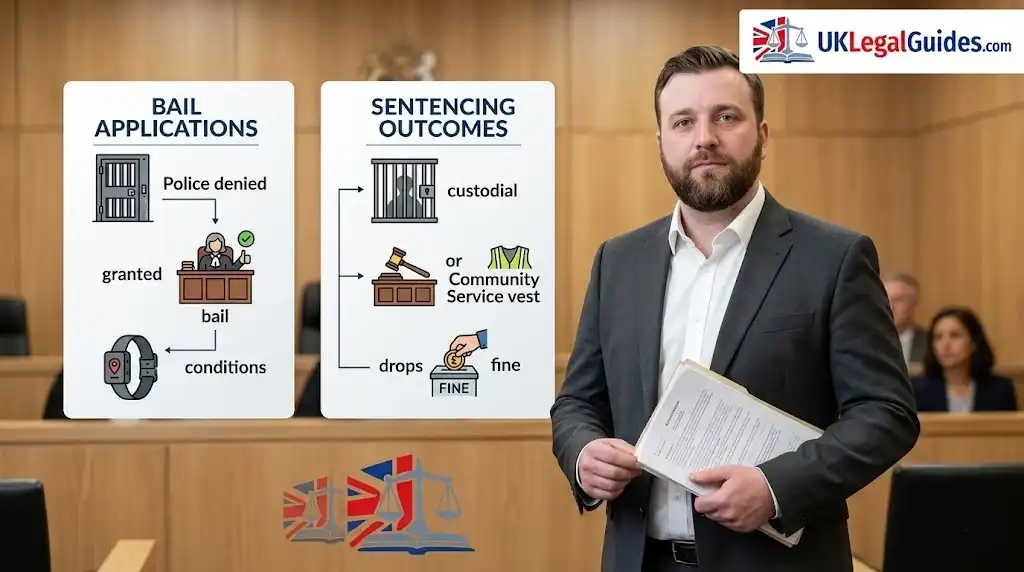
Curfew conditions are a common requirement imposed by courts in England and Wales as part of bail orders, sentences or other criminal justice orders. They require a person to remain at a specified address during certain hours each day. Curfews are a tool to manage risk, encourage compliance with the criminal process, protect the public and assist rehabilitation. This guide explains what curfew conditions are, how they are applied and enforced, and what practical considerations arise for defendants and the authorities.
What Are Curfew Conditions?
A curfew condition means that an individual must stay at a designated address during specified periods of time. Curfew conditions can be attached to:
- Bail orders, where a defendant must abide by restrictions while awaiting trial or further hearings;
- Sentencing orders, such as community orders where the court imposes a curfew requirement alongside other measures; and
- Other criminal justice measures, including Criminal Behaviour Orders or other restrictions.
Curfews are designed to limit a person's movements so that they remain in a controlled environment during times when risk is potentially highest, such as overnight or late at night. Some curfews are monitored manually by police checks, while others are enforced using electronic monitoring (tagging) technology.
Legal Basis for Curfew Conditions
Curfew requirements derive from the broader power of courts to impose conditions that are necessary to ensure a defendant attends court, does not commit further offences, does not interfere with witnesses, and protects the public or the defendant's own welfare. Under Section 3(6) of the Bail Act 1976, courts may include conditions such as curfews as part of bail where necessary.
Curfews can also be part of sentencing requirements. For example, under the Sentencing Code, courts may impose a curfew requirement with or without electronic monitoring as part of community sentences.
Types of Curfew Conditions
1. Non‑monitored Curfews (“Doorstep Curfew”)
A non‑monitored curfew simply requires the defendant to remain at a specified address during set hours. Enforcement typically relies on:
- Police visits to the address to check compliance; and
- Reports from neighbours or others about potential breaches.
This approach can be resource‑intensive and less precise than monitored options.
2. Electronic Monitoring Curfews
Most modern curfew conditions are enforced with electronic monitoring, where a tracking device is used to confirm that the individual remains at the curfew address during the required period. There are two main technologies:
- Radio Frequency (RF): used to confirm presence at the curfew address during imposed hours.
- GPS (location monitoring): used for more complex restrictions, such as exclusion zones, and can also support curfew enforcement where available.
The use of electronic monitoring for curfews supports both public protection and ensures clearer evidence of compliance or breach.
How Curfew Conditions Are Applied
At Bail Stage
When a court considers bail, it may impose a curfew with or without electronic monitoring if it believes that:
- The defendant poses a risk of absconding or re‑offending;
- A curfew condition will reduce risk and help ensure compliance; and
- The addition of electronic monitoring would permit bail where it might otherwise be refused.
Electronic curfew conditions are typically imposed only where the court is satisfied that, without monitoring, bail would not be granted. This reflects that tagging and enforced curfews are an alternative to remand in custody.
During Sentencing
As part of sentencing, courts may require a curfew for specified hours each day. Under the sentencing framework:
- Curfews may be between 2 and 20 hours in any 24‑hour period (depending on the type of order).
- Curfew conditions must be proportionate and reasonable given the context of the offence and the person's circumstances.
- Courts must consider the impact on work, education, family or dependants before imposing a curfew requirement.
Where curfews are imposed as part of a sentence, courts must also consider electronic monitoring unless it is inappropriate. This reflects that monitoring strengthens compliance and public confidence.
Enforcement of Curfew Conditions
Role of Electronic Monitoring Suppliers
Where a curfew condition is electronically monitored:
- A tagging device is fitted to the individual, usually at the curfew address.
- The device detects exits during curfew hours and other violations (for example, if someone removes or deliberately damages the tag).
- The monitoring system generates alerts that go to the monitoring centre.
- If an alert indicates a breach (for example absence for 15 minutes or more), the supplier reports this to the police.
Curfew enforcement relies on clear protocols for detection, reporting and follow‑up action by police or other authorities.
Police and Court Enforcement
After an electronic monitoring alert:
- Police may investigate and, if necessary, arrest or recall the individual to court for bail reconsideration or breach proceedings.
- Courts have powers to vary, revoke or impose stricter conditions if a breach occurs.
Even for non‑monitored curfews, police can attend the address during the restricted period to check compliance and respond to any breach.
Consequences of Breaching Curfew Conditions
A breach of curfew conditions is a breach of bail or sentence requirements. The consequences can include:
- Recall to custody under the bail order.
- Breach proceedings in court, potentially resulting in revocation of bail.
- Variation of conditions to impose stricter limitations.
- Adverse effect at sentencing, where the court may take breaches into account when deciding on sentence severity.
Electronic monitoring alerts and evidence of non‑presence at the curfew address can form part of the basis for enforcement action.
Practical Considerations for Defendants
Cooperation with Installation and Use
When a court imposes an electronically monitored curfew:
- The individual must cooperate with installation of equipment at the curfew address.
- They should ensure they understand the hours of curfew, how the device works, and what to do if there is a technical issue.
- Requests for temporary absence during curfew hours for reasonable causes (such as medical appointments) must usually be made to the court before the event occurs.
Reasonable and Proportionate Conditions
Courts must act fairly and take into account personal circumstances when imposing curfews. Conditions should be proportionate, taking into consideration employment, education, family responsibilities and any other relevant factors.
Common Questions About Curfew Conditions
Are curfews always electronically monitored?
Not always. Some curfews are monitored by police attendance at the address, but electronic monitoring is increasingly used for greater certainty and efficiency.
Can curfew hours vary?
Yes. There is no statutory minimum or maximum curfew length; courts decide hours depending on the circumstances.
What happens if the electronic tag fails?
Technical failures should be reported promptly to the supplier and police, as misuse or technical issues can impact compliance records and enforcement action.
Key Takeaways
Curfew conditions require a person to stay at a specified address during set times and are used in bail and sentencing contexts to manage risk and promote compliance with the judicial process. They may be enforced with electronic monitoring technology or by police checks. Electronic curfews provide more precise evidence of compliance and support enforcement. Where breaches occur, authorities can take enforcement action, including recall to custody or variation of conditions. Understanding how curfews work helps defendants, solicitors and the public engage with the justice system and uphold legal obligations.
