
This guide is maintained as a current resource for September 2026 and covers only the laws of England and Wales. Information is for general guidance, not legal advice. Consult a qualified solicitor for advice specific to your situation.
Learn your legal rights for poor quality services in the UK. Understand repeat performance, refunds, compensation, and how to claim under the Consumer Rights Act 2015.
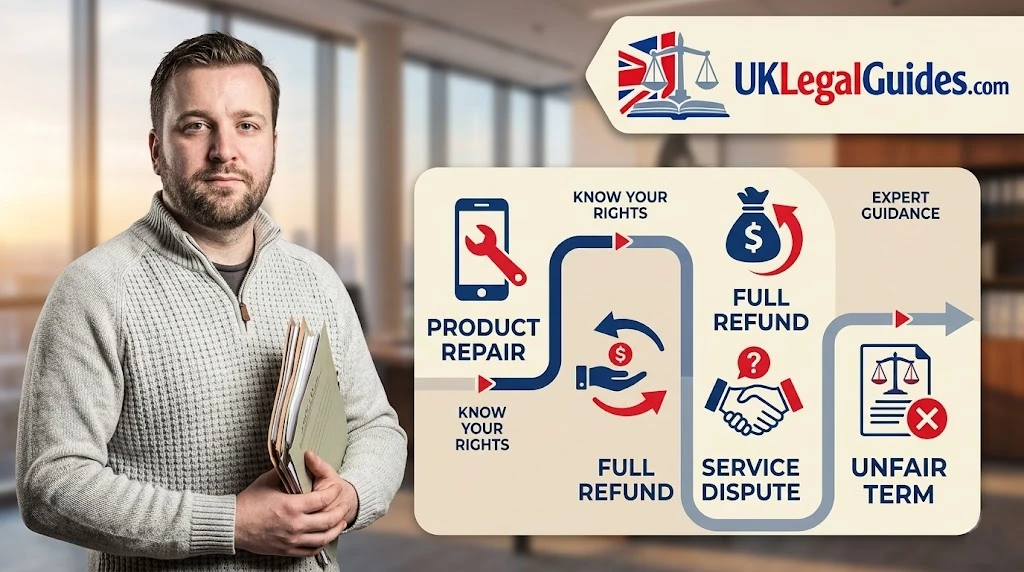
Consumers regularly pay for services such as building work, car repairs, hairdressing, professional advice, and home improvements. When those services fall below acceptable standards, the law in England and Wales provides clear protections under the Consumer Rights Act 2015.
This article explains what constitutes poor quality service, the legal standards providers must meet, and the remedies available when things go wrong. It also outlines practical steps for pursuing compensation or resolving disputes through appropriate legal channels.
What Counts as a “Service” in Consumer Law?
A service is any paid activity carried out by a trader for a consumer. Examples include:
- Tradesperson work (e.g. plumbing, electrical, construction)
- Professional services (e.g. legal, financial, consultancy)
- Personal services (e.g. hairdressing, beauty treatments)
- Repairs, maintenance, and installations
The law applies where a consumer contracts with a business, not private individuals acting outside a commercial context.
Legal Standards for Services
Under the Consumer Rights Act 2015, services must meet specific legal standards.
Reasonable Care and Skill
The trader must perform the service with the level of competence expected of a reasonably skilled professional in that field.
This is the central legal test. It focuses on how the service was carried out, not just the final result.
Reasonable Time
If no completion date is agreed, the service must be completed within a reasonable timeframe.
What is “reasonable” depends on the nature of the work, industry standards, and circumstances.
Reasonable Price
If no price is agreed in advance, the consumer is only required to pay a reasonable amount.
As Described or Promised
Any information provided by the trader-whether written or verbal-becomes legally binding if the consumer relies on it when entering the contract.
When Is a Service Considered Poor Quality?
A service may be legally defective if:
- Work is carried out carelessly or below professional standards
- The result is unsafe, incomplete, or defective
- Promised features or outcomes are not delivered
- The service takes an unreasonable amount of time
- The trader fails to follow agreed specifications
Practical Examples
- A builder installs flooring incorrectly, causing damage
- A mechanic fails to properly repair a vehicle
- A cleaner damages property due to negligence
- A contractor fails to complete agreed work
In these situations, the service may breach the legal standards required under the Act.
Your Legal Remedies for Poor Quality Services
The law provides a structured, two-stage system of remedies.
1. Right to Repeat Performance
The primary remedy is the right to have the service performed again.
This means:
- The trader must correct or redo the work
- It must be done at no additional cost
- It must be completed within a reasonable time
- It must not cause significant inconvenience
This remedy is appropriate where the issue can realistically be fixed.
2. Right to a Price Reduction (Refund)
If repeat performance is:
- Impossible, or
- Not carried out within a reasonable time, or
- Likely to cause significant inconvenience
The consumer is entitled to a price reduction, which may include a full refund.
Key Points
- The reduction must reflect the seriousness of the problem
- It can be up to 100% of the price paid
- Refunds must usually be issued within 14 days of agreement
Compensation and Additional Claims
In some cases, consumers may also claim damages for losses caused by poor service.
Examples
- Cost of hiring another contractor to fix defective work
- Damage to property caused by negligence
- Financial losses resulting from delays
These claims may be pursued through the civil courts, typically the County Court, depending on the value of the dispute.
Step-by-Step: What to Do If a Service Is Poor
1. Identify the Problem Clearly
Determine how the service fails to meet:
- Reasonable care and skill
- Agreed terms or descriptions
2. Gather Evidence
Collect:
- Contracts, quotes, or invoices
- Photos or videos of defective work
- Correspondence with the trader
3. Contact the Trader
Explain:
- What went wrong
- What remedy you are seeking (repeat performance or refund)
- Reference your statutory rights
4. Allow an Opportunity to Fix the Issue
The trader should be given a reasonable chance to carry out repeat performance where appropriate.
5. Escalate the Complaint
If unresolved:
- Request a price reduction or refund
- Use formal complaints procedures
- Consider Alternative Dispute Resolution (ADR)
6. Consider Legal Action
If necessary, a claim can be brought in the County Court for:
- Refunds
- Compensation
- Breach of contract
Time Limits for Claims
Consumers generally have up to six years from the date of breach to bring a claim in England and Wales.
However:
- Early action is advisable
- Evidence and documentation are easier to obtain soon after the issue arises
Common Issues in Service Disputes
Disagreements Over Quality
What constitutes “reasonable care and skill” can be disputed and may require expert evidence.
Refusal to Return
Consumers may not want the same trader to redo the work, especially where trust has broken down.
Delays and Inconvenience
Repeated delays can justify moving directly to a price reduction.
Mixed Contracts
Where services include goods (e.g. building materials), both service and goods rules may apply.
Common Questions from our Readers
Can I demand a refund immediately?
Not usually. The trader generally has the right to attempt repeat performance first.
What if the service cannot be redone?
You can seek a price reduction, potentially up to a full refund.
Can I hire another contractor and recover the cost?
Yes, but you may need to claim the cost as damages through the courts.
What if the service caused damage?
You may be entitled to compensation in addition to other remedies.
Risks and Practical Considerations
- Proving poor workmanship may require expert evidence
- Traders may dispute responsibility or standards
- Contracts may include terms affecting liability (subject to fairness rules)
- Court proceedings involve time and cost
Maintaining clear records and acting promptly improves the likelihood of a successful outcome.
Final Thoughts
The Consumer Rights Act 2015 provides strong protection where services fall below acceptable standards. The key points are:
- Services must be performed with reasonable care and skill
- Consumers can require repeat performance where appropriate
- If that fails, a price reduction or refund is available
- Additional compensation may be claimed for losses
- Disputes can be resolved through complaints procedures, ADR, or the courts
Understanding these rights enables consumers to challenge poor quality services effectively and hold traders accountable.
