
This guide is maintained as a current resource for September 2026 and covers only the laws of England and Wales. Information is for general guidance, not legal advice. Consult a qualified solicitor for advice specific to your situation.
Learn how to claim a refund for unsatisfactory services under UK law. Understand your rights to repeat performance, price reduction, and compensation under the Consumer Rights Act 2015.
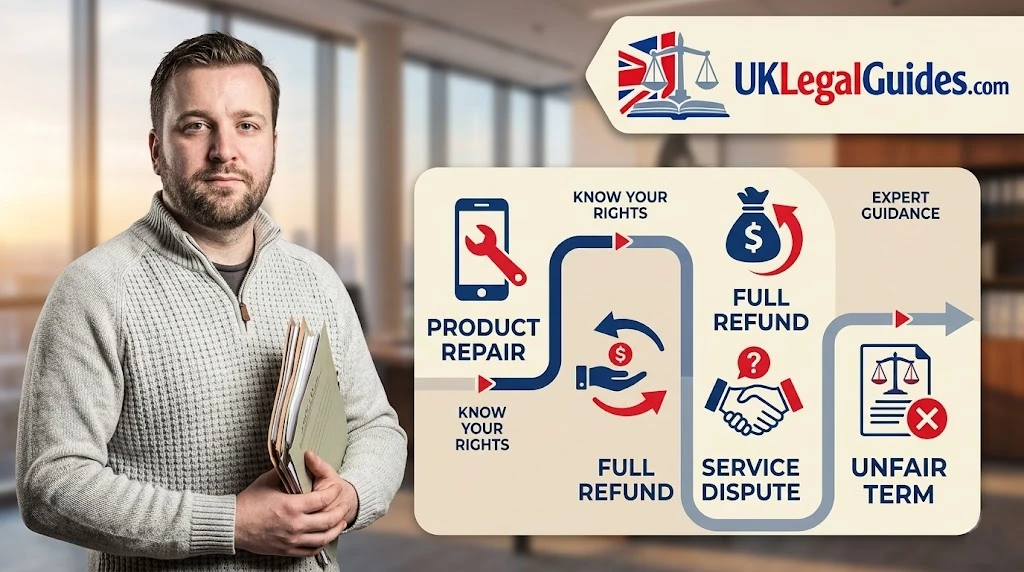
When consumers pay for services-such as home improvements, repairs, professional advice, or personal care-they are entitled to expect a reasonable standard of performance. If the service falls below that standard, the law in England and Wales provides clear rights and remedies under the Consumer Rights Act 2015.
However, obtaining a refund for unsatisfactory services is not always immediate. The law sets out a structured process that consumers must follow. This guide explains when a service is legally unsatisfactory, when a refund becomes available, and the practical steps involved in making a successful claim.
What Makes a Service “Unsatisfactory”?
Under the Consumer Rights Act 2015, a service must meet certain legal standards. A service will be considered unsatisfactory if it fails to meet any of the following:
Reasonable Care and Skill
The trader must perform the service to the standard expected of a competent professional in that field.
Reasonable Time
If no deadline is agreed, the service must be completed within a reasonable timeframe.
Reasonable Price
If no price is agreed in advance, the consumer must only be charged a reasonable amount.
As Described
Any promises, descriptions, or representations made by the trader are legally binding if relied upon.
Examples of Unsatisfactory Services
A service may be legally defective where:
- Work is poorly carried out or below professional standards
- The result is incomplete or unsafe
- The trader fails to follow agreed specifications
- There are unreasonable delays
- Promised outcomes are not delivered
Examples:
- A builder installs fixtures incorrectly, causing damage
- A mechanic fails to fix a known fault
- A contractor leaves work unfinished
- A service causes damage to property due to negligence
Key Legal Principle: Refunds Are Not Always Immediate
A common misunderstanding is that consumers can demand a refund as soon as a service is unsatisfactory. In most cases, this is not correct.
The law provides a two-stage remedy system:
- Repeat performance (primary remedy)
- Price reduction (secondary remedy, including refunds)
A refund is usually only available after the first stage has been considered or attempted.
Step 1: Request Repeat Performance
What Is Repeat Performance?
Repeat performance means requiring the trader to:
- Redo the service, or
- Fix the defective aspects of the work
This must be carried out:
- At no additional cost
- Within a reasonable time
- Without causing significant inconvenience
When This Applies
This remedy is appropriate where:
- The problem can realistically be corrected
- The consumer is willing for the trader to return
Example
If a decorator paints a room poorly, they may be required to repaint it correctly.
Step 2: When You Can Claim a Refund
A refund becomes available when:
- Repeat performance is impossible, or
- The trader fails to carry it out properly, or
- It is not completed within a reasonable time, or
- It would cause significant inconvenience
In these cases, the consumer is entitled to a price reduction, which may include a full refund.
How Much Refund Can You Claim?
The amount depends on the seriousness of the issue.
- Minor defects → partial refund
- Major or unusable service → full refund
The law allows the reduction to be up to 100% of the price paid where appropriate.
Refund Rules and Timeframes
If a refund is agreed:
- It must be issued without undue delay
- It must be paid within 14 days of agreement
- It must use the original payment method, unless agreed otherwise
- No fees can be charged for issuing the refund
Step-by-Step Guide to Claiming a Refund
1. Identify the Problem
Clearly explain how the service failed to meet:
- Reasonable care and skill
- Agreed terms or expectations
2. Gather Evidence
Collect supporting evidence such as:
- Contracts, invoices, or quotations
- Photographs of defective work
- Emails or written communications
- Expert reports (if necessary)
3. Contact the Trader
Write to the service provider:
- Describe the issue clearly
- Request repeat performance initially (if appropriate)
- Refer to your statutory rights
4. Allow a Reasonable Opportunity to Fix the Issue
The trader should be given a fair chance to correct the problem.
5. Request a Refund (Price Reduction)
If the issue is not resolved:
- Explain why repeat performance is unsuitable or has failed
- Request a partial or full refund
6. Escalate the Dispute
If the trader refuses:
- Use the business's complaints procedure
- Consider Alternative Dispute Resolution (ADR)
- Make a claim through the County Court
Claiming Additional Compensation
In some cases, consumers may also claim damages for losses caused by poor service.
Examples
- Paying another contractor to fix defective work
- Property damage caused by negligence
- Financial losses due to delays
These claims are separate from refunds and may require court action.
Time Limits for Making a Claim
Consumers generally have up to six years to bring a claim for breach of contract in England and Wales.
However:
- Claims should be made as soon as possible
- Evidence becomes harder to obtain over time
Common Issues in Refund Claims
Refusal to Allow Repeat Performance
Consumers may not want the trader to return, especially where trust has broken down. In some cases, this may justify moving directly to a refund.
Disputes Over Quality
What constitutes “reasonable care and skill” can be contested and may require expert evidence.
Partial Completion
Where part of the service is acceptable, disputes may arise over the level of refund.
Mixed Contracts
If goods are supplied alongside services (e.g. building materials), additional rights may apply.
Common Questions from our Readers
Can I demand a refund immediately?
Usually no. The trader typically has the right to attempt repeat performance first.
What if the service cannot be fixed?
You can request a price reduction, which may be a full refund.
Can I refuse to let the trader return?
In some situations, particularly where there is a loss of confidence or safety concerns, this may be reasonable.
What if I paid by card?
You may also have additional protection through chargeback or Section 75 claims, depending on the circumstances.
Risks and Practical Considerations
- Proving poor workmanship may require expert evidence
- Traders may dispute liability or standards
- Court proceedings involve time, cost, and risk
- Contracts may include terms affecting liability (subject to fairness rules)
Maintaining detailed records and acting promptly can significantly strengthen a claim.
Final Thoughts
Claiming a refund for unsatisfactory services requires following the legal framework set out in the Consumer Rights Act 2015. The key points are:
- Services must be performed with reasonable care and skill
- Consumers should usually request repeat performance first
- A refund becomes available where that fails or is not feasible
- Refunds must be fair, timely, and proportionate
- Additional compensation may be claimed where losses occur
By understanding these rights and following a structured approach, consumers can effectively challenge poor quality services and pursue appropriate financial remedies.
