
This guide is maintained as a current resource for September 2026 and covers only the laws of England and Wales. Information is for general guidance, not legal advice. Consult a qualified solicitor for advice specific to your situation.
A comprehensive guide to how liability is determined in consumer contract disputes under English and Welsh law, covering statutory implied terms, breach of contract principles, unfair contract terms, remedies, and practical steps for consumers and traders navigating liability issues.
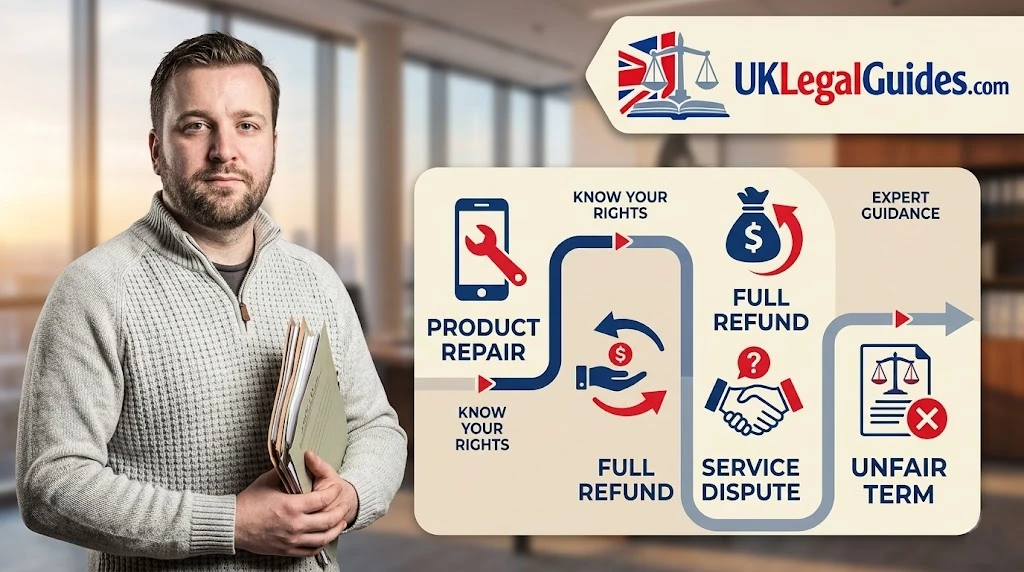
In England and Wales, liability in consumer contract disputes arises when one party to a consumer contract fails to meet the obligations set out in that contract or imposed by law. Determining liability involves identifying what rights and obligations the consumer and trader had, whether there was a breach, and what legal standards apply. The Consumer Rights Act 2015 (CRA) is the primary piece of legislation governing statutory rights and implied terms in consumer contracts for goods, services, and digital content. Understanding how liability is calculated helps consumers and traders prepare, negotiate, or pursue claims in court or alternative dispute resolution forums when disputes emerge.
What a Consumer Contract Is
A consumer contract is a legally binding agreement between a trader and an individual consumer for the provision of goods, services, or digital content where the individual is acting mainly outside trade, business, craft or profession. Traders include businesses, sole traders, partnerships, and other entities supplying goods or services to consumers.
Key Legal Framework for Liability
The Consumer Rights Act 2015 sets out statutory obligations that automatically form part of consumer contracts. The Act consolidates protections previously found in separate laws and provides clear statutory promises about quality, performance, and fairness.
Statutory Implied Terms
Under UK law, certain obligations are automatically implied into consumer contracts regardless of whether they are expressly stated:
- Goods must be of satisfactory quality, fit for purpose, and match the description provided.
- Services must be carried out with reasonable care and skill and, where no time or price is fixed, within a reasonable time and for a reasonable charge.
- Digital content must be of satisfactory quality and fit for purpose when provided under contract.
These implied terms form part of the contractual obligation. If a trader fails to meet them, that failure can constitute a breach, exposing the trader to liability.
When Liability Arises - Breach of Contract
Liability is typically established by proving that the trader has breached a contractual term - either express (written or communicated) or implied by law. A breach occurs where the supply of goods or services fails to comply with agreed or statutory standards.
Express Terms
Express terms are the obligations that the parties specifically agree on - for example, delivery deadlines, prices, and contractual descriptions. A clear failure to fulfil these terms can establish liability because the trader has not delivered what was agreed.
Implied Terms
Even if express terms are silent on quality or performance, the CRA and related law imply terms as part of the contract. Liability can arise from failure to meet these statutory duties, such as providing services without reasonable care and skill, or supplying goods that are not of satisfactory quality.
Assessing Breach and Liability
To determine liability in a consumer contract dispute, key elements must be established:
1. Existence of a Valid Contract
Before liability can arise, a contract must exist. This requires offer, acceptance, and consideration (e.g., payment). Evidence such as invoices, order confirmations, contracts, and communications will typically be used to show a contract was formed.
2. Identification of the Contractual Terms
Both express and implied terms must be identified. In consumer contracts, the CRA implies key terms - for example, quality and fitness standards for goods and services. Clear express terms must also be documented either in writing or by reliable communication.
3. Demonstrating Breach of Terms
A breach occurs when performance falls short of these terms. For example, a service not delivered within a reasonable time, goods that are defective or do not match the contract description, or digital content that fails to meet promised functionality can all constitute breaches.
4. Causation and Loss
Liability requires that the breach caused loss or damage to the consumer. This can include financial loss, additional costs incurred, or loss of value in goods or services received. In legal proceedings, the consumer must prove on the balance of probabilities that the breach caused the loss claimed.
Unfair Contract Terms and Liability
Under the Consumer Rights Act, liability can also be affected by the fairness of contract terms. Terms that seek to exclude or limit liability may be void or unenforceable if they are unfair and cause a significant imbalance in the parties' rights to the consumer's detriment.
For example:
- Contract terms purporting to exclude liability for a trader's failure to provide services with reasonable care may be considered unfair and unenforceable.
- Terms that restrict statutory rights implied by statute, such as quality standards, are also likely to be void.
When terms are found to be unfair, they do not bind the consumer, and the trader may remain fully liable for the breach. Courts will look at the nature of the term and overall contract context when making this determination.
Remedies and Consequences of Liability
When liability is established, remedies aim to put the consumer back into the position they would have been in had the contract been properly performed.
Statutory Remedies
Under the CRA, consumers can exercise statutory remedies if the contract fails to meet statutory standards:
- Repair or Replacement for goods that are faulty or do not conform.
- Repeat Performance or Price Reduction for services not meeting the required standard.
These remedies apply in addition to, or instead of, traditional common law remedies.
Common Law Remedies
Where statutory remedies are inadequate, consumers may pursue:
- Damages for financial loss.
- Specific performance, where appropriate.
- Rescission, terminating the contract where appropriate.
The choice of remedy depends on the circumstances of the breach and the extent of loss suffered.
Practical Considerations in Liability Disputes
Burden of Proof
Generally, the consumer must prove the breach and loss. However, in some cases - for example, when goods fail to conform within six months - the law presumes the fault existed at the time of delivery unless the trader can prove otherwise, shifting the burden of proof to the trader in that context.
Evidence
Strong documentary and factual evidence, such as contracts, bills, communications, photos of defective goods, and expert reports, is crucial to establish the obligations and breach.
Enforcement
Consumers may pursue liability claims through the county court, small claims court, or tribunals depending on the value of the claim. Alternative dispute resolution and consumer ombudsman services can offer less formal routes to address liability issues.
Common Questions About Liability
Can a trader exclude liability entirely?
No. Terms that exclude liability for fundamental statutory obligations, such as reasonable care in services, are likely to be unenforceable.
What if the contract is oral?
Oral contracts can still be enforceable. However, proving terms and breaches requires rigorous documentation and corroborating evidence such as emails, invoices, or witness testimony.
Is a trader always liable for faulty goods purchased?
If goods fail to meet statutory standards, traders are liable unless they can show the goods conformed at the time of transfer or that the fault is attributable to consumer misuse.
Key Takeaways
Liability in consumer contract disputes in England and Wales depends on whether a valid contract exists, what obligations arise from express and implied terms, and whether these have been breached. The Consumer Rights Act 2015 plays a central role by implying statutory standards into consumer contracts for goods, services, and digital content, and by providing remedies when breaches occur. Consumers must demonstrate breach and resulting loss, while traders must comply with statutory obligations and cannot rely on unfair terms to evade liability. Thorough preparation, clear evidence, and understanding of statutory and common law principles are essential for effectively addressing liability in consumer contract disputes.
