
This guide is maintained as a current resource for November 2026 and covers only the laws of England and Wales. Information is for general guidance, not legal advice. Consult a qualified solicitor for advice specific to your situation.
You don't have to pay for broken items. Understand your consumer rights to reject damaged goods, demand a repair or replacement, and how to hold the retailer accountable under law.
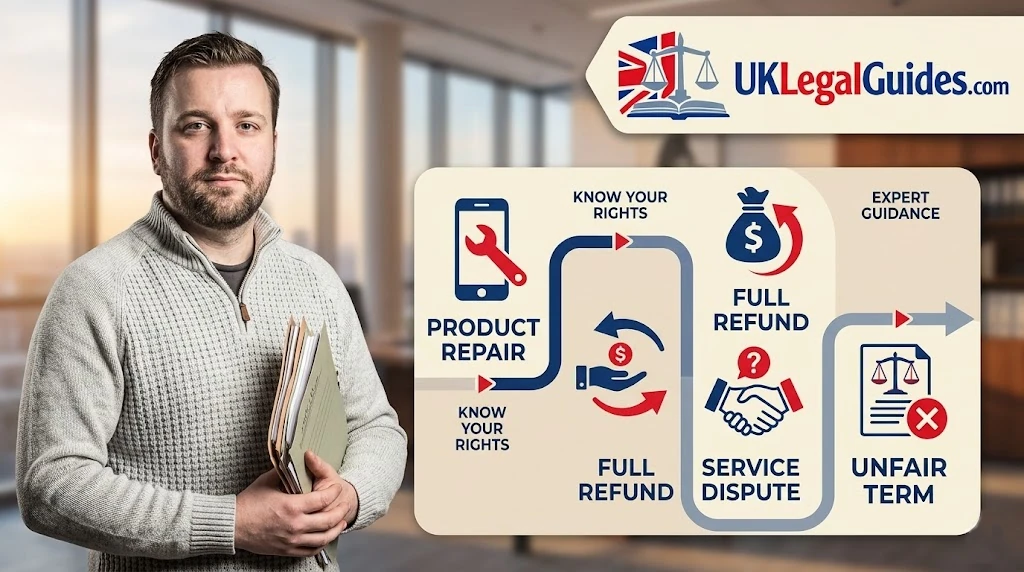
Receiving damaged goods can be frustrating and financially concerning. In England and Wales, consumers are protected by clear legal rights when goods arrive damaged, faulty, or not as expected. These rights are primarily set out in the Consumer Rights Act 2015, which establishes standards that all goods must meet and provides remedies where those standards are not satisfied.
This guide explains what the law says about damaged goods, what remedies are available, and the practical steps consumers can take to resolve disputes effectively.
The Legal Standard: What Condition Should Goods Be In?
Under the Consumer Rights Act 2015, all goods supplied by a trader must meet three key standards:
- Satisfactory quality
- Fit for purpose
- As described
Goods that arrive damaged will almost always fail the requirement of satisfactory quality, as they should not be faulty or defective at the point of delivery .
This applies to:
- Online purchases
- In-store purchases
- Second-hand goods (with adjusted expectations)
Who Is Legally Responsible for Damaged Goods?
The retailer (seller) is responsible for the condition of the goods when they reach the consumer.
This means:
- Your claim must be made against the retailer
- The retailer cannot insist you deal with the manufacturer or courier
This principle is central to UK consumer law and ensures accountability remains with the party that sold the goods .
Key Consumer Rights When Goods Arrive Damaged
1. Short-Term Right to Reject (First 30 Days)
If goods arrive damaged, you have a legal right to reject them within 30 days of delivery and receive a full refund.
Key points:
- You do not have to accept a repair or replacement
- The refund should include standard delivery costs
- You must inform the retailer within the 30-day period
This is often referred to as the “short-term right to reject” .
2. Right to Repair or Replacement (After 30 Days)
If more than 30 days have passed:
- You must usually give the retailer one opportunity to repair or replace the goods
The retailer can choose:
- Repair, or
- Replacement (whichever is more practical or cost-effective)
However, this must be done:
- Within a reasonable time, and
- Without significant inconvenience to the consumer .
3. Final Right to Reject or Price Reduction
If repair or replacement fails, or is not possible:
- You can reject the goods and claim a refund, or
- Keep the goods and request a price reduction
Refunds may be:
- Full (in many cases within the first six months), or
- Partial (particularly after extended use) .
4. Burden of Proof (First Six Months)
If goods are damaged within the first six months:
- It is generally presumed the fault existed at the time of delivery
This means:
- The retailer must prove otherwise if they dispute your claim
After six months:
- The burden shifts to the consumer to prove the fault was present at delivery
Delivery Damage vs Manufacturing Faults
Damage During Delivery
If goods are damaged in transit:
- The retailer remains responsible until the goods are delivered into your possession
You are not required to pursue the courier.
Manufacturing Defects
If damage is due to a defect:
- The same legal rights apply
- The issue is still considered a breach of contract
Step-by-Step: What to Do If Goods Arrive Damaged
Step 1: Inspect the Goods Immediately
Check for:
- Visible damage
- Missing parts
- Signs of poor quality
Take photographs as evidence.
Step 2: Notify the Retailer Promptly
Contact the seller:
- Explain the issue clearly
- Provide evidence (photos, order details)
Early notification strengthens your position.
Step 3: State Your Preferred Remedy
Depending on timing, request:
- A full refund (within 30 days), or
- Repair or replacement
Be clear and specific in your communication.
Step 4: Return the Goods (If Required)
If rejecting the goods:
- The retailer must bear reasonable return costs
- You may need to make the goods available for collection
Step 5: Escalate the Dispute
If the retailer refuses to comply:
- Raise a formal complaint
- Use Alternative Dispute Resolution (ADR) where available
- Consider a claim in the County Court (Small Claims Track)
Refunds and Compensation
Refund Entitlements
Where goods are rejected:
- You are entitled to a refund without undue delay
- This includes standard delivery charges
Additional Compensation
In some cases, you may claim for:
- Financial losses caused by the damage (if foreseeable)
However:
- Claims for inconvenience are generally limited
- Retailers may dispute indirect losses
Special Situations
Second-Hand Goods
Used goods must still be:
- Of satisfactory quality relative to their age and price
Damage beyond reasonable wear and tear may still breach the law.
Perishable Goods
For perishable items:
- Rights may be more limited once goods have been accepted
- Prompt action is essential
Large or Fragile Items
For items such as furniture or appliances:
- Delivery damage is common
- Detailed evidence (photos on arrival) is particularly important
Time Limits for Bringing a Claim
- You generally have 6 years to bring a breach of contract claim in England and Wales
- Acting quickly improves the likelihood of resolution
Risks and Practical Considerations
- Disputes may arise over whether damage occurred after delivery
- Retailers may argue misuse or accidental damage
- Evidence is critical to support your claim
Keeping records, photographs, and correspondence strengthens your position.
Common Questions
Can a retailer refuse a refund for damaged goods?
No. If goods breach statutory requirements, your rights under the Consumer Rights Act apply regardless of store policies.
Do I have to accept a repair instead of a refund?
Within the first 30 days, no. After that, you usually must allow a repair or replacement.
Who pays for returning damaged goods?
The retailer is responsible for reasonable return costs where goods are faulty or damaged.
Final Thoughts
When goods arrive damaged, UK law provides strong consumer protection. In most cases:
- Goods must be of satisfactory quality and undamaged on arrival
- You can reject damaged goods within 30 days for a full refund
- After 30 days, repair or replacement is usually required first
- If this fails, you can seek a refund or price reduction
Understanding these rights allows consumers to act confidently, resolve disputes efficiently, and ensure fair treatment when goods do not meet legal standards.
