
This guide is maintained as a current resource for September 2026 and covers only the laws of England and Wales. Information is for general guidance, not legal advice. Consult a qualified solicitor for advice specific to your situation.
Discover how bail can be reviewed after refusal in England and Wales. This guide explains statutory rights to reconsideration, appeals, judicial review, changing circumstances and practical steps for defendants seeking a fresh bail hearing.
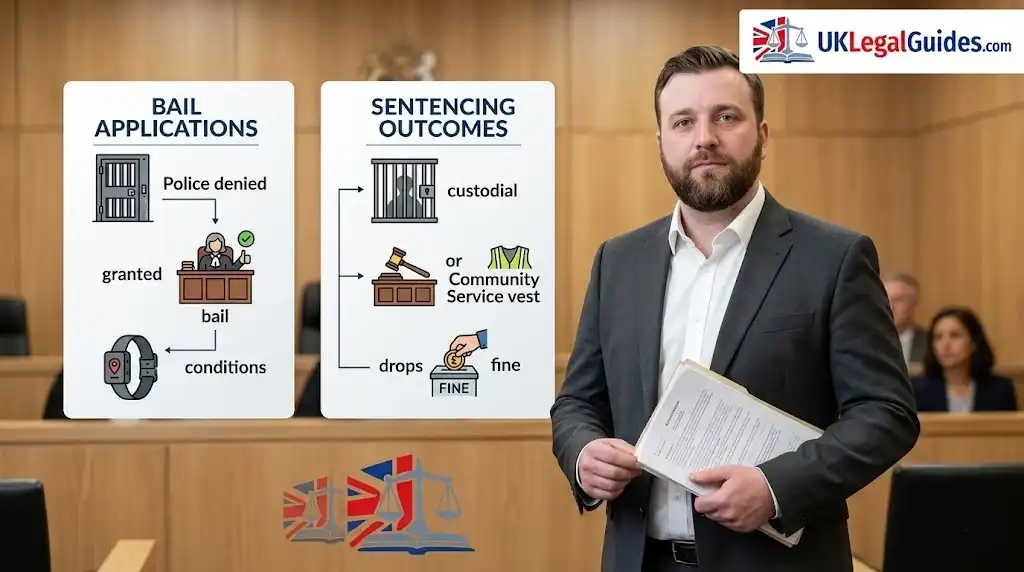
When a court refuses bail, the defendant remains in custody while their case continues. However, a refusal is not necessarily final; the law in England and Wales provides several mechanisms through which bail can be re‑reviewed or challenged. These include statutory rights to have bail reconsidered at later hearings, appeals in certain circumstances, and judicial review in limited cases. This article explains how bail can be reviewed after an initial refusal, the legal framework that applies, common procedural routes, and what defendants and their representatives can expect at each stage.
Bail Refusal and the Need for Review
Bail is a legal mechanism that allows a person charged with a criminal offence to remain at liberty while their case progresses through the courts. Under the Bail Act 1976, there is a general presumption in favour of bail, but this can be displaced if the court believes there are substantial grounds for concern such as risk of non‑attendance, further offending, or interference with witnesses or evidence.
If bail is refused, the court must record its reasons and remand the defendant in custody. But refusal does not extinguish all rights relating to bail: defendants may have multiple opportunities to challenge that refusal as their case develops, particularly if circumstances change or new information becomes available.
Legal Framework: Bail and Reconsideration
Statutory Requirement to Reconsider Bail
Under section 4 and Schedule 1 of the Bail Act 1976, if a court refuses bail at one hearing, it is generally required to reconsider bail on each subsequent occasion the defendant appears before it, unless strictly limited by specific exceptions.
The principle behind this requirement is that a defendant's risk profile or case circumstances may change over time. Therefore, courts must give fresh consideration to bail at later hearings, even if they refused it previously, especially where new evidence or mitigating factors emerge.
Changes in Circumstances
A key ground for a fresh bail application is a material change in circumstances. For example, new evidence, alterations in personal circumstances (such as housing or employment stability), or resolution of specific prosecution concerns (such as witness safety) can be put forward to persuade the court that the risk factors that justified refusal have diminished.
Courts do not have to rehear the same arguments on fact or law unless there is a change in circumstances or new evidence that might have affected the earlier decision. If all arguments are merely repetitions without new substance, the court may decline to entertain them again.
Procedural Routes for Reviewing Bail
1. Reapplication at Subsequent Court Hearings
One of the most common routes for reviewing bail after refusal is simply to renew the application at a later hearing. Because courts are under a duty to reconsider bail on each appearance, a defendant can make fresh submissions, particularly focusing on new or changed circumstances that might mitigate the original concerns.
2. Prosecutor's Application to Revoke or Vary Bail
Under section 5B of the Bail Act 1976, the prosecutor can apply to have bail reconsidered - even after bail has been granted - but this is relevant in the opposite situation where bail was initially granted and the prosecution believes new information justifies revocation or stricter terms.
Although this provision is focused on prosecution‑initiated review, it illustrates the broader principle that bail decisions are not fixed and may be revisited when new material emerges that was not previously before the court.
3. Appeal to a Higher Court
In some cases, a defendant may appeal a bail refusal to a higher court. For example:
- A defendant can appeal a magistrates' court bail refusal to the Crown Court, particularly after being refused full argument below and being given the relevant certificate.
- In cases involving refusal after conviction or specific statutory criteria, there may be rights of appeal to the High Court under certain procedural rules.
Appeals are typically considered a re‑hearing of the bail decision and allow both sides to present arguments before a judge who was not involved in the original decision.
4. Judicial Review in Exceptional Circumstances
In rare situations, a defendant remanded in custody may seek a judicial review of the bail refusal decision. Judicial review is a public law process in which the High Court examines whether the decision was made lawfully - for example, whether the court provided adequate reasons or applied incorrect legal principles.
Case law shows that judicial review has been used where a court failed to consider relevant factors or failed to provide proper reasoning, leading to the refusal decision being quashed and the matter remitted for reconsideration.
Practical Steps in a Bail Review Application
Submitting Fresh Evidence
When seeking a bail review after refusal, the defendant or their legal representative should:
- Identify and present new evidence or changed circumstances that address the reasons for refusal;
- Prepare submissions that directly respond to those concerns (for example, stable accommodation or strong community ties);
- Consider proposing conditions of bail that directly mitigate identified risks (such as residence requirements or electronic monitoring).
Fresh evidence might include changes in personal life, resolution of prosecution concerns, or newly available information that was not before the court originally.
Timing of Applications
A bail review application is typically made at the next court appearance, when the defendant must be present or properly represented. Some higher court appeal procedures have strict time limits within which notices must be filed, so legal advice is essential to avoid procedural defaults.
Common Outcomes of Review Applications
When bail is reviewed after initial refusal, the court may:
- Grant bail, either unconditionally or with conditions tailored to mitigate risk;
- Modify previous refusal reasons or impose alternative conditions;
- Refuse bail again, explaining why the review does not alter the risk assessment.
Even if bail remains refused at a review, the court's obligation to record reasons provides clarity about what factors are still considered problematic, guiding future applications or appeals.
Key Takeaways
Reviewing bail after an initial refusal in England and Wales is a multi‑stage process that reflects the dynamic nature of the criminal justice system and the statutory framework of the Bail Act 1976. Courts are obliged to reconsider bail at each subsequent hearing, and defendants can present new evidence or changed circumstances to persuade decision‑makers that the earlier concerns have diminished. In some cases, appeals to higher courts or judicial review may be appropriate where legal errors arise. Understanding these procedures helps defendants, solicitors and families ensure that bail applications remain live and responsive to developments in a case.
