
This guide is maintained as a current resource for September 2026 and covers only the laws of England and Wales. Information is for general guidance, not legal advice. Consult a qualified solicitor for advice specific to your situation.
A practical guide to breach of warranty in consumer contracts in England and Wales. Learn what a warranty is, how breach of warranty works, your statutory rights under the Consumer Rights Act 2015, remedies available, time limits, and the steps to take when a product or service fails to meet promised standards.
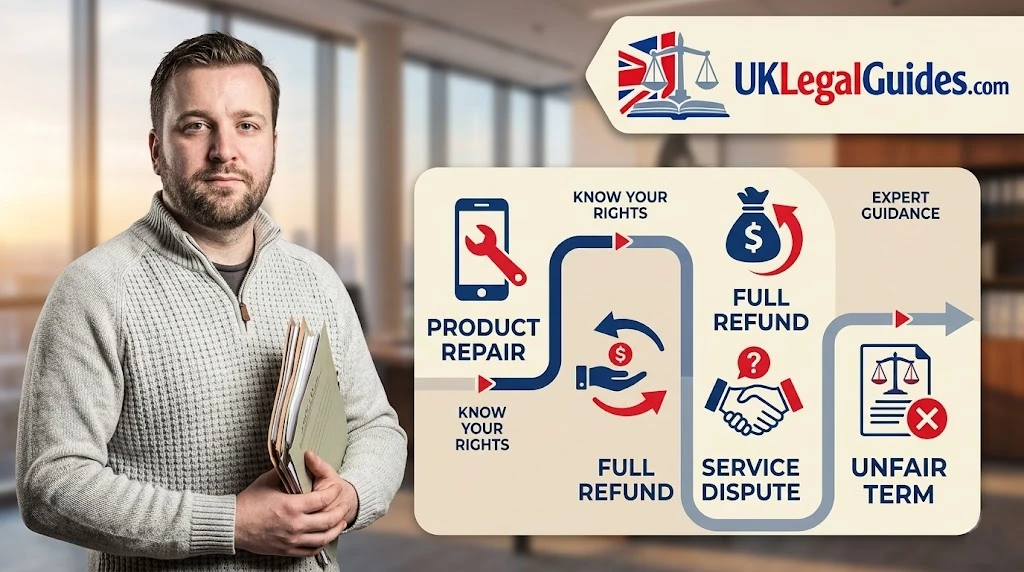
In consumer contracts, a warranty is a specific promise or assurance that something about the goods, services or digital content supplied will be true, of a stated quality, or perform in a particular way. When that promise is not fulfilled, the consumer may have a breach of warranty claim. Understanding what a warranty is, how it fits into your contract rights, and what remedies you may pursue can help you resolve disputes more effectively when products or services fail to live up to expectations. This article explains the legal principles, statutory consumer protections, practical steps to consider, and how breach of warranty disputes are handled within English and Welsh law.
1. What Is a Warranty in Consumer Contracts?
A warranty is a contractual term that promises a particular fact or outcome about goods, services or digital content. It might be an express warranty, where the seller expressly states something (for example that a device will run for a year without fault), or, in some contexts, an assurance implied by law. In English contract law, warranties are generally distinguished from conditions - central promises in a contract - and innominate terms whose consequences depend on the breach's impact. A breach of warranty typically gives rise to a right to damages (compensation) but not necessarily a right to end the contract itself.
In consumer law, statutory implied guarantees under the Consumer Rights Act 2015 (CRA 2015) (which replaces earlier Sale of Goods and Supply of Goods and Services Acts) create certain assurance‑type terms about quality and fitness. While these statutory terms are often treated as conditions with broader remedies, separate warranties also play a role when the trader promises more than what the statutory minimum requires.
2. How Warranty Rights Interact with Consumer Law
Under the Consumer Rights Act 2015, consumers have non‑excludable statutory rights regarding the quality of goods, digital content and services they buy from traders. These include terms requiring:
- goods to be of satisfactory quality,
- goods to be fit for a particular purpose, and
- goods to match the description given at the time of sale.
Although these statutory implied terms are technically not called “warranties” in the Act, a failure to meet them gives consumers strong remedies including refund, repair or replacement, depending on how long they have owned the item. The CRA 2015 also covers digital content and quality expectations for services. Remedies for those failures may include repeat performance or price reductions.
A contractual warranty, on the other hand, is a specific promise that goes beyond basic statutory rights. For example, a seller's promise that a stereo system will operate without fault for a stated period is typically a warranty. If that promise is untrue, the consumer may pursue a claim for losses flowing from the broken warranty.
3. Breach of Warranty: Legal Effect and Remedies
3.1 Breach of Warranty Explained
A breach of warranty occurs when the assurance or promise in the consumer contract is not fulfilled - for example, where a gadget marketed with a guaranteed specification ceases to work as promised, or a service fails to deliver an agreed feature. Breach of warranty differs from breach of a core contract condition: it gives a right to compensation for loss, but normally does not allow the consumer to terminate the entire contract solely on that basis.
3.2 Remedies for Breach of Warranty
The main remedies for breach of warranty include:
- Damages (compensation) – financial compensation to put the consumer in the position they would have been in had the warranty been honoured; this is the primary remedy for warranty breach;
- Repair or replacement – in some cases, particularly where the warranty expressly provides such remedies;
- Refund or price reduction – where the faulty goods or services are returned or retained with compensation; though statutory remedies under CRA 2015 may provide these independently where statutory implied terms are breached.
Keep in mind that claiming damages for breaching a contractual warranty differs from statutory remedies under the Consumer Rights Act. Statutory rights in CRA 2015 may allow refund, repair or replacement independent of whether there is a contractual warranty, and consumers can pursue statutory and contractual remedies in parallel without double recovery for the same loss.
4. Time Limits and Practical Considerations
In England and Wales, the general limitation period for contractual breach claims - including breach of warranty - is six years from the date the breach occurred, under the Limitation Act 1980. This means you must generally start any legal claim within that timeframe, or you may lose the right to enforce it in court.
In practice, however, statutory remedies under the Consumer Rights Act for faulty goods or services are most effective early on - for example, immediate rights to reject within the first 30 days of purchase and repair or replacement rights within six months - whether or not there is a separate warranty.
For warranties provided by manufacturers or retailers (often as separate documents or extended warranty contracts), check the express terms carefully. They often set out the duration of cover, what is included, how to make a claim, and whether additional steps (such as registration or proof of purchase) are required to rely on them.
5. Step‑by‑Step: What to Do If a Warranty Is Breached
5.1 Confirm the Warranty Terms
Read the warranty documentation, contract terms and any pre‑contract representations carefully to identify what the seller or manufacturer promised. Make a note of what was said, what was expected, and when the problem arose.
5.2 Gather Evidence
Keep evidence of the purchase (receipts, emails, contracts), details of the fault or failure, and any correspondence with the trader. This will support any claim you make.
5.3 Contact the Trader or Warranty Provider
Notify the seller or warranty provider in writing as soon as you identify the problem. Explain that the warranty term appears to have been breached and request the remedy specified (such as repair, replacement, compensation). Ask for written confirmation of their position.
5.4 Consider Statutory Remedies
If the issue also represents a failure to meet statutory implied terms under the Consumer Rights Act (for example goods not of satisfactory quality), you may have rights to reject goods or require repair/replacement outside the warranty. Explain this as part of your complaint if applicable.
5.5 Escalate If Necessary
If the trader refuses to comply, escalate the complaint. You can contact Citizens Advice for help, use alternative dispute resolution schemes if available, or - as a last resort - pursue a claim in the county court seeking damages or other remedies.
6. Common Questions About Breach of Warranty
Is a warranty the same as a guarantee?
A warranty is a contractual promise; a guarantee is a separate promise, often by the manufacturer, to repair or replace if something goes wrong. Both are binding if validly offered.
Can I terminate a contract for a breach of warranty?
Generally, breach of warranty does not automatically allow termination. You usually remain bound to the contract but can claim compensation or statutory remedies.
Does the Consumer Rights Act override a warranty?
Statutory rights under CRA 2015 operate alongside warranties and cannot be excluded. Even if a warranty period has passed, statutory rights may still apply where statutory implied terms are breached.
Conclusion
A breach of warranty in a consumer contract occurs when a specific promise or assurance in the contract about goods, services or digital content fails to be met. Although a warranty breach does not usually entitle the consumer to terminate the entire contract, it gives the right to claim damages or other remedies under contract law. In addition, the Consumer Rights Act 2015 provides strong statutory protections for quality and performance that operate alongside warranties and often offer direct remedies such as repair, replacement, refund or price reduction. Understanding your rights, gathering clear evidence, communicating effectively with the trader, and pursuing available remedies in a timely manner will help you address breaches of warranty effectively under English and Welsh consumer law.
